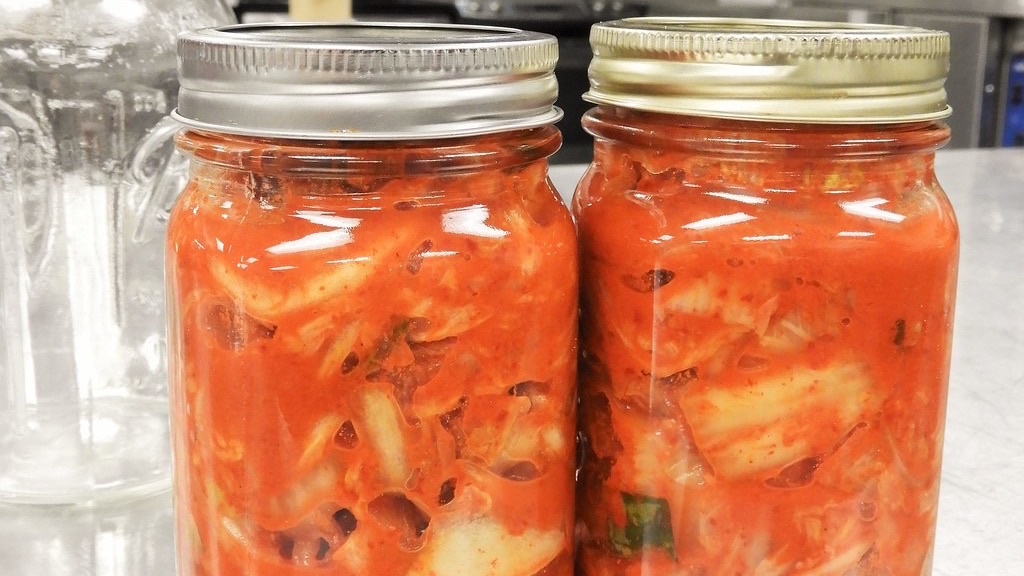
A bug pulled from kimchi grabbed 87% of nanoplastics in a dish and more than doubled the plastic mice flushed in their feces. Promising science, not a detox plan.
A lactic acid bacterium isolated from kimchi bound roughly 87% of polystyrene nanoplastics in a test tube, and when researchers fed it to mice alongside those plastics, the animals excreted more than twice as much in their feces as untreated controls (Study). That is a genuinely surprising 2026 result, and it is why kimchi microplastics searches are suddenly everywhere. But here is the catch worth bolting to the front of this article: this is one specific lab strain and a mouse study, not a license to call kimchi a microplastic cleanse. Binding plastic in a dish is not the same as clearing it from a person, and there are zero human trials.
Why Microplastics Worry Us
Start with why anyone cares about getting plastic out of the body in the first place. Plastic particles are no longer just an ocean problem; they are turning up inside us. In 2022, researchers quantified microplastics in human blood for the first time, detecting them in the majority of 22 healthy volunteers, with polyethylene, PET, and styrene polymers among the most common (Study). They cross into deeper tissue too. A 2021 study found microplastic fragments in human placenta — on the maternal side, the fetal side, and the membranes in between — in a sample of six placentas, raising the uncomfortable prospect of prenatal exposure (Study). And a 2025 Nature Medicine analysis of decedent brain tissue found micro- and nanoplastics accumulating in the brain at higher concentrations than in liver or kidney, with even greater levels in a small cohort of brains from people who had dementia (Study).
Size is the part that matters most here. Microplastics are generally defined as fragments from 1 micrometer up to 5 millimeters, while nanoplastics are far smaller — typically under 1 micrometer, sometimes under 100 nanometers (Review). That tiny scale is exactly why nanoplastics are biologically interesting and concerning: their small diameter lets them slip across barriers that block bigger particles. A 2023 systematic review found that smaller polystyrene particles (50, 80, and 240 nm) crossed the placenta into fetal circulation in an ex vivo model, while larger 500 nm particles tended to stay put (Review). Only particles below about 150 micrometers can penetrate the intestinal lining at all, and just a small fraction of what we swallow — on the order of 0.2–0.45% — appears to cross the gut barrier into the body (Review).
That sets up the real problem. We can measure plastic accumulating in human tissue, but there is no proven method to get it out. No drug, no supplement, no protocol has been shown to lower the body’s plastic burden. That vacuum is precisely why a bacterium that physically grabs nanoplastics in the gut grabbed headlines.
Meet Strain CBA3656
The organism at the center of all this is Leuconostoc mesenteroides CBA3656, a lactic acid bacterium isolated from kimchi by South Korea’s World Institute of Kimchi (WiKim) and described in the journal Bioresource Technology in 2026 (Study). The peer-reviewed paper is real — its DOI resolves to the Elsevier article record — though the full text sits behind a paywall, so several of the figures below come from the official institutional release and corroborating science-news coverage of the same study (Study).
The mechanism is the key to understanding what this strain does and, just as importantly, what it doesn’t. The bacterium isn’t digesting or breaking down plastic. It’s doing something far more passive called biosorption: the cell wall is studded with negatively charged functional groups — carboxyl, phosphoryl, and related chemistry — and plastic particles physically stick to that surface, the way lint clings to wool. Nothing is metabolized. The plastic is simply caught and held on the outside of the cell. That detail matters more than it sounds: because biosorption is a physical, surface-level grab rather than a metabolic process, it doesn’t require the bacterium to be alive and actively growing to work, and it doesn’t change the plastic itself — it only relocates it. A particle stuck to a passing cell can ride out of the gut instead of lingering against the intestinal wall.
One distinction deserves italics because it is the hinge of this entire piece: this is a specific strain, not the food. “Kimchi binds microplastics” is not what the study shows. A particular bacterium that happens to have been found in kimchi binds microplastics under particular conditions. Whether the kimchi in your fridge contains this strain, or enough of it, is a separate and unanswered question. Hold that thought.
What 87% Actually Means
Now the headline number, framed carefully. Under standard laboratory conditions, CBA3656 adsorbed 87% of polystyrene nanoplastics — and notably, a reference strain, Latilactobacillus sakei CBA3608, did almost as well at 85% (Study). On its own, 87% versus 85% is not a dramatic gap, and that’s worth sitting with: under easy conditions, plenty of lactic acid bacteria are sticky.
What makes the binding credible as physical adsorption rather than a fluke is how robust and how chemically boring it is. The strain held its grip across nanoplastic concentrations from 10 to 200 ppm, across temperatures from 4 to 55°C, and across pH 3 to 9 — a punishing range that spans everything from a cold fridge to body heat and from stomach acid to the small intestine (Study). The binding followed pseudo-first-order kinetics and a Langmuir isotherm, with cell-surface functional groups (P=O, C=O, C–O–C) mediating the interaction (Study). In plain terms, those models are the fingerprints of physical surface adsorption — particles sticking to a surface — not of the bacterium chemically consuming or transforming the plastic.
But here is the line this blog exists to draw, and it’s worth saying bluntly: 87% is binding in a tube, not removal from a body. A number from a controlled dish, where bacteria and plastic are mixed and then measured, tells you the strain is a good sorbent. It says nothing, yet, about what happens in a living digestive tract — a churning, enzyme-soaked, microbe-crowded environment that bears little resemblance to a clean test tube. Which is exactly the gap the researchers tried to close next.
The Gut Test and the Mice
This is the most important section, because it’s where the impressive-but-shallow lab number gets pressure-tested. The team ran the binding assay again under simulated human intestinal conditions — recreating the chemistry of the gut. And the two strains parted ways dramatically. CBA3656 held onto about 57% of the nanoplastics, while the reference strain CBA3608 — the one that matched it at 85% in the easy test — collapsed to just 3% (Study). In simulated intestinal fluid, CBA3656 reached that 57% within 60 minutes (Study).
That 57%-versus-3% split, not the flashier 87%, is the real story. Lots of bacteria can bind plastic in a beaker; almost none keep doing it in a gut-like environment. CBA3656’s robustness — its ability to survive the conditions where it would actually have to work — is what distinguishes it from a generic sticky microbe (Study).
Then came the one in-vivo experiment. Both male and female mice given CBA3656 along with polystyrene nanoplastics excreted more than twice as much nanoplastic in their feces as control mice that got the plastic without the bacterium (Study). The effect showed up in both sexes, which is a point in its favor.
Now the caveat that has to ride alongside that result, because it is everything. More plastic coming out in the feces is not proof that less plastic stayed in the body. Enhanced excretion is exactly what biosorption predicts — the bacterium grabs particles and carries them out the back end — but the study measured what left in the stool, not what accumulated in tissues, blood, or brain. Doubling fecal output is a promising signal that the mechanism works in a living animal. It is not a demonstration of reduced tissue load, and it is certainly not a health outcome. And, to be unambiguous: this was a mouse experiment. No human trials exist.
Why It’s Plausible
Strip away the novelty and the kimchi finding fits a mechanism scientists have documented for years, which is part of why it’s credible. Lactic acid bacteria are already known to act as passive surface sorbents for nasty molecules. In one study, Lactobacillus rhamnosus GR-1 bound roughly 76% of lead and 57% of cadmium from solution and significantly cut the movement of both heavy metals across a model of the intestinal lining (Study). Other candidate probiotic lactic acid bacteria have stripped meaningful fractions of lead and cadmium from culture medium through the same metabolism-independent, surface-binding process (Study).
The precedent extends to man-made organic chemicals, too. Lactic acid bacteria have been shown to bind bisphenol A (BPA) — the notorious plastic-associated endocrine disruptor — onto their cell-wall components, with peptidoglycan and teichoic acids doing the gripping, the study indicating hydrogen bonding and hydrophobic interactions rather than metabolic breakdown (Study). And Leuconostoc mesenteroides itself — the same species as CBA3656 — has been documented binding the plasticizer di-n-butyl phthalate through cell-surface adsorption that fits standard kinetic and isotherm models, with heat-killed cells still binding the chemical and the bound phthalate washing back off with solvent — both hallmarks of physical adsorption rather than digestion (Study). So a kimchi bacterium that physically sticks to plastic nanoparticles isn’t a wild claim; it’s a new entry in a well-established pattern of surface binding.
Plausibility, though, is not proof, and the unknowns are large and specific. We don’t know the effective dose in a human. We don’t know whether CBA3656 survives, stays viable, and keeps binding when delivered as part of food. We don’t know whether ordinary, store-bought kimchi contains this exact strain at all — let alone in numbers that would matter. And we don’t know whether any of this translates to a measurable benefit in people, because the entire evidence base is preclinical. A 2023 review searching for probiotics that protect against polystyrene plastic toxicity found no study demonstrating the effect in humans, calling the protective role “a claim that needs further evaluation” (Review). A separate 2024 line of work that screened hundreds of fermented-food strains and tested fecal microplastic excretion likewise stopped at mice, with the authors noting that human applicability still requires future clinical validation (Study). The honest verdict: promising, biologically plausible, and firmly early-stage.
Frequently Asked Questions
Can eating kimchi remove microplastics from your body?
There is no evidence that it does, and you should not treat kimchi as a microplastic cleanse. The 2026 research looked at one specific bacterial strain that happened to be isolated from kimchi, not kimchi itself, and the whole field is still in test tubes and animals. In mice, the strain more than doubled the amount of plastic flushed out in feces, but that does not prove less plastic stayed in the body, and there are zero human trials.
What is the kimchi bacteria CBA3656 that binds nanoplastics?
It is Leuconostoc mesenteroides CBA3656, a lactic acid bacterium isolated from kimchi by South Korea’s World Institute of Kimchi and described in the journal Bioresource Technology in 2026. It does not digest or break down plastic. Instead it uses biosorption, meaning plastic particles physically stick to negatively charged groups on its cell wall, the way lint clings to wool, and can then ride out of the gut (Study).
What does the 87% figure in the kimchi microplastics study actually mean?
Under standard laboratory conditions in a dish, CBA3656 stuck to about 87% of polystyrene nanoplastics, which was barely ahead of a reference strain at 85%. That number is binding in a test tube, not removal from a living body. The more meaningful result came under simulated gut conditions, where CBA3656 held on to about 57% while the reference strain collapsed to just 3%.
How can I actually reduce my microplastic exposure?
The article says the proven lever is cutting down on what comes in, not bacterial cleanup. People who drink bottled water may swallow roughly 90,000 microplastic particles a year, versus about 4,000 for tap-water drinkers, so switching to tap may cut intake substantially. It also helps to avoid heating food in plastic, since microwaving plastic containers released the highest burst of particles of any scenario tested (Study).
Does regular store-bought kimchi contain the CBA3656 strain?
That is unknown. The article notes we do not know whether ordinary, store-bought kimchi contains this exact strain at all, let alone in the numbers that would matter, and there is no data on the effective dose in a human. Kimchi is still a genuinely healthy fermented food worth eating for its own sake, just not as a plastic detox.
Key Takeaways
- The 87% is binding in a dish. CBA3656 adsorbed ~87% of polystyrene nanoplastics under standard lab conditions, barely ahead of a reference strain at 85% — impressive sorption in vitro, but not “detox” in a body (Study).
- The 57% vs 3% is the real headline. Under simulated human intestinal conditions, CBA3656 held ~57% binding while the reference strain collapsed to ~3%; robustness in gut-like chemistry, not the raw percentage, is what sets it apart (Study).
- Mice excreted more, but that’s not a health outcome. Male and female mice given CBA3656 flushed more than twice the nanoplastics in feces versus controls — a real in-vivo signal, but it does not yet prove lower tissue accumulation or any benefit (Study).
- The mechanism is well-precedented. Lactic acid bacteria already surface-bind heavy metals like lead and cadmium (Study) and the plasticizer BPA (Study), so binding nanoplastics fits a known, metabolism-independent pattern.
- There is no human evidence — don’t treat kimchi as a cleanse. No clinical trial has shown probiotics reduce the body’s plastic burden; the whole field is in vitro and animal only (Review).
- The proven lever is cutting exposure. Microwaving food in plastic releases the most particles (Study), and switching from bottled to tap water may cut intake by tens of thousands of particles a year (Study).
Eat the Kimchi, Skip the Hype
Here’s the warm, honest landing. Kimchi is a genuinely healthy fermented food — rich, living, and worth eating for its own sake, completely independent of anything in this study. So eat it for that. What you should not do is reframe your kimchi habit as a microplastic cleanse. The CBA3656 result is exciting science to watch: a specific strain, a real mechanism, a doubling of fecal plastic excretion in mice, and a robustness profile that beats its peers under gut conditions. It is also, unambiguously, preclinical. No dose, no food-delivery data, no proof your jar even contains the strain, and not a single human trial.
So what is proven to lower your plastic exposure today? Turning down the tap on what comes in. The single best-documented dietary lever is your water: people who get their water from bottles may swallow roughly 90,000 microplastic particles a year, versus about 4,000 for tap drinkers (Study). And avoid heating food in plastic — microwaving plastic containers released the highest burst of particles of any tested scenario, in some cases as many as millions of microplastics and billions of nanoplastics per square centimeter in three minutes (Study). Cutting exposure is the move with evidence behind it; bacterial cleanup is still a hypothesis.
Enjoy your kimchi for the gut-friendly, delicious food it is, drink from the tap, and keep your leftovers out of the microwave-safe lie.
This article is for educational purposes and is not medical advice. Talk to a qualified clinician before changing your health regimen.


Leave a Reply