No. In a 3-year trial of 265 adults, 2,000 FU of nattokinase a day did not clean arteries (Trial). Artery walls thickened and stiffened at about the same pace as on a dummy pill. Blood pressure did not move either.
The bolder claims, like 10,800 FU a day dissolving plaque, come from studies with no dummy-pill group to compare against. The clearer risk is bleeding, especially for people on aspirin or blood thinners.
What Nattokinase Is
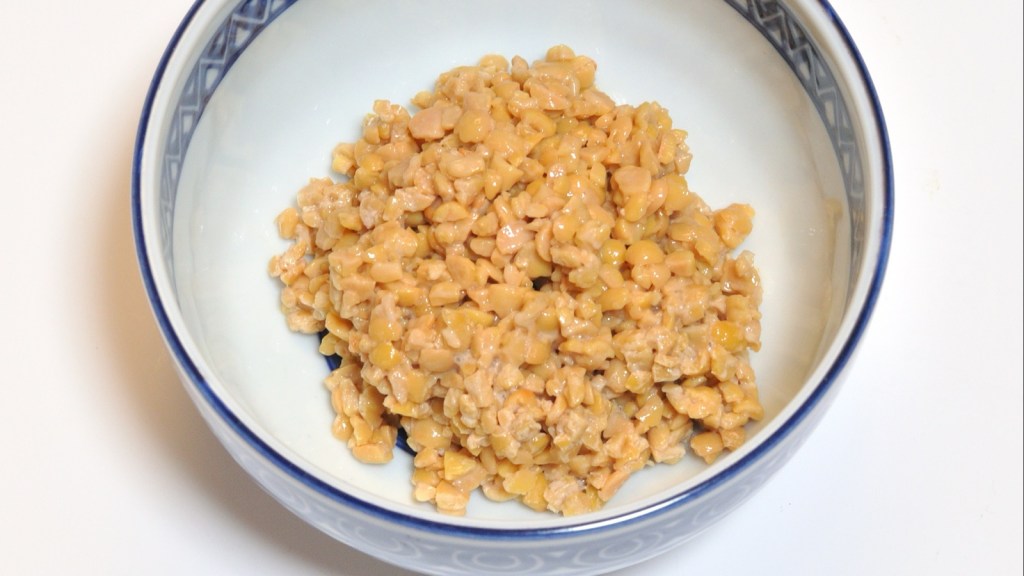
Nattokinase is an enzyme. It is made by Bacillus subtilis natto, the bacterium that turns soybeans into natto, a sticky fermented food popular in Japan.
Researchers named the enzyme in 1987 after finding that natto could break down fibrin in lab tests (Study). Fibrin is the protein mesh that holds a blood clot together. That paper measured how well natto dissolved clots in plasmin units per gram of the food. Supplement labels use a different unit, so there is no clean way to turn a bowl of natto into a pill dose.
Supplements list their dose in fibrinolytic units (FU). An FU is a count of enzyme activity from a lab test, not a weight. There is no single standard way to run that test. The common methods also have known problems with precision (Review).
In 2025, ConsumerLab tested 8 nattokinase supplements, and 3 failed (Report). One delivered less than half its listed activity. Another delivered nearly 60% more than the label said. So 2,000 FU on one bottle may not equal 2,000 FU on another.
The pill is an enzyme extract, not the food. It is also separate from vitamin K2, which natto contains in large amounts (Study). K2 has its own trials, covered in our article on vitamin K2 and artery calcium.
Nattokinase Did Not Clean Arteries
The best test of the pill is NAPS, a trial run at the University of Southern California (Trial). It enrolled 265 adults with no known heart disease, and about half of them were over 65 (Trial).
A coin flip decided who took 2,000 FU of nattokinase a day and who took a dummy pill, called a placebo. Neither the volunteers nor the researchers knew who got what.
Every 6 months, an ultrasound scanned the carotid arteries, the large vessels in the neck that feed the brain. The scans tracked how fast the artery wall was thickening and how stiff the artery was becoming. Both are early, silent signs of atherosclerosis, the slow buildup that narrows arteries (Trial).
After about 3 years, the result was flat. The artery wall thickened by about 13 micrometers a year on nattokinase and 11 on placebo (Trial). A micrometer is a thousandth of a millimeter. The gap was small enough that chance could explain it, and the two measures of stiffness showed no real difference either.
Blood pressure did not change. Neither did any of the lab tests, including clotting factors and markers of inflammation (Trial). The authors reported no effect on early artery disease.
The trial has limits. Everyone was over 55 and at low risk, and every woman in it was past menopause. It kept out people with heart disease or diabetes, and anyone who took cholesterol drugs, aspirin or blood thinners (Trial). It tested only one dose. And it measured wall thickness and stiffness, not the size of plaque already there (Trial).
That means NAPS cannot say what nattokinase does to existing plaque. Still, it is the longest test of the pill against a placebo. A 2023 review that looked only at trials against a placebo found none that measured plaque size at all (Meta-analysis).
Behind the 10,800 FU Claim
A bolder claim goes around online: take 10,800 FU a day and nattokinase will dissolve plaque. That number traces back to one paper, Chen 2022.
The study looked back at the records of 1,062 people in China who were already taking nattokinase (Study). Each tablet held 3,600 FU, so 10,800 FU meant 3 tablets a day for 12 months. There was no placebo group. The authors note that it was not a trial where chance decided who got the pill.
Only people who kept taking the full dose for all 12 months were counted. Anyone who stopped early was left out.
The headline numbers are “improvement rates” of 66.5% to 95.4%. They sound like plaque shrinking by two-thirds or more, but that is not what they measure. Each rate is just the share of people the paper put in its “improved” group. The paper never says how big a change had to be to count (Study). For plaque, 454 of 683 people “improved,” which is the 66.5%. That leaves about 1 in 3 who did not improve, even by this vague standard.
The average plaque area on ultrasound did fall by about a third over the year (Study). But each person was compared only with themselves a year earlier. With no comparison group, nobody can tell how much of that came from the tablets.
The paper even casts doubt on lower doses like the common 2,000 FU. In 61 people who took 3,600 FU a day, plaque and cholesterol barely moved, and the authors called that dose ineffective (Study). That group was not picked by coin flip. The paper does not say how it was chosen.
Five of the ten authors worked for Sungen Bioscience, the company that made the tablets (Study). A correction came out in December 2022. It names only the table that describes the people at the start, and it says the conclusions stand (Correction).
An earlier Chinese study, Ren 2017, is also quoted for shrinking plaque (Study). It followed 82 outpatients for 26 weeks. It compared 6,000 FU a day against a statin, a cholesterol drug, and had no placebo group. Plaque area fell more on nattokinase, but the statin lowered cholesterol more. The summary does not say whether the patients or the people reading the scans knew who took what.
Another viral claim says nattokinase breaks down the COVID spike protein. It traces back to a lab study in cell dishes and cell extracts (Study). It used no live virus, no animals and no people. Three of its ten authors listed ties to the company that supplied the enzyme. Even so, the paper declared no conflict of interest.
A 2026 review of long COVID treatments found no human studies of nattokinase for long COVID (Review). It found none underway or planned for the near future either. A separate report on five patients paired nattokinase with ivermectin and a probiotic for “post spike syndrome.” Its journal retracted it (Notice).
In May 2026, the FDA sent a warning letter to the seller of Nattokinase Max (Letter). Its marketing said the product lowered blood pressure, thinned the blood and cut the risk of atherosclerosis. It also called the product a safer alternative to aspirin. The FDA said those claims made it an unapproved new drug. Letters in 2011 and 2020 said the same about other sellers’ claims on clots, strokes and blood pressure (Letter) (Letter). Nattokinase can be sold in the US as a supplement, but it cannot be marketed as a treatment for disease.
A Small Blood Pressure Signal
Blood pressure is the one place where short trials hint at a small effect.
A 2008 trial gave 86 adults a 2,000 FU nattokinase capsule or a placebo for 8 weeks (Trial). All had mildly raised blood pressure that was not being treated, and 73 of them finished. On nattokinase, the top number (systolic pressure) fell about 5.5 points more than on placebo. The bottom number (diastolic) fell about 3 points more. The trial was small, though, and the true effect could be close to zero.
A 2023 review combined 6 trials against a placebo, with 546 people in all (Meta-analysis). Its blood pressure result came from just 3 of them, and one was the 2008 trial. Together they showed a drop of about 3.5 points in the top number and about 2 in the bottom.
Cholesterol went the other way. Total cholesterol did not fall, and it even ran slightly higher on nattokinase (Meta-analysis). The authors call their findings preliminary. And in NAPS, the 3-year trial, blood pressure did not move at all (Trial).
A drop of a few points is a modest nudge. It will not treat high blood pressure, and it says nothing about cleaner arteries. In the one trial that scanned artery walls, they thickened at about the same pace on nattokinase and on placebo.
Natto the Food vs the Pill
The food has a better record than the pill, but it is a different kind of evidence.
In the Takayama study, 29,079 Japanese adults reported their diets once and were followed for 16 years (Study). The biggest natto eaters had about a 25% lower risk of dying from heart disease and stroke than those who ate the least. Total soy protein, and soy from other foods, showed no clear link with these deaths as a whole.
The larger JPHC study followed 92,915 Japanese adults for about 15 years (Study). People who ate the most fermented soy, meaning natto and miso, had about a 10% lower risk of dying from any cause. The top natto eaters had about a fifth lower risk of dying from heart disease and stroke.
A separate 2023 review pooled studies like these (Meta-analysis). In it, natto was linked with about an 18% lower risk of heart and blood vessel disease. The link held for stroke, but not clearly for heart attacks.
All of this is observational: researchers asked what people ate and counted who died. Natto eaters may differ from other people in many ways. The JPHC authors call those hidden differences their biggest limit. They add that such links do not prove the food helps patients (Study).
Natto is also far more than its enzyme. It brings vitamin K2, fiber, soy protein and isoflavones, plant compounds found in soy. So even if natto helps, these studies cannot give the enzyme the credit. And they say nothing about a pill.
One warning applies to the food itself. Natto is rich in vitamin K2, and people on the blood thinner warfarin are told to avoid it (Study). Even small amounts of K2 can matter. In a 2013 study, 18 healthy volunteers took a blood thinner similar to warfarin (Study). Just 10 to 20 micrograms of K2 a day weakened the drug. Two blood specialists judged the change big enough to matter in at least 4 in 10 of them. A normal serving of natto holds many times more K2 than that (Study).
The Real Risk Is Bleeding
Nattokinase does act on blood clotting in people, and that is where its risks lie.
In a small trial, 12 healthy young men took one 2,000 FU dose and, on another occasion, a placebo (Trial). Over the next 4 to 8 hours, markers of clot breakdown rose on nattokinase. One clotting time stretched by about a second. The changes stayed within the normal range.
A longer trial gave 100 adults with mildly high cholesterol nattokinase or a placebo for 8 weeks (Trial). On nattokinase, two clotting tests took longer than on placebo. One of them measures how fast platelets plug a leak. Anyone on medicines or supplements was kept out (Trial). That means it says nothing direct about mixing nattokinase with blood thinners.
A published case from Taiwan describes a patient already on aspirin after a stroke. The patient took 400 mg of nattokinase a day for 7 days (Case report). Then came a bleed in the cerebellum, at the back of the brain. A scan also showed many tiny bleeds, called microbleeds. One case cannot prove cause. Still, the authors warn about people with microbleeds who also take another drug that prevents clots. For them, nattokinase may raise the risk of brain bleeding.
Memorial Sloan Kettering’s herb guide lists more cases (Monograph). In one, an older woman took store-bought nattokinase for an irregular heartbeat. She took no other blood thinner, and she died of internal bleeding. In another, a person swapped warfarin for nattokinase. A clot then formed on their mechanical heart valve, and the valve had to be replaced again.
In NAPS, 13 people on nattokinase and 15 on placebo had a serious health problem (Trial). But the trial kept out anyone on aspirin or blood thinners, the riskiest users.
Skip nattokinase if any of these apply to you.
- You take a blood thinner such as warfarin, or a platelet drug such as clopidogrel (Monograph) (Monograph).
- You take aspirin every day. The two together may lead to too much bleeding (Monograph).
- You have a bleeding disorder (Monograph), or you have been told you have brain microbleeds (Case report).
- You have surgery coming up. Stop at least 2 weeks before it (Monograph).
- You take fish oil or other supplements sold for circulation. We found no study of the two together, so ask your doctor first.
If you take blood pressure pills, nattokinase may lower your pressure a little further (Monograph). And never use it in place of a prescribed blood thinner, as the heart valve case shows.
Frequently Asked Questions
How Much Nattokinase to Reduce Plaque?
No dose has been shown to reduce plaque in a trial against a placebo. The 10,800 FU figure comes from a records review with no comparison group, and staff of the tablet maker co-wrote it (Study). The one long placebo trial tested 2,000 FU a day and found no effect on artery walls (Trial).
Is Nattokinase a Blood Thinner?
It is not a proven or prescribed blood thinner, but it acts mildly like one. In trials it lengthened some clotting times (Trial). After one dose in healthy young men, those times stayed in the normal range (Trial). That effect is why it may raise bleeding risk with aspirin or prescription blood thinners (Monograph).
Does Nattokinase Lower Blood Pressure?
It may, a little. Short trials found drops of about 3 to 5 points in the top number (Trial) (Meta-analysis). The 3-year NAPS trial found no change at all (Trial). It is no substitute for blood pressure treatment.
Does Nattokinase Lower Cholesterol?
So far, the trials against a placebo say no. When a 2023 review pooled them, total cholesterol ran slightly higher on nattokinase (Meta-analysis). Claims of big cholesterol drops come from the Chen study, which had no comparison group (Study).
Is Nattokinase Safe?
Trials against a placebo, lasting from weeks to 3 years, reported no notable side effects (Meta-analysis). But the long NAPS trial kept out people on aspirin or blood thinners (Trial). The main concern is bleeding, especially with aspirin, blood thinners or surgery (Monograph).
Key Takeaways
- The long trial was flat: In 265 adults, 2,000 FU a day for about 3 years did not slow how fast artery walls thickened or stiffened (Trial).
- The plaque claim has no control group: The 10,800 FU figure comes from a records review with no placebo group. Half its authors worked for the tablet maker (Study).
- Blood pressure is a small maybe: Short trials found a drop of a few points. Cholesterol did not fall (Meta-analysis).
- The food is not the pill: In Japanese studies, natto eaters had fewer deaths from heart disease and stroke. That data is observational and cannot credit the enzyme (Study).
- Bleeding is the real risk: Nattokinase can lengthen clotting times. In one case report, it was linked to a brain bleed in a patient also taking aspirin (Case report).
- Labels are unreliable: FU has no standard test. One product delivered less than half its stated activity (Report).
Invest in Proven Heart Care
The proven ways to protect your arteries are less exciting than a pill. Keeping your blood pressure and LDL cholesterol in check lowers heart risk. So do taking prescribed medicines, not smoking and moving most days. A supplement whose best trial came back flat does not belong on that list yet.
If you like natto, enjoy it as food, unless you take warfarin.
Before you start any clot-busting supplement, show it to your doctor. That goes double before surgery or if you take a blood thinner.
The evidence for the pill is thin, so put your money and effort where the trials show results.
This article is for educational purposes and is not medical advice. Talk to a qualified clinician before changing your health regimen.


Leave a Reply