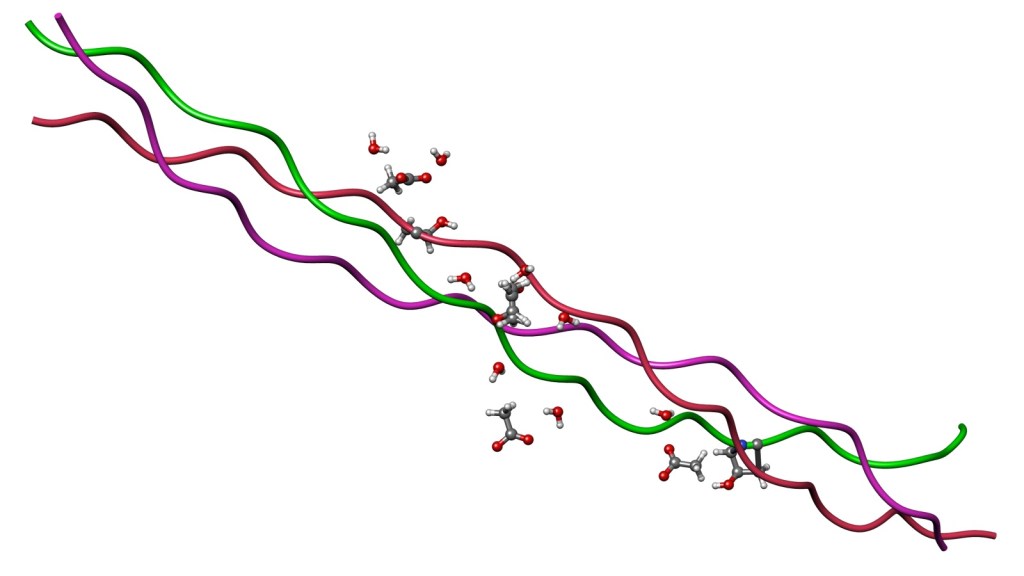
Collagen is the internet’s favorite supplement — a scoop of flavorless powder that millions stir into their coffee on faith, because almost nobody who takes it can actually say whether it works. Here’s the honest surprise: of all the trendy "peptides," collagen peptides are the only ones with a real stack of oral human randomized trials behind them. They’re food-derived, not a gray-market injectable, and the evidence that they do something for skin and joints is genuine. It’s also smaller, and more fragile, than the marketing implies. So hold two ideas at once: modest, but real — not a miracle.
What Collagen Peptides Are
Start with the word, because the label is doing some work. Collagen peptides and hydrolyzed collagen are the same thing: gelatin that’s been enzymatically chopped into short amino-acid chains — mostly di- and tripeptides just two or three building blocks long. Gelatin is cooked-down collagen, the structural protein that makes up skin, tendon, cartilage and bone; hydrolysis breaks it into fragments small enough to dissolve in cold water and, crucially, to survive the trip through your gut.
That last part is the plausibility hook, and it’s better established than you’d expect. When people ingest collagen hydrolysate, hydroxyproline — a signature amino acid found almost nowhere else in the diet — shows up in the blood not just as a free amino acid but riding intact peptides, and it does so dose-dependently: give more, and plasma levels of hydroxyproline-containing peptides climb in step, from roughly 6 to 33 nmol/mL across a roughly tenfold dose range (Study). Researchers have named the specific fragments that make it through — Pro-Hyp, Hyp-Gly and Gly-Pro-Hyp all appear intact in human plasma after a dose, with Pro-Hyp the most abundant, peaking one to two hours after you drink it (Trial). These aren’t smuggled in by accident: the gut has dedicated peptide transporters in the intestinal lining that ferry these collagen-derived fragments straight into circulation (Study).
Why belabor absorption? Because it’s the one place the collagen story stands on firm ground, and because it’s what separates this from the rest of our peptide series. The injectable "research peptides" — BPC-157 and the gray-market vials — are unapproved drugs with essentially no human data. Collagen peptides are the opposite: a food you eat, absorbed by a known route, tested in actual people. That doesn’t make them powerful. It makes them worth taking seriously — which is exactly why the size of the effect matters so much.
The Skin Story
The strongest positive signal is skin, and it comes from a large, recent synthesis. A 2023 meta-analysis in Nutrients pooled 26 randomized controlled trials covering 1,721 people and found that hydrolyzed collagen genuinely beat placebo on the two measures people buy it for: skin hydration and skin elasticity (Meta-analysis).
The numbers, in plain terms. For hydration, the pooled effect was a standardized mean difference of 0.63 (95% CI 0.38–0.88); for elasticity, 0.72 (0.40–1.03). A standardized mean difference is just a way to compare results measured on different instruments — roughly, 0.2 counts as small, 0.5 as moderate, 0.8 as large. So these land in the moderate range: bigger than nothing, smaller than a facelift. The trials ran two to twelve weeks at doses around 0.6 to 10 grams a day, and — importantly for anyone impatient — the benefit built with time. Courses longer than eight weeks outperformed short ones (Meta-analysis).
Taken at face value, that’s a real result: two to three months of a daily scoop measurably improves how hydrated and springy skin is, versus placebo, across dozens of trials and well over a thousand people. If the article stopped here, collagen would look like a quiet win. It shouldn’t stop here.
When the Benefit Shrinks
Because the very next question a skeptic asks is: who paid for those trials? A 2025 meta-analysis in The American Journal of Medicine asked exactly that, pooling 23 RCTs in 1,474 people and then doing the thing the marketing hopes you won’t — slicing the data by trial quality and by funding source (Meta-analysis).
Pooled across everything, it echoed the good news: collagen appeared to help hydration, elasticity and wrinkles. But when the authors looked only at studies not funded by the collagen or supplement industry, the effect on all three outcomes vanished. And when they looked only at the highest-quality trials, it vanished again — no significant benefit in any category. The weaker studies were carrying the win. Their conclusion is blunt: "There is currently no clinical evidence to support the use of collagen supplements to prevent or treat skin aging" (Meta-analysis).
This is the pivot of the whole piece, so sit with what it does and doesn’t mean. It does not mean collagen was proven useless — a benefit that fades under stricter analysis isn’t the same as a benefit disproven. What it means is that the pooled skin signal is heavily inflated by weaker, industry-sponsored trials, a pattern so common in supplement research it has a name: funding bias — studies paid for by a product’s maker tend to report rosier results — compounded by publication bias, where flattering results get published and null ones quietly don’t. The honest read on collagen for skin, then, is a shrug with a lean: possibly a small real effect, plausibly close to zero, and definitely oversold. That signal-versus-hype line is where this entire category lives.
Knees and Joints
Skin gets the ad campaigns; joints may be the better bet. Here the outcome people care about is pain, and the headline meta-analysis is encouraging. A 2023 review in the Journal of Orthopaedic Surgery and Research pooled four RCTs in 507 people with knee osteoarthritis and found collagen peptide beat placebo on pain, with a standardized mean difference of −0.58 (95% CI −0.98 to −0.18) — a moderate effect, and statistically solid (Meta-analysis).
Now the counterweight, given equal billing because it has to be: all four of those trials were rated high risk of bias using the Cochrane tool, and the pooled certainty was only moderate (Meta-analysis). The doses and durations were substantial and realistic — 2 to 10 grams a day for three to six months across the four studies — but a moderate effect built on four flawed trials is a promising lead, not a proven treatment.
There’s a useful sanity check from a bigger, more conservative pool. A 2024 trial-sequential meta-analysis in Osteoarthritis and Cartilage widened the net to 25 RCTs and 2,856 patients — including gelatin and other collagen derivatives, not just the peptide — and landed on a smaller effect: a standardized mean difference of −0.35 (95% CI −0.48 to −0.22), which it graded as small-to-moderate but, notably, robust enough to call the question settled (Meta-analysis). So the joint story is the mirror image of the skin story: a smaller-than-advertised effect that, unlike skin, seems to hold up as you make the analysis stricter rather than melting away.
Tendons and Timing
The third domain is the most mechanistically interesting and the least clinically proven — and it’s aimed at a different reader: the athlete, not the anti-aging shopper. In a small, elegant 2017 crossover trial in the American Journal of Clinical Nutrition, eight healthy men took gelatin enriched with vitamin C about an hour before a short bout of rope-skipping. The 15-gram dose roughly doubled their blood level of P1NP — amino-terminal propeptide of collagen I, a marker that rises when the body is actively building new collagen — compared with placebo (Trial).
Two details make this more than a curiosity. First, the vitamin C isn’t optional garnish: it’s a required cofactor for the enzymes that stitch collagen together, which is why the gelatin was fortified with it. Second, the timing — an hour before exercise — is deliberate. Circulating glycine, proline and hydroxyproline all peaked about an hour after intake, meaning the raw materials were flooding the bloodstream right as exercise sent blood flow and mechanical load to the tendons that would use them (Trial).
Now the essential asterisk, in bold so no one misreads it: this is a biomarker, not an outcome. P1NP going up tells you the synthesis machinery revved — it does not tell you a tendon got stronger, an injury healed faster, or an ache went away. And even the biomarker is wobblier than the headline suggests. A 2019 follow-up from the same lab tried to replicate it and saw P1NP tend to rise only about 20% with gelatin and hydrolyzed collagen — a real direction, but so variable it never reached statistical significance (Trial). Treat the tendon story as a live and plausible hypothesis for active people, not a promise.
How Much and Who Benefits
So what does this add up to for someone standing in the supplement aisle? Doses in the trials cluster by goal. For skin, the effective range is low — a systematic review of 14 skin RCTs put a safe and effective dose at roughly 0.3 to 5 grams a day, with individual trials running from 0.3 to 10 grams over 4 to 12 weeks (Meta-analysis). For joints, doses ran higher — 2 to 10 grams a day for three to six months (Meta-analysis). The common thread across every domain is patience: give it eight to twelve weeks of daily use before you decide whether it’s doing anything.
It also matters who the evidence is about. These trials were run overwhelmingly in older adults and postmenopausal women — the people whose own collagen is actually in decline — not twenty-somethings topping up. That’s clearest in the bone data. A 12-month RCT in 131 postmenopausal women found that 5 grams a day of specific collagen peptides significantly increased bone mineral density at both the spine and hip versus placebo (Trial) — a genuinely encouraging result with one large caveat printed in its own funding statement: the study was financed by a collagen manufacturer, GELITA AG. That’s the same industry-funding flag the skin data waved. A 2025 meta-analysis of the bone-and-muscle evidence leans cautiously positive but confirms the effect is concentrated in postmenopausal women, driven largely by that single trial, and dogged by substantial heterogeneity and serious risk-of-bias concerns (Meta-analysis).
The reassuring part is safety. Across the knee-osteoarthritis trials there was no significant increase in adverse events versus placebo (Meta-analysis), and the larger osteoarthritis analysis agreed — collagen derivatives didn’t raise the risk of side effects or dropouts (Meta-analysis). In a placebo-controlled skin trial of 112 women taking a hefty 10 grams a day for eight weeks, the complaints were mild and mostly digestive — some nausea, a little constipation — with no serious events (Trial). For a food-derived protein, that’s about what you’d expect: unlikely to hurt you, which lowers the stakes on the gamble considerably.
Frequently Asked Questions
Does collagen actually work for your skin?
A 2023 meta-analysis of 26 randomized trials in 1,721 people found that hydrolyzed collagen may modestly improve skin hydration and elasticity compared with placebo over about 8 to 12 weeks. But a 2025 review of 23 trials found that this benefit disappeared once you looked only at the highest-quality studies and at trials not funded by the collagen industry. So the skin effect may be small and possibly close to zero, and it is likely oversold. The honest read is a possible small real effect that is heavily inflated by weaker, industry-sponsored studies (Meta-analysis).
How much collagen should I take per day?
The article says doses cluster by goal. For skin, one review put a safe and effective range at roughly 0.3 to 5 grams a day, with trials running from 0.3 to 10 grams over 4 to 12 weeks. For joints, doses ran higher, around 2 to 10 grams a day for three to six months. Across every use, the common thread is patience: give it about 8 to 12 weeks of daily use before deciding whether it is doing anything (Meta-analysis).
Does collagen help knee pain from osteoarthritis?
Possibly, though the evidence is not settled. A 2023 review of four trials in 507 people with knee osteoarthritis found collagen peptide beat placebo on pain with a moderate effect, but all four studies were rated high risk of bias. A larger, more conservative 2024 analysis of 25 trials in 2,856 patients found a smaller effect that held up as the analysis got stricter. So collagen may offer a moderate reduction in knee pain that is worth a careful try, but it is a promising lead rather than a proven treatment (Meta-analysis).
Should I take collagen with vitamin C before a workout?
There is an interesting but unproven signal here. In a small 2017 crossover trial, eight healthy men took 15 grams of vitamin C-enriched gelatin about an hour before rope-skipping, which roughly doubled a blood marker of active collagen building versus placebo. The vitamin C matters because it is a required cofactor for the enzymes that build collagen, and the one-hour timing lines up with when the raw materials peak in the blood. But this is a biomarker, not a proven outcome, and a 2019 follow-up saw a smaller, non-significant rise, so treat it as a plausible idea for active people rather than a promise (Trial).
Does collagen have side effects, or is it safe to take?
Safety looks reassuring in the studies. Across the knee-osteoarthritis trials there was no significant increase in side effects compared with placebo, and a larger osteoarthritis analysis agreed that collagen did not raise the risk of side effects or dropouts. In a skin trial of 112 women taking a fairly high 10 grams a day for eight weeks, the complaints were mild and mostly digestive, such as some nausea and a little constipation, with no serious events. For a food-derived protein, that is about what you would expect: unlikely to harm you (Trial).
Key Takeaways
- They’re real peptides that reach your blood. Unlike injectable gray-market peptides, collagen is food — and specific fragments like Pro-Hyp and Hyp-Gly survive digestion and appear intact in human plasma within an hour or two of a dose (Trial).
- The skin benefit is real but modest. A meta-analysis of 26 RCTs in 1,721 people found moderate improvements in skin hydration and elasticity over 8–12 weeks versus placebo (Meta-analysis).
- That benefit shrinks under scrutiny. In a 2025 meta-analysis, the skin effect disappeared in the highest-quality trials and in trials not funded by the collagen industry (Meta-analysis).
- Knee-arthritis pain relief is moderate but unproven. Four RCTs showed a moderate reduction in knee-OA pain, but all four were high risk of bias — promising, not settled (Meta-analysis).
- Active people get a synthesis signal, not a guarantee. Gelatin plus vitamin C before exercise doubled a collagen-building blood marker — a biomarker, not a proven injury or performance outcome (Trial).
- Low doses, real patience, specific people. Roughly 2.5–15 g a day for at least 8–12 weeks, with the clearest evidence in older adults and postmenopausal women (Meta-analysis).
Modest, but Real
Strip away the influencer gloss and collagen peptides land in a genuinely unusual spot: a supplement with real oral human trial evidence, which is more than almost anything else in the "peptide" conversation can say. The honest verdict is the one we started with. For skin, the effect is probably small and may sit close to zero once you filter out the industry-funded studies. For knee pain, it’s a moderate signal worth a careful try. For tendons, it’s an intriguing hypothesis with a vitamin-C twist. None of that is a miracle, and none of it is the injectable peptides sold in unlabeled vials — this is food, absorbed the ordinary way, unlikely to harm you and possibly helpful at the margins.
So if you’re an older adult or a postmenopausal woman curious about your skin, joints or bones, a daily 5-to-15-gram scoop with a squeeze of vitamin C is a low-risk, low-cost experiment — just give it three months and calibrate your expectations to "noticeably better," not "transformed." If you’re chasing dramatic anti-aging from a twenty-something baseline, the evidence isn’t really about you. Either way, the smartest thing to bring to the collagen aisle isn’t hope — it’s honesty about how big the effect actually is.
Modest but real beats miraculous but fake every time — and on that honest scale, collagen peptides earn a cautious, clear-eyed yes.
This article is for educational purposes and is not medical advice. Talk to a qualified clinician before changing your health regimen.


Leave a Reply