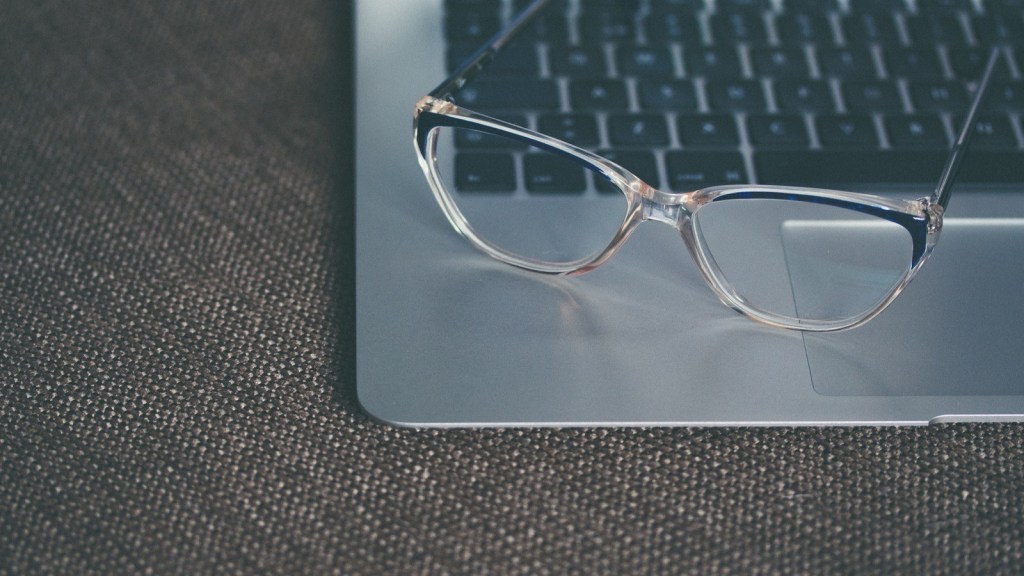
Blue light glasses have been tested in 17 trials on 619 people. Put together, they probably make no difference to eye strain (Review). The sleep results disagreed with each other. Not one trial checked whether the lenses protect the back of the eye.
That verdict comes from a 2023 Cochrane review. Nobody should feel foolish for owning a pair. The evidence just points somewhere else: at how bright your evening is, and when.
What Blue Light Glasses Do
They are ordinary glasses with a filter added. Some carry a coating that reflects part of the blue light away. Others use a tint mixed into the plastic. That is why the strongest ones look amber.
The target is the blue end of visible light, roughly 400 to 500 nanometers. That is the bluest slice human eyes can see. Screens, LED bulbs and daylight all give it off. Daylight gives off by far the most.
The word blocking oversells what the lens does. Researchers measured five popular brands with an instrument that reads exactly what a lens lets through. The lenses passed 75% to 90% of blue light straight to the eye (Study). A plain clear lens in the same test passed 90%.
A 2026 review gathered lab measurements of seven filtering lenses. The cut in blue light ran from about 6% to 43%, depending on the brand and the lens power (Review). The Cochrane reviewers saw the same spread. One product in their trials filtered 10% to 30% of the blue band. Another filtered nearly 90% (Review).
Filtering is not free, either. The same measurements found the lenses slightly dull low-light vision and mute blue tones. The reviewers call those losses too small to matter in daily life (Review). More than 7 in 10 wearers in the five-brand study felt no difference from a plain lens (Study).
A filter that weak is unlikely to change how your eyes feel.
The Cochrane Verdict
Cochrane reviews sit near the top of medical evidence. A team pools the fair tests, grades how good each one is, and refuses to guess past the data. In August 2023 a Cochrane team did that for blue light glasses (Review).
They found 17 trials holding 619 people, published between 2009 and 2021 across six countries. The smallest had 5 people and the largest 156. Follow-up ran from less than a day to five weeks. In every trial, a coin flip decided who wore the filtering lenses and who wore plain ones.
Eye strain was the headline question. Over less than a week of use, there may be no difference between filtering lenses and ordinary ones. The reviewers rated that evidence weak, so read it as a soft no rather than a hard one. Sharpness of vision came out cleaner: probably no effect, on better evidence.
Sleep is the messy part. Six trials asked people to rate how they slept. Three found an improvement and three found nothing. The reviewers refused to call it either way. They graded that evidence as weak as their scale allows.
Then there is the gap. No trial in the whole set measured the health of the macula, the central patch of retina you read with. None measured glare, how well people tell colors apart, or melatonin in the blood (Review).
That difference matters. “No evidence” here means nobody looked. It does not mean somebody looked and found nothing.
Study quality was thin too. Not one trial was clean on every measure of good design. Only about a third registered their plan before starting.
Harms were rare and mild. Nine trials covering 333 people logged the odd headache, discomfort and low mood (Review). The reviewers closed by asking for better trials, because the ones they had could not say what these lenses do.
The Sleep Claim Falls Apart
Cochrane could only report what people said about their sleep. In 2025 a team pooled the trials that measured sleep instead, using wrist trackers.
Three trials, 49 people. Everyone wore both kinds of lens on different nights, so each person acted as their own comparison. Nothing moved. The lenses did not change how fast people fell asleep or how long they slept. They did not change the share of the night spent asleep, or time awake in the small hours (Meta-analysis).
49 people is a small pile of evidence. The authors say these trials do not show a benefit. That is not the same as ruling one out.
The strongest case for the other side comes from 2018. Researchers gave amber lenses to adults with insomnia symptoms (Trial). Fourteen people finished, with an average age around 47. The lenses absorbed about two thirds of blue light. Each person wore them for two hours before bed for a week, then spent a week in clear dummy lenses.
On amber nights, people reported sleeping about 52 minutes longer. They rated their sleep better and sounder. Their wrist trackers agreed on one measure only, showing about 28 minutes more sleep. The time it took to fall asleep did not budge.
That result is real and deserves respect. It is also one week, in 14 people who already slept badly, and it came mostly from asking them.
The pattern repeats elsewhere. A 2020 review pooled 12 studies. The lenses helped more when people rated their own sleep than when a device measured it. Across the individual studies, the benefit showed up most often in people with insomnia, bipolar disorder, a delayed body clock or ADHD (Meta-analysis). Healthy sleepers had the least to gain.
The box makes a specific promise. These lenses are sold as melatonin protection. Not a single trial in the Cochrane set measured melatonin (Review).
One recent trial finally did. Thirty-nine boys aged 10 to 12 wore store-bought lenses that block 40% of blue light, for three hours before bed. The melatonin in their saliva did not change (Trial). Their bedtime did creep earlier, by under 10 minutes, so something else was doing that work.
Melatonin has moved in a trial, but only with serious hardware. In 47 pregnant women, amber safety glasses blocking 99% of blue light brought melatonin on about half an hour earlier than light-gray lenses (Trial). Those are not the near-clear lenses sold for desk work.
The Retina Claim, Measured
This is the scariest sales claim, and the easiest to check. Public Health England measured it in the lab.
They tested consumer devices against the international safety limit for blue light. That number is what eye-safety standards are built on. Monitors, laptops and tablets came in at a small fraction of one percent of it. Smartphones topped out at under half of one percent (Study). Even under extreme long-term viewing, the authors wrote, none of the sources tested gave cause for concern.
A 2022 review put that in scale. Looking at a clear British sky on a sunny day in June measures about a tenth of the same limit (Review). That is at least 27 times the blue light of a phone at full brightness. The sky is not dangerous either.
Household LED bulbs sit higher, at 10% to 20% of the limit. So does an ordinary old-style bulb. That figure also assumes something nobody does: staring straight at the bulb for hours a day (Study).
The fear came from real laboratory work, carried too far. Intense blue light can damage cells in a dish and animal eyes, at doses far above anything a screen gives off. Asking whether screens scaled down to the same problem was fair. Somebody measured, and the answer was no.
The 2022 reviewers still stop short of a lifetime guarantee. Nobody has followed screen users for 40 years. So they call the evidence too thin to rule out slow effects (Review).
As for whether the lenses protect anything, the evidence is not weak. It is missing. No trial has ever followed people wearing blue light glasses to see what happened to their retinas (Review).
Dry Eyes, Not Blue Light
Sore, gritty, tired eyes after a long screen day are not imaginary. The cause is just not the color of the light.
Blinking is where it goes wrong. Each blink spreads a fresh layer of tear film over the eye. That thin wet layer keeps vision clear and the surface comfortable. Stop blinking properly and it breaks up.
Reading cuts the blink rate hard. In one lab study, 50 adults blinked about 16 times a minute while looking at a distant view. On a tablet the rate fell to about 6 (Study). Print was no better. Reading a book gave about 5 blinks a minute, and reading aloud about 4. The authors blamed the mental effort of reading, not the screen.
The screen did differ in one way. Reading on paper left under 5 in every 100 blinks unfinished. On a tablet, about 14 in every 100 failed to close fully, the same level as resting.
A second study matched screen and printed text for size and contrast. The blink rate came out the same on both, but unfinished blinks were more common on the screen (Study).
A 2023 study strapped eye trackers to 24 people reading from print, a laptop, a TV and a phone. Blink rate fell to about a third of its conversation level during every reading task, print included (Study). It did not differ by device, brightness, text difficulty or distance.
So the thing drying your eyes may be concentration rather than color. None of these studies measured symptoms, so treat that as the better explanation, not a proven chain. Either way, a tint cannot wet the surface of your eye.
What may help targets the actual problem. Sit about an arm’s length from the screen. Keep the monitor a little below eye level, so your lids cover more of the eye. Blink fully and deliberately now and then. Lubricating drops help stubborn dryness, and a current prescription removes another source of strain.
The best-known fix has almost no evidence behind it. The 20-20-20 rule says that every 20 minutes you should look at something 20 feet away for 20 seconds. It has been tested once. Thirty adults read on a tablet for 40 minutes, taking a 20-second break every 5, 10, 20 or 40 minutes. Symptoms rose under every schedule, and the breaks changed nothing (Trial).
One study of screen breaks did look kinder. Break reminders went to 29 computer users with symptoms. Their scores improved while the reminders ran, then largely faded within a week (Study). Everyone got the reminders, so there was no group left to compare against.
Keep the rule if you like it. Just do not treat it as a proven swap for the glasses you are setting down.
Intensity and Timing Win
Brightness and time of day matter more than color. Light is measured in lux. Outdoor daylight runs up to 130,000 lux, while indoors you are usually under 1,000 (Review).
In 2000 a team gave 23 adults one long evening dose of light and traced the response (Study). Half of the full body-clock shift arrived near 100 lux, which is ordinary room lighting. Dim room light of about 106 lux held melatonin down by 88%. Light 85 times brighter held it down by 98%.
A 2019 study pushed the number lower. It followed 55 healthy adults aged 18 to 30 across 351 study nights. Half of the melatonin response came at about 25 lux (Study). Sensitivity varied enormously between people. The most sensitive responded at 6 lux, the least at 350. On average, evening light of 10, 30 and 50 lux delayed melatonin by roughly 22, 77 and 109 minutes.
Your living room does the rest. Room light under 200 lux before bed cut melatonin in the hours before sleep by about 70%, against near-darkness (Study).
Ordinary evening lamps already sit high on that curve. Shaving one narrow slice of color off one screen barely registers against them.
One famous study did find a big effect from a screen. Twelve adults spent five evenings reading for about four hours. They used either a light-emitting tablet or a printed book (Trial). The tablet pushed their melatonin timing more than an hour and a half later. It added about 10 minutes to falling asleep.
The conditions are the catch. The reading room sat at about 3 lux, close to darkness. Their whole waking day sat at about 90 lux, dimmer than most offices. A published response in the same journal argued that this is not how people live. After a normally bright day, it said, the tablet would have mattered far less (Letter).
That points to four changes, strongest first. Get bright light early in the day, ideally outdoors. That is the strongest single input a body clock receives, and the subject of our morning light guide. Dim the house after dinner, using one lamp instead of the ceiling light. Hold the phone further from your face, because brightness at the eye drops off fast with distance. Then set a time to stop, and keep to it.
Frequently Asked Questions
Do blue light glasses work for sleep?
Probably not on their own. When sleep was measured with wrist trackers instead of questionnaires, blue-blocking lenses changed nothing measurable, though those trials were small (Meta-analysis). The Cochrane review could not reach a verdict, because the trials asking people how they slept disagreed (Review). People with insomnia symptoms may get more from them than good sleepers do (Meta-analysis).
Are blue light glasses bad for your eyes?
No. Side effects across nine trials in 333 people were uncommon and mild, mainly headache, discomfort or low mood (Review). The lenses do slightly dull dim-light vision and mute blue tones (Review). At worst they are a poor use of money, not a hazard.
Do I need blue light glasses for computer work?
The evidence does not support it. The pooled trials found no clear drop in eye strain (Review). Screen discomfort may have more to do with a collapsed blink rate and unfinished blinks, which a tint cannot change (Study). Screen distance, deliberate blinking, dryness care and a current prescription target the likelier cause.
Does night mode on my phone help?
No trial here tested night mode, so this is reasoning rather than a finding. Night mode shifts color and usually lowers brightness a little. Brightness is the half with evidence behind it, since evening melatonin responds sharply across ordinary indoor light levels (Study). Turning the screen down and holding it further away probably matters more than the tint.
What actually causes eye strain from screens?
Mostly dryness and long spells of focus, as best anyone can tell. Blink rate falls to about a third of normal during any reading task, on paper as well as on screens (Study). On screens, more of those blinks fail to close fully, so the tear film breaks up (Study). An out-of-date prescription and a badly placed monitor add to it.
Key Takeaways
- The verdict: 17 trials in 619 people found blue light glasses probably make no difference to eye strain, and the sleep results disagreed (Review).
- They barely filter: measured across seven lenses, the cut in blue light was only about 6% to 43% (Review).
- Screens are no measurable retina hazard: consumer devices sit at a fraction of one percent of the safety limit, far below a summer sky (Study).
- Dryness fits better: blink rate falls to about a third of normal during any reading task, print included, and screens leave more blinks unfinished (Study).
- Melatonin was never tested: no trial in the review measured it, and when one finally did, 40%-blocking lenses left it unchanged (Trial).
- Intensity and timing win: half of the evening melatonin response happens at about 25 lux, dimmer than most living rooms (Study).
Fix the Light, Not the Lens
If you own a pair and you like them, keep wearing them. They are cheap, comfortable and harmless, and a placebo you enjoy is not nothing. The mistake is only in what you expect from them.
Put the effort where the measurements point: morning daylight, a dimmer evening, more distance from the screen, a real stop time. Blink properly, and treat dryness as dryness. All of it has more evidence behind it than the lenses do.
If your eyes hurt most days, if screens bring headaches, or if your vision blurs, see an optometrist. Lasting symptoms deserve an eye exam, not a filter.
All of that is free. That is the honest answer about blue light glasses.
This article is for educational purposes and is not medical advice. Talk to a qualified clinician before changing your health regimen.


Leave a Reply