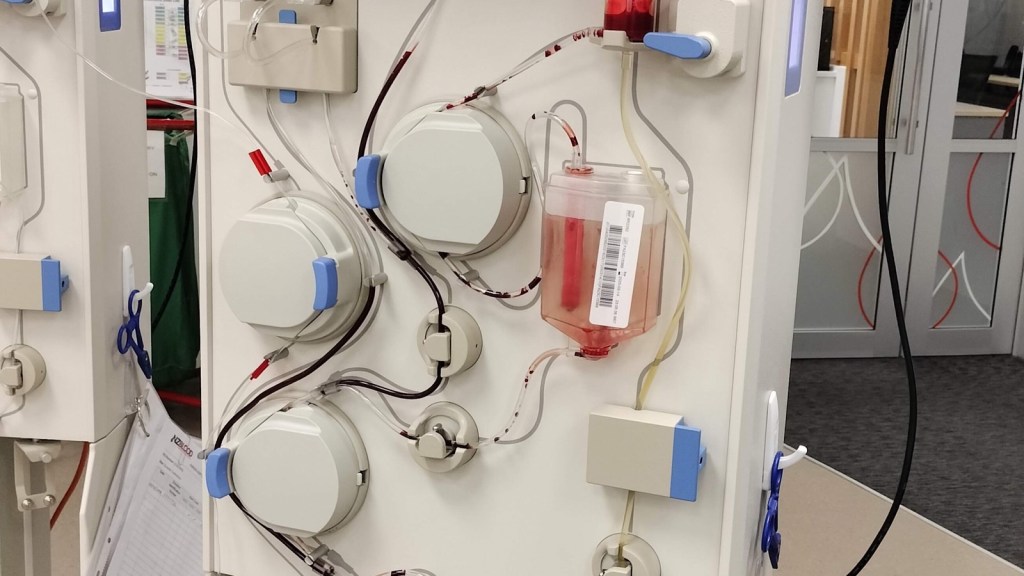
The whole human case for plasma exchange longevity treatment rests on one small trial of 42 people. In its best group a biological age score fell about 2.6 years, measured midway through (Trial). The trial never measured strength, memory, illness or survival, so nothing a person can feel was tested. At a US wellness clinic the procedure can cost from $5,000 to more than $10,000 (Report). The biology is worth watching, but the price has run far ahead of the evidence.
What Plasma Exchange Actually Is
Blood is cells floating in a straw-colored liquid called plasma. Therapeutic plasma exchange uses a machine to separate the two. The machine throws your plasma away. Your cells go back in, carried by salt water and albumin, the main protein plasma contains.
A session takes a couple of hours. Blood leaves and returns through wide needles in the arms. Some people get a line placed in a large vein instead.
Apheresis, the family of procedures that filter blood this way, is standard hospital care. The American Society for Apheresis grades 166 uses of these machines (Guideline). Plasma exchange is one of the options in 118 of them (Analysis). In twenty it is the first thing doctors reach for. Those are nerve and immune diseases, such as Guillain-Barre syndrome, myasthenia gravis and a rare clotting disorder called TTP.
The FDA has cleared the apheresis system used for this work for three procedures (Clearance). Those are plasma exchange, red cell exchange in sickle cell disease, and removal of excess white cells. Aging is not on that list. Selling the procedure for longevity is off-label use, which is legal and common in American medicine.
The evidence behind those 166 uses is thinner than the number suggests. Researchers tracked five editions of the guidelines. Most uses of plasma exchange still sit in the weakest evidence tier. For 102 conditions the evidence never improved at all (Analysis).
Why Mice Started This
The idea came from a strange old experiment. Surgeons joined an old mouse to a young one so the pair shared a blood supply. The technique is called heterochronic parabiosis. Old tissue began behaving younger. That set off a decade of hunting for the youth factor in young blood.
A later experiment dropped the young mouse entirely. Researchers took old mice and swapped about half their plasma for plain salt water and albumin. No young blood went in at all. Muscle repair improved, liver fat and scarring fell, and new brain cell growth rose about eightfold (Study). The authors judged the effect in muscle and brain to be at least as strong as in the joined mice.
A companion study tested how the animals behaved. Old mice given the same one-off dilution did better on two memory tasks. Inflamed immune cells in their brains fell far enough to match the young mice (Study). The authors concluded that you do not need anything from young blood.
That changed how the field thought about old blood. Aging blood may build up signals that hold tissue back. Dilute those signals and tissue may recover for a while. That is why the human version became plasma exchange rather than a transfusion of young plasma.
Mouse tissue findings are a reason to run a human trial, not evidence about people.
The Plasma Exchange Longevity Trial
Before 2025 the human evidence was one open study in 8 people. Everyone in it got the treatment, and the authors scored biological age with a measure they had invented themselves (Study). It reported ages falling by decades. The 2025 trial exists because nobody had yet run a controlled test.
The newer trial enrolled 44 healthy adults, nearly all over 50, and 42 finished. A coin flip sorted them into four groups of about eleven (Trial).
One group got two sessions in a single week, then a break, over about three months. A second got the same schedule plus a dose of pooled donor antibodies, called IVIG, straight after each session. A third got one session a month for six months. The fourth got a fake procedure.
The fake was carefully built. Those participants had drips in both arms and received about a cup of salt water, while dark curtains hid the apheresis machine (Trial). Participants did not know which group they were in, though the staff running the trial did (Registry). Treatment ran up to six months and counted 240 procedures in total.
The team collected blood three times. At the middle collection the plasma exchange plus antibodies group showed the biggest drop in biological age, about 2.6 years. The once-a-month plasma exchange group dropped about 1.3 years (Trial). The fake group’s score stayed where it started.
The doses did not line up. Among the groups given plasma exchange alone, the once-a-month schedule did better than the twice-in-a-week one. The authors say so directly: more frequent sessions do not necessarily produce more rejuvenation (Trial).
The effect also faded. By the final blood draw every group looked like the fake group (Trial). Almost all of the movement had happened between the first two draws.
Who ran the trial matters too. The registered sponsor is the study’s own apheresis doctor. He is listed as chief medical officer of an apheresis company, and Circulate Inc. is the named collaborator (Registry). Three of the authors belong to Circulate, a company that markets the treatment (Trial).
The funding line is stranger still. The paper says the authors received no specific funding for the work. The host institute’s own press release says Circulate supported the study, and that company scientists led it (Report).
One other coin-flip test in healthy people points the other way. Thirty-four adults aged 40 to 60 gave plasma four or eight times over 18 weeks. Their clocks did not get younger, and several read slightly older with each extra session (Trial). That study used plasma donation, with nothing given back in place of the plasma, so the two treatments are not identical.
The Endpoint Problem
What improved in that trial was a score, not a person.
A surrogate endpoint is a stand-in. Rather than wait years to see who gets ill, a trial measures something faster that is meant to predict it. A stand-in earns that job only when someone shows that moving it moves the outcome you care about.
No aging clock has cleared that bar. A 2026 analysis pooled 51 human trials and ran 16 clocks across every one. Its authors say this kind of testing has to come first, before any clock can serve as a stand-in. Nobody had done it properly before (Analysis). They also admit the big unknown. Whether a short-term clock change means better health, less disease or a longer life is still unclear.
Steve Horvath built the first epigenetic clock that worked across tissues. In 2026 he called that analysis the first systematic test of whether these clocks behave the way a stand-in should (Commentary). The person who built the first clock treats the question as open.
The clocks also disagree with each other about the same trial. In CALERIE, a trial of eating less, one measure of the pace of aging slowed. The PhenoAge, GrimAge, Horvath and Hannum clocks stayed put (Trial). One group of researchers points at cases like that and argues the clocks are not yet steady enough to use as endpoints (Perspective).
We have written about both halves of this before. One piece asks what actually moves biological aging across 51 trials. Another asks how accurate a biological age test really is for one person. The plasma exchange trial moved that same kind of number, and that number is not yet a proven stand-in for health.
The trial team is honest about this. The paper says it did not measure how people moved, thought or felt, and that no such changes were seen (Trial). Grip strength and walking speed appear in the results only as estimates from blood, not as anyone actually gripping or walking.
When Function Was Measured
A trial called AMBAR measured the things people notice.
347 people with mild to moderate Alzheimer’s disease took part at 41 hospitals in Spain and the United States. A coin flip assigned them to one of three plasma exchange schedules or to a fake procedure. Treatment ran 14 months, and staff performed about 4,700 procedures, fake sessions included (Trial).
The fake was elaborate. Staff stitched the cut tip of a catheter under a dressing on the chest. In the larger sessions a machine beside the bed circulated salt water dyed with iron to look like plasma. It ran in a closed loop and took nothing out (Trial).
After 14 months the treated groups had held on to more of their daily skills, such as dressing and handling money. They lost about half as much ground as the fake group on that score. Thinking scores moved the same way and by a similar amount, but that difference was small enough that chance could explain it (Trial).
The benefit sat in one part of the group. People with moderate disease declined roughly 60% less on both scores, while people with mild disease gained nothing on either (Trial). Independent commentators called the result encouraging and unexplained, since nobody knows what produced the slowing (Commentary).
AMBAR does show that a real outcome trial of this procedure is possible, at scale, with a convincing fake. What it produced was a modest result in one disease, and only in part of the group. Guidelines still grade plasma exchange for Alzheimer’s as a treatment whose role is not established (Guideline). None of it says anything about rejuvenating a healthy adult.
The Price and the Risks
Independent reporting puts the cost at a US wellness clinic between $5,000 and more than $10,000 (Report). Nobody sells just one session. In late 2024 the doctor who sponsored the 2025 trial charged $6,000 a session at his California clinic. He advised repeating it every two months, which comes to about $36,000 a year (Report).
Insurance pays for plasma exchange when it treats a recognized condition, but not for anti-aging use. Many scientists who study the procedure stay skeptical, because large trials have not shown an anti-aging benefit in healthy people (Report).
Hospitals run this procedure every day, so the safety record is real. It still causes trouble.
The largest real-world record covers 50,846 apheresis procedures in 7,142 patients at specialist centers. Something went wrong in roughly 1 in 20 procedures, and most of it was mild. About 3 in every 100 needed medication, and 4 in every 1,000 forced the session to stop (Registry). First sessions caused more trouble than later ones, about 8 in 100 against 6 in 100.
The commonest complaint is tingling. The machine uses a blood thinner called citrate, which binds calcium. Low calcium brings numbness around the mouth and pins and needles in the hands and feet. In one older series of plasma exchange patients, about 8 in every 100 had such a reaction (Review). Running calcium into the returning blood cuts them sharply.
In sicker patients the numbers climb. Researchers pooled 38 studies covering 2,199 people treated for autoimmune nerve disease. Among those treated, about 12 in 100 had a drop in blood pressure and 11 in 100 had clotting problems. Line infections hit 8 in 100, and 7 in 100 had an allergic reaction (Meta-analysis). Those were ill patients, not healthy buyers, and the rates varied a lot from study to study.
AMBAR sits in the middle. About 1 in 10 of its procedures caused at least one side effect, most often a reaction where the catheter went in. Between 8 and 17 in every 100 treated patients quit because of side effects, against 1 in 100 in the fake group (Trial).
The longevity trial logged one mild allergic reaction to albumin across its 240 procedures (Trial). That is reassuring, but 240 procedures is far too small a sample to catch rare harm. The count also covers only the people who finished. Two others quit because of side effects, and one of those was linked to the antibody drip rather than the exchange.
Frequently Asked Questions
Does plasma exchange longevity treatment actually work?
In one trial a coin flip sorted 42 healthy adults into four groups. A biological age score fell about 2.6 years in the group given plasma exchange plus donor antibodies (Trial). The trial measured no strength, memory, illness or survival outcome. By the final blood draw the treated groups matched the fake group again. A lab score can move, and nobody has yet shown that the person is better off.
How much does plasma exchange cost?
Independent reporting puts the cost at a US wellness clinic at $5,000 to more than $10,000 (Report). One well-known provider charged $6,000 a session in late 2024 and advised six sessions a year, roughly $36,000 (Report). Insurance covers the procedure for recognized medical conditions, not for anti-aging use (Report).
Is plasma exchange safe for healthy people?
Nobody has run a large safety study in healthy people buying repeat sessions. Hospital records give the best available guide. Something goes wrong in roughly 1 in 20 procedures, and most of it is mild. About 4 in every 1,000 sessions are stopped early (Registry). Low blood pressure, tingling, allergic reactions and line infections are the usual problems (Meta-analysis).
Is plasma exchange the same as young blood transfusion?
No. A transfusion puts young plasma in. Plasma exchange takes your own plasma out and replaces it with albumin and salt water. Mouse work suggested the dilution itself did most of the job, with no young blood involved (Study). The FDA has stated there is no proven benefit from young donor plasma for aging or memory loss (Statement).
Do the results last after you stop?
Nobody knows, and the one trial is not encouraging on the point. Most of the biological age change happened between the first two blood draws. By the final draw the treated groups matched the fake group (Trial). That is probably why providers tell you to repeat the treatment every two months (Report).
Key Takeaways
- The human evidence is one small trial. 44 people enrolled, 42 finished, four groups, up to six months, 240 procedures (Trial).
- The 2.6 years belongs to one group. That group also got donor antibodies, and the reading came from the midpoint. Plasma exchange alone moved about 1.3 years, and the gap was gone by the end (Trial).
- The endpoint is the weak link. No aging clock has been proven as a stand-in for health, and different clocks disagree about the same trial (Analysis).
- The sellers ran the study. The sponsor is an apheresis company’s chief medical officer, and three authors belong to the firm that markets the treatment (Registry).
- The procedure itself is real medicine. Plasma exchange is the first choice for 20 graded conditions, none of them aging (Guideline).
- Cost and certainty do not match. About $36,000 a year buys a clock reading, not a measured health gain (Report).
Worth Watching, Not Yet Worth Buying
The biology here is interesting. Diluting old blood did something real in mice. The 2025 trial was also run properly for its size, with a fake-procedure group and a registered plan.
The next step is a bigger trial with outcomes people can feel: strength, memory, illness, years lived. AMBAR shows such a trial can be built. Until someone runs one in healthy adults, a $10,000 session buys a number on a lab report.
The cheap habits are the ones with outcome data behind them. Sleep, steady movement, home-cooked food and care for the conditions you already have rest on decades of outcome studies. Plasma exchange for aging does not have that kind of evidence yet. For now those habits are the better-evidenced choice.
Follow this one with interest. Keep your money in your pocket until the trial that matters is finished.
This article is for educational purposes and is not medical advice. Talk to a qualified clinician before changing your health regimen.


Leave a comment