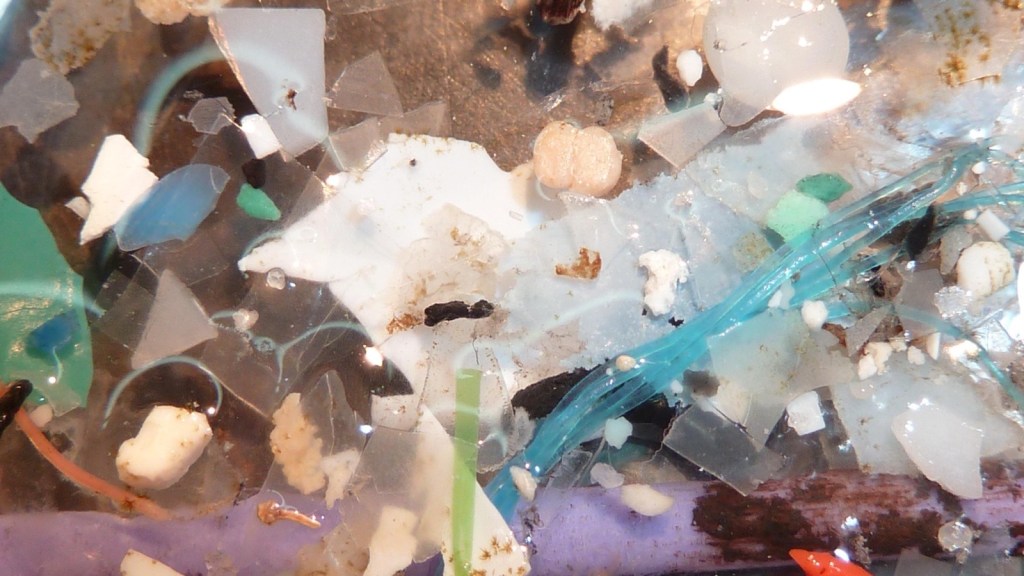
A 2025 study found more plastic in human brain tissue than in the liver or the kidney (Study). The samples ran to about half a percent plastic by weight. That reading is where the “spoon of plastic in your brain” headline came from. Nine other chemists say the figure may be far too high, because brain fat can look like plastic to the machine (Matters Arising). Microplastics in brain tissue are probably real, but nobody has shown they make anyone ill.
Microplastics in Brain Tissue
Microplastics are plastic fragments under 5 millimetres wide, and most are far smaller. Nanoplastics are smaller again, below one micrometre, which is roughly a hundredth the width of a hair. You cannot see either kind, and a nanoplastic is small enough to slip between cells.
Plastic gets into people through food, drink and air. Some of it may cross the gut wall or the lung lining and enter the blood (Review). From there it can reach organs. The brain is meant to be the hard one. It sits behind the blood-brain barrier, a tight lining that keeps most things out. Lab models show tiny particles can cross barriers like it (Review). Proof in living people is much thinner.
The 2025 study used a method called pyrolysis gas chromatography. How it works changes what the headline means. The method does not count particles. It heats the tissue until any plastic inside burns into gas, then reads that gas and works back to a weight.
So a spoon’s worth is a weight comparison. It is not a lump of plastic sitting in a skull. If the figure is right, the plastic is spread through the tissue like dust.
The Spoon’s Worth Headline
Researchers at the University of New Mexico took brain, liver and kidney samples after death (Study). Each organ had between 20 and 28 people at each time point. Every sample went through the burn and read method.
The brain came out highest by a wide margin. Frontal cortex samples from 2024 measured about half a percent plastic by weight. That works out to roughly one gram in every 200 grams of tissue. Liver and kidney samples came in under a tenth of that (Study).
Brains sampled in 2024 held more than brains sampled in 2016. The jump was close to half again in eight years (Study). A separate set of 28 brains, from deaths between 1997 and 2013, measured lower still. Age, sex and cause of death made no difference to the readings.
One material dominated. About three quarters of the plastic in the brain samples was polyethylene (Study). That is the stuff of carrier bags, milk jugs and bottle caps. Under an electron microscope the team saw shard-like flakes, not neat beads.
The spoon line came later, and not from the paper. The paper holds no spoon and no gram. Senior author Matthew Campen drew that comparison himself, from the study he led (Report). It is a way to picture a weight, not an object anyone found in a skull.
Why the Number Is Contested
Nine plastics chemists filed a formal challenge in the same journal (Matters Arising). They wrote that the study seems to have weak contamination controls and too few checks that the method works. That, they argue, may affect how reliable the reported amounts are.
The central objection is fat. Brain tissue is roughly 60% fat by dry weight, while liver and kidney sit under 5% (Full text). Heated fat breaks into pieces that look like polyethylene. The marker chemicals that would confirm real polyethylene were reported as absent. So the organ with the highest reading is also the easiest one for the test to get wrong.
Three more points followed. The step that dissolves tissue works poorly on fatty tissue, and several brain samples did not fully dissolve. The paper does not report blank runs or spiked test samples. Those are the standard checks for stray plastic from gloves, labware and air. And the rise over time may track rising body fat rather than rising plastic (Full text).
Labs really do get contaminated. One German lab kept finding piles of polyethylene in its empty control samples. The source turned out to be wet lab gloves (Report).
The original authors saw some of this coming. Their own paper says unknown leftover tissue stayed in the samples and could interfere (Study). Their numbers show the gap. After the dissolving step, half a gram of liver left about 3 milligrams of residue. The same weight of brain left about 41.
In their published reply, the team accepted three real open problems (Reply). They named the dissolving method, interference from unknown biological material, and the quality checks. They did not withdraw the finding. They framed the exchange as a discussion of how uncertain even the best current methods are.
Nature Medicine also issued a correction (Correction). It fixed repeated images in the supplement, two wrongly sized scale bars, a missing preparation step and a particle count table. No measured amount changed, and nothing was retracted.
Both sides have a point. Plastic has been found in human tissue by several groups using different methods, so detection is credible. The exact amount in a brain is not settled. As the chemistry trade press put it, the study has not been disproved either (Report).
The Dementia Link Runs Both Ways
Twelve of the brains came from people with a recorded dementia diagnosis. Those samples measured about five times the level of the normal 2024 brains (Study). The extra material sat along blood vessel walls and near immune cells.
That finding is the one that travelled. It also needs the most care.
Dementia changes the brain in ways that would lift a plastic reading on their own. Tissue shrinks, so whatever is left sits in a smaller space. The systems that wash waste out work poorly. The blood-brain barrier leaks. The study’s authors list all three, then say plainly that they assume no cause and effect (Study).
The high reading fits two stories. If plastic caused dementia, the reading would be high. If dementia let more plastic in and kept it there, the reading would be high as well. A sample taken after death is a single snapshot at the end of a life. It cannot tell you which thing came first.
The sample is small, too: twelve brains, each sampled once. The size of the gap also rests on the method the challenge questions (Matters Arising). Nothing here shows that plastic causes dementia. For brain development in children, graders rated the evidence as weak as it gets, from three studies (Systematic review). All three came from China, and two may cover the same children.
What Plastic Does in the Body
The strongest human outcome data is about arteries, not brains. Surgeons in Italy stripped fatty plaque from the neck arteries of 304 patients (Study). Most were then followed for about three years. Polyethylene turned up in the plaque of about 58 in every 100 of them.
Those patients did worse. More of them went on to have a heart attack or a stroke, or to die (Study).
The authors wrote down the caveats themselves (Study). Nobody assigned the plastic: the team measured what was already there and watched what happened. They did not measure air pollution, income, education, diet or drinking water, any of which could explain the gap. They could not fully rule out plastic contamination in their own lab. And every patient was ill enough to need surgery. Their closing note is worth repeating: plastic exposure has climbed for decades while heart disease rates have fallen.
A 2026 review gathered the 14 human studies on plastics and the heart (Systematic review). It rated the artery study among the better ones, but still judged the evidence as a whole to be very weak. It concluded that cause is not proven.
The wider picture matches. A Nature Medicine review found early signals in immune, reproductive and heart measures (Review). It then noted that these studies are small and measure exposure poorly. That gap blocks any real risk estimate. A 2025 review of 30 studies rated the evidence moderate for inflammation and hormone markers, and low for thinking and chronic disease (Systematic review). Links to specific diseases, it said, are still not established.
Plastic particles can irritate cells, so harm is plausible. Plausible is not the same as proven.
Exposures You Can Actually Cut
Start with heat, because it is the clearest one. A 2023 test microwaved plastic containers for three minutes (Study). A single square centimetre of surface shed up to 4.22 million micro-sized particles and 2.11 billion nano-sized ones. Fridge and shelf storage shed millions to billions too, but took more than six months. Reheat in glass or ceramic and the question goes away.
The microwave test has limits. It used water and vinegar, not real food, and other chemists have questioned the counting method. A 2025 map of 103 studies confirms that ordinary use of plastic food packaging can shed particles into food (Evidence map). It also found heat did not raise the count in every experiment. Treat the microwave figure as one strong result, not a law.
Water comes next. Drinking only bottled water may add about 90,000 plastic particles a year, against roughly 4,000 for tap (Analysis). Sharper instruments push the bottled figure much higher. A 2024 scan counted around 240,000 particles in a litre, about 90% of them nanoplastics (Study). Other chemists have asked whether lab contamination inflated that count.
That jump is about eyesight, not about bottles getting worse. The 2018 benchmark study found about 325 particles a litre, because it could only see down to 6.5 micrometres (Study).
If your tap water is hard, boiling may help. Heat drives limescale out of the water, and the scale traps particles as it forms. Boiled and strained hard water lost at least 80% of its plastic particles in one experiment (Study). The catch is the water itself. In very hard water removal reached about 90%, but in soft water it was only about a quarter (Report). That test used tap water from one city, spiked with known amounts of plastic. A paper coffee filter takes the scale out.
Plastic tea bags are the famous case, and they carry their own dispute. A 2019 test of four commercial bags reported that one bag brewed at 95 degrees released billions of particles into a cup (Study). Seven German food and water chemists then argued in the same journal that most of those specks were not plastic at all (Comment). They said the material is short nylon by-products, which dissolve when hot and harden as a sample dries. An independent lab watched that happen. The material slipped through a fine filter while hot, formed particles as it cooled, then dissolved again on reheating (Study). Those authors call it one possible explanation, not a settled one. Germany’s food risk agency judged the original count far too high. It put the figure at 5,800 to 20,400 particles per bag instead of billions (Assessment). Loose leaf tea sidesteps the whole argument.
Indoor air is the route people forget. Modelled estimates suggest indoor air exposes people to more plastic than outdoor air, in every age group (Systematic review). Those figures are calculated from published air samples, not measured on real people. Most of the material is textile fibre from clothes, carpet and soft furnishings. In three Danish flats, plastic made up only about 4 in every 100 airborne particles, and polyester was most of that (Study). Those fibres settle into house dust, where about a third contain petrochemicals (Study). Most are too big to breathe in, so the route is hand to mouth. That matters most for small children. Vacuuming, damp dusting and open windows do more here than any purchase.
All of this has a limit. Counting what you breathe in roughly doubles the yearly particle total from food and drink. The same authors call even that an underestimate (Analysis). Kitchen swaps reach only part of it. A 2026 pilot trial gave 60 adults a week of low-plastic food and plastic-free kitchenware (Trial). A coin flip decided who got what. Plastic-related chemicals in their urine fell, some by about a third and some by about half. But that trial measured chemicals leaching out of plastic, not plastic particles. The stool samples that would show particle intake were stored and never reported.
So every swap here lowers measured intake. Not one has been shown to change a health outcome.
Frequently Asked Questions
How did microplastics in brain tissue get there?
The likely path is food, drink and air, then the bloodstream. Lab models show small plastic particles can cross the gut and lung lining and reach organs (Review). Nanoplastics may be small enough to pass the blood-brain barrier. Nobody has traced the route end to end in a living person.
Is there really a spoon of plastic in my brain?
Nobody measured a spoon. One of the study’s authors drew that comparison from the tissue readings, and the paper itself never mentions a spoon (Report). Independent chemists argue the underlying figure may be too high, because brain fat can look like polyethylene in the test (Matters Arising). Plastic in the brain is plausible. The spoon is an estimate built on a contested number.
Do microplastics cause dementia?
No study shows that. Brains with a dementia diagnosis did hold more plastic, but the authors say they assume no cause and effect (Study). Dementia shrinks tissue, weakens waste clearance and leaves the blood-brain barrier leaky, all of which may raise a plastic reading by themselves. The cause and the effect may run the other way.
Can you detox microplastics from your body?
No product has been shown to do this in people. A kimchi bacterium bound nanoplastics and pushed more of them out in mouse droppings. That is promising, and it is still mouse work, as our piece on the kimchi microplastics study explains. Cutting intake is the only lever with human data behind it. So far it has only been shown to move chemical levels (Trial).
Is bottled water worse than tap water?
By particle count, yes. Drinking only bottled water may add about 90,000 particles a year, against roughly 4,000 for tap (Analysis). A 2024 method that can see single nanoparticles counted around 240,000 particles in one litre of bottled water (Study). What that means for health is unknown.
Key Takeaways
- The finding: brain samples held more plastic than liver or kidney, and 2024 samples held more than 2016 ones. Polyethylene made up about three quarters of it (Study).
- The dispute: nine chemists argue the test can mistake body fat for polyethylene, and that contamination checks were thin (Matters Arising). The authors accepted those concerns and stood by the work (Reply).
- The dementia caveat: brains with dementia held about five times more. But dementia itself lifts plastic readings, so the cause may run the other way (Study).
- No proven harm: the best human data is an artery study its own authors call unproven for cause (Study). Reviews rate the whole field very weak (Systematic review).
- Worth doing anyway: stop microwaving food in plastic (Study), drink tap over bottled (Analysis), and keep house dust down (Systematic review).
- The honest gap: cutting plastic contact lowers measured intake, and no trial has shown it changes a health outcome (Trial).
Cut the Easy Exposures First
Plastic particles are in human tissue, and the brain figure that went viral is a real measurement with a real argument around it. Nobody has shown it is making you ill. Worry is not much use here, but a few cheap habits are.
So do the cheap things. Reheat food in glass, drink the tap water, and keep the dust down. Skip anything sold as a plastic cleanse, because no such product has been tested in people.
After that, wait for better numbers rather than buying a cure. Better methods are close, and they will either confirm this number or shrink it. The evidence is still being built, and it is worth watching.
This article is for educational purposes and is not medical advice. Talk to a qualified clinician before changing your health regimen.


Leave a comment