A full body MRI scan finds a confirmed cancer in about 1.6 of every 100 healthy people screened. That figure pools 10 studies and 9,024 people (Meta-analysis). Far more people leave with a harmless spot that starts a chain of follow-up. Around 94 in every 100 have at least one finding, and up to 30 in every 100 get sent for another test (Review). The scan costs roughly $1,000 to $2,500 out of pocket. No finished trial shows that it helps anyone live longer.
Inside a Full Body MRI Scan
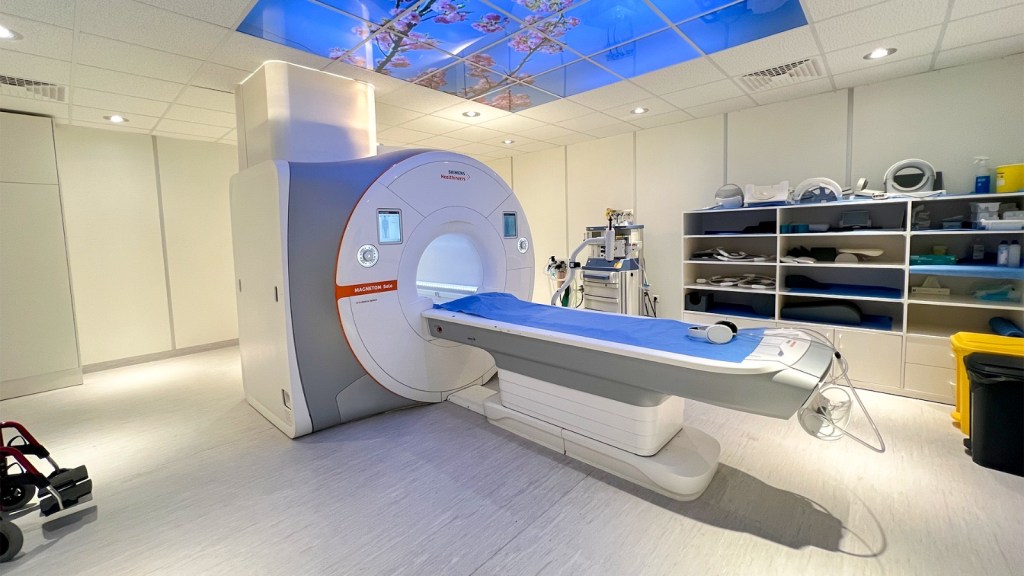
A full body MRI scan is about an hour of lying still inside a magnet. The machine takes pictures from your head down to the middle of your thigh. It sees soft tissue well: brain, liver, kidneys, pancreas, ovaries, spine. Most consumer versions use no injected dye. A whole body scan takes 60 to 90 minutes. A single body part takes 20 to 30 (Review).
An MRI works with a strong magnet and radio waves, not X-rays. So it gives you no ionizing radiation, the kind an X-ray uses. That is a genuine advantage over a screening CT (Source). The case against these scans has nothing to do with radiation. The trouble starts somewhere else.
The scan is a sweep for shapes that look different from the tissue around them. It is not a cancer blood test, and it is not a diagnosis. A radiologist sees a shadow and decides whether it is worth chasing.
The price is real money. Prenuvo lists a standalone whole body scan at $2,499, and a shorter focused scan at $1,199 (Source). Those are US prices, separate from its membership tiers. Ezra advertises an entry scan at $999 (Source). Most private and government plans do not cover a screening scan in someone with no symptoms. The reason they give is simple: no study links the scan to living longer (Review). So most people who get one pay the bill themselves.
What the Scans Actually Find
A 2026 review pooled 10 studies of whole body MRI in people with no symptoms. Together they covered 9,024 participants (Meta-analysis). Doctors confirmed a cancer in about 1.6 of every 100 people scanned. Anyone with a known genetic cancer syndrome was left out, so that is the average-risk figure.
The reviewers were blunt about it. They called the detection rate modest. The scan protocols are not standardized, and the long-term outcome and cost data are missing. Most of the pooled studies also had flaws that make a test look better than it is. They warn in plain words that the scan may lead to tests nobody needed (Meta-analysis).
A second team of clinicians summarized two reviews of the same question (Review). They found a confirmed cancer in 1.1 to 1.6 of every 100 people. The cancers turning up most often were prostate, kidney, lung and thyroid. About 94 in every 100 people had at least one finding, and 4.5 findings each on average. Those numbers come from studies that watched people, not from trials.
Nobody has run a trial comparing scanned people against unscanned people, and there is no death data (Review). Cochrane registered the question in 2026 but has not answered it. The review is still only a plan, with no studies in it and no results (Protocol). Whether these scans help anyone live longer is still open.
Meet the Incidentaloma
An incidentaloma is the spot nobody was looking for. You go in to check for cancer. The scan finds a cyst on a kidney, a nodule on a thyroid, a lump on an adrenal gland. It had probably been there for years. It was probably never going to do anything to you.
These are not rare. Across 12 studies and 5,373 healthy adults, about 32 in every 100 people had a finding rated critical or unclear (Review). Only about 13 in every 100 reported findings were ever checked against a firm diagnosis. Among those that did get followed up, roughly 1 in 6 turned out to be benign. The studies disagreed with each other so much that even that figure is shaky.
The protocol changes the count. When the scan also covered the heart vessels or the colon, the share of people with a finding roughly doubled (Review). Looking at more of the body simply finds more things in it.
That is not a fault in the machine. Healthy bodies are full of cysts, nodules and benign lumps that were always there. A scan that looks at everything at once is bound to meet some of them.
Why Most Alarms Are False
Picture 100 healthy adults walking into a scanner on the same morning. The rest of this is arithmetic, not medicine.
About 2 of them have a cancer that will be confirmed (Meta-analysis). Around 94 walk out with at least one finding. Up to 30 are sent for a further test (Review). So most of the people holding a worrying result are perfectly fine.
One large review tried to put a number on that. It gathered 32 studies and 27,643 adults with no symptoms (Meta-analysis). Only five of those studies tracked people all the way to a final diagnosis. Of the 234 people who were followed up, 48 ended up with a serious diagnosis. That is about one fifth. The authors stress that this follow-up evidence is thin and patchy.
Doctors call the starting point pre-test probability. It is how likely the disease was before anyone ran the test. In a person with no symptoms and no risk factors, it is very low. When only a couple of people in a hundred are ill, even a good scan flags more healthy people than sick ones.
A sharper scanner may make this worse rather than better. Better resolution picks up smaller specks, and small specks are usually nothing. The false alarms come out of the numbers. They are not the fault of a bad machine or a careless radiologist.
The Cascade After a Spot
Overdiagnosis sounds like a paperwork problem. Follow one flagged spot through the months after the scan to see what it costs a person.
A repeat scan comes three months later, to see whether the spot grows. Then there is a specialist appointment, and maybe a needle biopsy. In between, you spend weeks not knowing. The bills arrive, and your insurer will not touch them. Every procedure carries its own small risk, and this one was never needed.
A German population study measured the cascade. Researchers gave a whole body MRI to about half of 6,753 adults, then told them what turned up (Study). Of everything the study itself did, telling people about a finding pushed biopsy rates up the most. It roughly doubled them. Some people were told about a scan finding and an odd lab result. Among them, about 6 in every 10 biopsies found no cancer or tumor. The authors called it potential overtesting and overdiagnosis.
South Korea is the clearest documented example. It added a cheap thyroid ultrasound to routine health checkups. By 2011 doctors were diagnosing thyroid cancer 15 times as often as in 1993. More than 40,000 people were diagnosed in a single year (NEJM analysis). Deaths stayed exactly where they had always been, between 300 and 400 a year.
Nearly everyone diagnosed was treated. An insurance-claims analysis in that paper covered more than 15,000 patients who had surgery. Of those, 11 in every 100 developed a parathyroid problem. Another 2 in every 100 were left with a paralyzed vocal cord (NEJM analysis).
After a public campaign in 2014, thyroid cancer operations fell from more than 43,000 a year to about 28,000 (NEJM letter). The authors judged it extraordinarily unlikely that fewer diagnoses would cost lives. The earlier surge in diagnosis and surgery had not lowered deaths. Finding more cancer is not the same as helping more people.
That lesson is not unique to Korea. One analysis pooled 18 trials and more than 2 million people across six screening tests (Meta-analysis). Only one test, flexible sigmoidoscopy, showed a clear gain in lifetime across everyone invited. Its authors call even that a possible benefit, and other researchers argue lifetime gained is too blunt a yardstick. Screening helps less than the marketing suggests, even where it works.
What the Scan Cannot Do
A clean scan is reassurance. It is not proof, and the gap between those two is where the money goes.
One clinic went back through 576 adults who paid for a preventive whole body MRI (Study). Sixteen had a missed finding, five of them cancers. The authors concluded the scan may be inadequate for colon, thyroid and breast cancer. They suggest it works best alongside other screening, not instead of it.
The wider evidence barely checks this. In the 12-study review, not one study checked clean scans beyond five years (Review). Only a single study counted missed cancers, at 2 in every 100. Nobody really knows what a clean scan is worth.
Where scans have been scored against later diagnoses, the misses are real. In a small study of 59 people with inherited cancer syndromes, whole body MRI caught 7 of the 11 cancers present (Study). It missed about a third of them. Those people were being watched closely, far more closely than a walk-in customer.
The bigger danger of a clean result is what it talks you out of. A clean scan can feel like a clean bill of health. That feels like permission to skip the mammogram or the colonoscopy. Those tests have decades of trial evidence behind them. This one does not. It is the same trap as a continuous glucose monitor or a nightly sleep score. Watching the measurement starts to feel like looking after your health.
Who the Scan Genuinely Suits
One group gets this scan as standard care, not as an upsell. Li-Fraumeni syndrome is an inherited fault in a gene called TP53. It raises cancer risk sharply across a whole lifetime. Guidance for these families lists a whole body MRI every year, at all ages (Guidance).
The yield explains why. One pooling covered 13 groups and 578 carriers having a first whole body MRI. It found a new, treatable cancer that had not spread in about 7 of every 100 people (Meta-analysis). That is roughly four times the average-risk rate. It also flagged spots needing follow-up in 173 of those 578 people. Of the 61 spots worked up to a diagnosis, 26 were false alarms.
An updated pooling shows how the yield settles over time. Across 11 studies and 703 carriers, cancer was found in about 6 in every 100 people scanned (Meta-analysis). Counting the first scan and later rounds together, the rate is about 2 in every 100 per round. About 31 in every 100 carriers had a spot that needed chasing. Fewer than 1 in 5 of those spots was cancer.
The scanner did not get better here. The people being scanned were simply far more likely to have something. Even in these families, the studies measure detection, not lives saved.
So a strong family history belongs in a clinician’s office, not a self-pay scanner. Several young cancers in close relatives is a reason to ask about genetic counseling and targeted screening. That route can move you into a group where this scan is real medicine, and sometimes a covered one (Review).
For everyone else, the radiologists have said their piece. In April 2023 the American College of Radiology issued a short statement (Statement). It does not believe, at this time, that there is enough evidence to recommend total body screening. That covers people with no symptoms, no risk factors and no family history that suggests disease. It adds that such scans turn up vague findings, which lead to follow-up testing and expense. The statement says nothing about inherited cancer syndromes.
Frequently Asked Questions
Is a full body MRI scan worth it?
For an average-risk adult with no symptoms, the evidence does not support it. About 1.6 in every 100 people screened have a cancer confirmed, while most leave with a finding of some kind (Meta-analysis). No trial has shown the scan helps people live longer or get sick less often (Review). If you want it anyway, go in expecting a false alarm rather than an answer.
Does insurance cover a full body MRI scan?
Usually not. Most private and government plans do not cover a screening whole body MRI, because no evidence links it to living longer (Review). Prenuvo lists $2,499 for a standalone whole body scan (Source), and Ezra starts at $999 (Source). Some providers accept health savings money instead.
Is an MRI safer than a CT scan?
On radiation, yes. An MRI works with magnets and radio waves, so it gives you no ionizing radiation, unlike a CT (Source). The harms here are a different shape: false alarms, extra tests, biopsies nobody needed, and the bill (Study).
Does a clean scan mean I do not have cancer?
No. It means nothing visible showed up that day. Whole body MRI may be poor at seeing colon, thyroid and breast cancer (Study). Almost no study has followed clean scans long enough to count what was missed (Review). Keep doing the screening tests recommended for your age and sex.
What should I do if my scan found something?
Take the report to a doctor who knows your history before booking anything else. Ask three questions. How likely is it that this is serious? What happens if we simply repeat the scan in six months? And what will the next test cost me? Among the few people tracked to a final diagnosis after a worrying finding, about one in five had something serious (Meta-analysis).
Key Takeaways
- The yield is about 1.6 in every 100. That is the pooled rate of confirmed cancer across 10 studies and 9,024 people with no symptoms, and the reviewers called it modest (Meta-analysis).
- A finding is the normal result. Around 94 in every 100 people get at least one, and up to 30 in every 100 are sent for more tests (Review). Roughly 32 in every 100 have something rated critical or unclear (Review).
- Most alarms are false alarms. Among the few adults tracked to a final diagnosis after a worrying finding, only about one in five had a serious one (Meta-analysis).
- Overdiagnosis is a real harm. Being told about a finding roughly doubled biopsy rates in a study of 6,753 adults, and most of those biopsies found nothing (Study). South Korea diagnosed 15 times more thyroid cancer without lowering deaths (NEJM analysis).
- High-risk families are the real exception. A whole body MRI every year is standard care in Li-Fraumeni syndrome (Guidance). A first scan there finds a treatable cancer in about 7 of every 100 people (Meta-analysis).
- You pay, and the benefit is unproven. Listed prices run from $999 to $2,499 (Source), insurance rarely covers a screening scan (Review), and no finished trial has measured a benefit (Protocol).
Screen Where It Counts
Take the $2,500 and spend it where trials have actually counted deaths.
Colorectal screening has the deepest evidence. Across 4 trials and 458,002 people, an invitation to flexible sigmoidoscopy cut deaths from colorectal cancer by roughly a quarter (Review). Testing stool every two years with the older guaiac test lowered them as well, across 5 trials and 419,966 people. Screening is recommended from age 45 to 75 (Guideline).
If you smoked heavily, there is a targeted scan with trial evidence behind it. Among 53,454 people at high risk, a yearly low-dose CT lowered the lung cancer death rate by about a fifth (Trial). It is recommended from age 50 to 80, for people with a 20 pack-year history. They have to still smoke, or have quit within the last 15 years (Guideline). Mammography every two years runs from 40 to 74, and cervical screening from 21 to 65 (Guideline).
Then have the conversation no scanner can have. Ask your relatives what they were diagnosed with, and how old they were at the time. Write it down and bring it to your next appointment. If the answers cluster young, that is the moment to ask about genetic counseling.
The appeal of the whole body scan is obvious: one hour, and everything checked at once. Bodies do not work that way, and neither does testing. The tests with real evidence behind them are narrower, duller, and aimed at the people who need them. Knowing what a test can and cannot tell you is worth more than the test.
This article is for educational purposes and is not medical advice. Talk to a qualified clinician before changing your health regimen.


Leave a comment