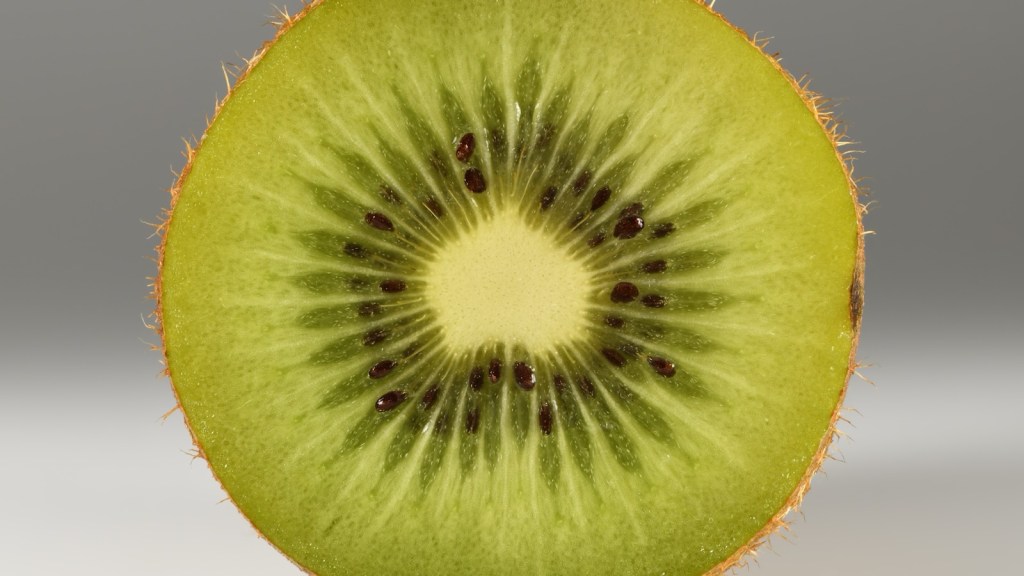
The best-supported of all kiwifruit benefits is also the least glamorous: staying regular. In a US comparative-effectiveness trial, eating two green kiwifruit a day eased chronic constipation about as well as psyllium and prunes over four weeks, but with the fewest side effects and the fewest dissatisfied patients (Trial). A larger international trial pushed the case further, with kiwifruit raising the number of complete, satisfying bowel movements more than psyllium, 1.69 versus 0.90 per week (Review). Everything else people hang on this fruit, better sleep, stronger immunity, a calmer mood, a healthier heart, is real but weaker: plausible signals rather than settled facts. The honest summary up front is that two kiwifruit a day is a cheap, low-risk habit with one well-proven benefit and a handful of promising extras.
What Two Kiwifruit Give You
A kiwifruit is not a fiber supplement in fruit form. It is a specific whole food whose parts happen to line up unusually well for digestion, and the variety matters. The common green type is the Hayward cultivar, tart and emerald-fleshed; the newer SunGold (gold) type is sweeter, smoother, and yellow inside. A standard serving in the research is about two fruit, the same dose used in the constipation trials.
The nutrient that jumps out is vitamin C. Green Hayward flesh carries roughly 85 mg per 100 g, Sweet Green about 150 mg, and SunGold about 161 mg (Study). In practice a single medium green kiwifruit supplies around 60 to 65 mg, most of an adult’s daily requirement (about 70 to 85 percent), so two green kiwifruit clear a full day comfortably, and one SunGold alone already exceeds it (Study).
Beyond vitamin C, the fruit brings a fiber matrix of soluble and insoluble parts, a high water content, the protein-digesting enzyme actinidin that is almost unique to kiwifruit, plus prebiotic oligosaccharides and polyphenols. Roughly 3 percent of the fruit is nonstarch polysaccharide, a blend of pectins, hemicellulose, and cellulose (Review). It is the way these pieces work together, not any single nutrient, that separates a whole kiwifruit from a generic scoop of fiber.
The Constipation Evidence
Start with the strongest study, because it is unusually fair-minded. A 2021 comparative-effectiveness trial in the American Journal of Gastroenterology randomized 79 adults with chronic constipation, each averaging three or fewer complete spontaneous bowel movements a week, to one of three natural remedies for four weeks: two green kiwifruit a day, 100 g of prunes a day, or 12 g of psyllium a day (Trial). All three worked. Each significantly raised the weekly rate of complete, satisfying bowel movements by weeks three and four. The difference was in the experience: side effects were most common with psyllium and least common with kiwifruit, and fewer people were dissatisfied with kiwifruit than with prunes or psyllium. Same result, gentler ride.
A second, larger trial replicated the core finding across countries. This international multicenter crossover study compared two green kiwifruit a day against 7.5 g of psyllium, each for four weeks, in healthy controls and in people with functional constipation or constipation-predominant IBS (Trial). Kiwifruit raised complete spontaneous bowel movements by a clinically meaningful 1.53 a week in functional constipation and 1.73 a week in IBS-C, while also improving general gut comfort. Pooling the two constipated groups, an American College of Gastroenterology evidence review reported kiwifruit ahead of psyllium head to head, 1.69 versus 0.90 extra bowel movements a week (Review).
Zoom out to the meta-analyses and the picture holds, with appropriate caution. A dedicated 2022 systematic review of seven randomized trials in 399 people concluded that kiwifruit may increase stool frequency, rated its effect comparable to psyllium, and found it reduced abdominal pain, though the certainty of the evidence was low to moderate (Meta-analysis). A separate 2022 meta-analysis that pooled every fruit tested for constipation singled out kiwifruit as one of the most consistent performers, significantly increasing stool frequency with zero heterogeneity between studies (Meta-analysis). None of this makes kiwifruit a drug. But for a whole food, two independent randomized trials plus converging meta-analyses is about as good as the evidence gets.
How Kiwifruit Gets Things Moving
Here is what keeps kiwifruit distinct from fiber as a nutrient. Its laxative effect runs on two mechanisms at once, and only one of them is fiber in the usual sense.
The first is water. The fruit’s fiber matrix has an unusually high water-holding capacity, roughly 1.5 times that of ispaghula (psyllium), the standard bulk laxative (Review). More water held in the stool means softer, bulkier, easier-to-pass motions. This is not just a lab measurement. A randomized MRI study in 14 healthy volunteers had them eat two green kiwifruit twice a day for three days, and the imaging showed markedly more water in the small bowel, more water in the ascending colon, and a larger colon volume compared with a calorie-matched control (Study). You can literally see the mechanism at work inside the gut.
The second mechanism is the enzyme. Actinidin, kiwifruit’s cysteine protease, stays active in the acid of the stomach and speeds things along. In a controlled feeding study in pigs, dietary actinidin sped gastric emptying, cutting the time for the stomach to half-empty and raising the rate at which proteins were broken down (Study). Because that work was done in animals, it is mechanistic support rather than proof in humans, but it fits the human data: a major review proposes that actinidin may activate motility signaling in the gut wall, moving contents faster through the small bowel and colon, while noting this motility effect is not yet fully characterized (Review). Water-holding fiber plus an active enzyme is a combination a fiber supplement simply cannot copy, and it is the best explanation for why the whole fruit outperforms its fiber content on paper.
The Sleep Signal
Kiwifruit’s reputation as a sleep aid rests on a single, much-cited study, and it is worth being honest about how thin that reed is. In 2011, researchers had 24 adults with self-reported sleep problems eat two kiwifruit one hour before bed every night for four weeks (Study). The before-and-after numbers looked striking: subjective sleep quality improved by about 42 percent, the time spent awake after first falling asleep dropped roughly 29 percent, the time it took to fall asleep fell about 35 percent, and total sleep time rose about 13 percent.
Impressive on the surface, but read the fine print. The study had no placebo and no control group; everyone ate kiwifruit and was simply compared with themselves. With only 24 people, almost all of them women, there is no way to separate the fruit from the placebo effect, from expectancy, or from the simple statistical pull of regression to the mean. That design makes the sleep result a hypothesis worth testing, not a proven benefit. If you enjoy a kiwi before bed, there is no harm in it, and it might help. Just do not mistake one uncontrolled trial for a reason to expect results.
Vitamin C, Immunity, and Mood
Two kiwifruit are a serious dose of vitamin C, and vitamin C is where the fruit’s non-digestive claims are least speculative. As noted above, a single green kiwifruit covers most of a day’s requirement and a SunGold covers all of it (Study). The interesting question is whether that dose does anything measurable inside the body.
For immunity, it clearly changes the raw material. When 14 young men with low vitamin C levels ate two SunGold kiwifruit a day for four weeks, their blood vitamin C nearly tripled, and, more tellingly, the vitamin C packed inside their neutrophils, the front-line immune cells that hunt bacteria, rose significantly too, alongside a roughly 20 percent improvement in those cells’ ability to move toward a target (Study). That is a plausible mechanism for better immune function, though the study measured cell behavior, not fewer colds, so the leap to real-world illness is still a gap.
Mood shows a similar pattern: real effects, mostly in people who start low. A 2025 randomized crossover trial in adults with mild-to-moderate mood disturbance found that two SunGold kiwifruit a day for 28 days cut total mood disturbance by about 65 percent and lifted vitality and wellbeing, more than their usual diet (Trial). An earlier placebo-controlled trial in young adults with low vitamin C found that two SunGold kiwifruit a day improved wellbeing and reduced fatigue, with the benefits strongest at two weeks and no longer statistically significant by the four-week mark, and appearing earlier and more broadly than the effects of plain vitamin C tablets (Trial). The honest caveats: these trials are small and mostly unblinded, and they say more about topping up a deficiency than about boosting an already-healthy person. Kiwifruit may support mood and immunity, especially if your vitamin C is low, but the clinical payoff is still being pinned down.
Hints for Heart and Iron
Two smaller threads round out the picture, both promising and both preliminary. On the cardiovascular side, an early randomized crossover trial had 30 healthy volunteers eat two or three kiwifruit a day for 28 days (Trial). Platelet stickiness, a factor in clot formation, dropped about 18 percent, and blood triglycerides fell about 15 percent, with no change in cholesterol. A later systematic review restated that same 15 percent triglyceride figure from the original trial, though its own pooled analysis of all kiwifruit studies found no statistically significant effect on triglycerides (Meta-analysis). It is a genuinely interesting signal, but the sample was small and the people were already healthy, so this is a hint about risk markers, not evidence about heart attacks.
Iron is the tidier story, because the mechanism is textbook. Vitamin C sharply boosts absorption of the non-heme iron found in plants and fortified foods, and kiwifruit is loaded with it. In a 16-week randomized trial, 89 women with low iron stores added either two gold kiwifruit or a banana to an iron-fortified breakfast cereal (Trial). The kiwifruit meal delivered 164 mg of vitamin C versus almost none from the banana, and the kiwifruit group saw their iron stores rise substantially, with ferritin climbing far more than in the banana group and a blood marker of iron shortage falling, both pointing to genuinely better iron status. For anyone prone to low iron, pairing a vitamin-C-rich fruit like kiwi with an iron source is a small, evidence-backed trick.
Frequently Asked Questions
Which kiwifruit benefits have the strongest evidence?
Digestion, by a wide margin. Two randomized controlled trials and a dedicated systematic review agree that eating two green kiwifruit a day increases the frequency of complete bowel movements and eases constipation, on par with psyllium and with fewer side effects (Meta-analysis). The other kiwifruit benefits, for sleep, immunity, mood, heart, and iron, rest on smaller or weaker studies and are best treated as promising rather than proven.
How many kiwifruit should I eat a day for constipation?
The dose used in the trials is two green kiwifruit a day, eaten with the meal of your choice. That amount matched or beat psyllium and prunes for chronic constipation in a head-to-head trial (Trial) and raised complete bowel movements in a second international trial (Trial). There is no evidence that eating more than two adds further benefit.
How fast does kiwifruit work for constipation?
Give it a few weeks rather than a few hours. In the comparative-effectiveness trial, the significant improvement in bowel-movement frequency was measured over weeks three and four of daily kiwifruit (Trial). Some people notice softer, easier stools sooner, but the studied effect comes from a steady daily habit, not a same-day laxative.
Are green or gold kiwifruit better?
It depends on the goal. The constipation trials used green (Hayward) kiwifruit, so that is the type with direct evidence for regularity (Trial). Gold (SunGold) kiwifruit carries more vitamin C, about 161 mg per 100 g versus 85 mg for green, so it edges ahead for immunity, mood, and iron-absorption purposes (Study).
Can kiwifruit help you sleep?
Possibly, but the evidence is weak. The one widely cited study found that two kiwifruit an hour before bed improved sleep over four weeks, yet it had no placebo group and only 24 participants, so it cannot rule out the placebo effect (Study). It is a harmless thing to try, just not something to count on.
Key Takeaways
- Regularity is the proven benefit. Two green kiwifruit a day matched psyllium and prunes for chronic constipation with the fewest side effects and least dissatisfaction (Trial), and beat psyllium on bowel-movement frequency in a second trial, 1.69 versus 0.90 a week (Review).
- The mechanism is fiber plus an enzyme. Kiwifruit’s fiber holds about 1.5 times more water than psyllium (Review), MRI confirms it adds water and volume to the gut (Study), and the enzyme actinidin appears to speed transit.
- Two fruit are a full day of vitamin C. Green kiwifruit carries about 85 mg per 100 g and SunGold about 161 mg, so two cover the daily requirement easily (Study).
- The sleep claim is a hypothesis. The single supporting study had no placebo and just 24 people, so better sleep remains unproven (Study).
- Heart and iron are promising hints. Two to three kiwifruit a day nudged triglycerides and platelet stickiness down in healthy volunteers (Trial), and gold kiwifruit improved iron status in women with low stores (Trial).
The Kiwifruit Benefits Worth Trying
Strip away the hype and kiwifruit lands in a rare, honest place: a cheap whole food with one solidly proven benefit and several plausible extras still being studied. If you struggle with regularity, the digestion evidence is strong enough to act on today, and gentler than the usual fiber supplements. If you are hoping for better sleep, a stronger immune system, a brighter mood, or a healthier heart, treat those as welcome maybes rather than reasons to buy a case of them. The downside is close to nonexistent: two kiwifruit are tasty, affordable, and about as low-risk as an intervention gets.
So it is an easy experiment to run on yourself. Eat two green kiwifruit a day for a month and see what your gut does. The evidence is still building, but the digestion case is already strong.
This article is for educational purposes and is not medical advice. Talk to a qualified clinician before changing your health regimen.


Leave a Reply