Eight trials have tested saffron for depression against an SSRI. Depression scores fell by about the same amount in both groups, and the saffron users reported fewer side effects, roughly 6 fewer per 100 people (Meta-analysis). Those trials were small and short, and nearly all of them ran in Iran. A trial that small can only spot a big difference. So these results leave the question open. The dose tested was 30 mg a day of a standardized extract, taken for six to eight weeks (Meta-analysis).
What Saffron Actually Is
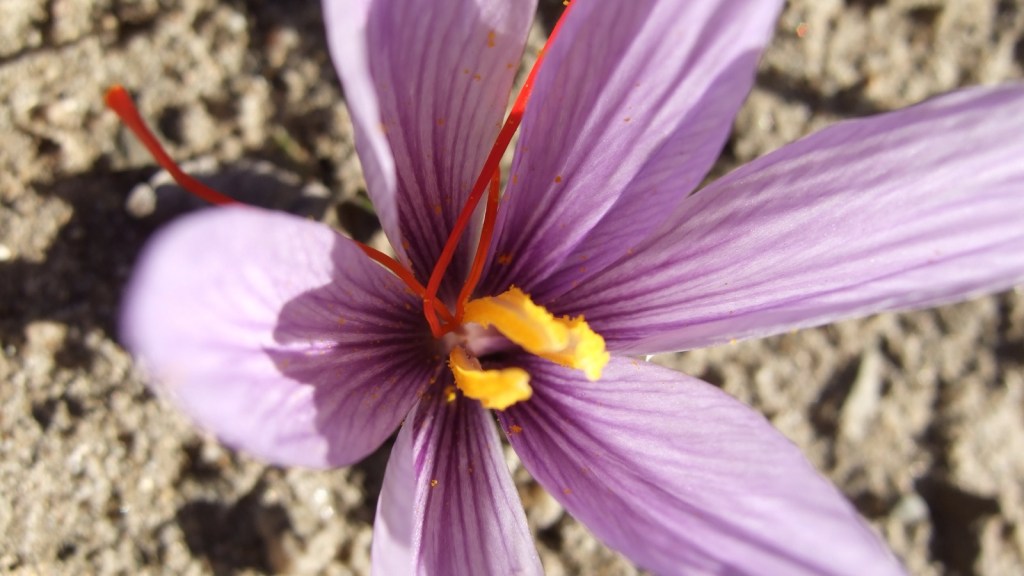
Saffron is the dried red thread inside a purple crocus flower. Each flower gives three of them, and every one is picked by hand. That is why it costs more per gram than any other spice.
Two compounds get the credit for the mood effect. Crocin gives saffron its color, and safranal gives it its smell. They are its best studied active parts (Review), and supplement makers measure them to set the strength of an extract (Study).
The trials do not use a pinch from the spice rack. They use a standardized extract in a capsule. Almost every depression trial has used 30 mg a day, split into two or three doses, for six to eight weeks (Meta-analysis). A 2025 review in the journal Cureus describes the same protocol (Review).
So this is a food compound tested at a drug-like dose. Cooking with saffron will not give you 30 mg of extract.
These two herbs often get lumped together. Saffron is being tested on the serotonin side of mood (Review), while Ashwagandha is tested on the stress-hormone side, for cortisol and sleep. Their safety warnings differ too, so one does not stand in for the other.
How Saffron Reaches The Brain
Saffron appears to act on serotonin, the same broad target SSRIs act on. The idea is that it slows serotonin’s removal from the gap between brain cells, so more of it stays available. A systematic review lists that alongside antioxidant, anti-inflammatory, hormone and brain-cell-protecting effects (Review).
That review split its evidence in two. Clinical trials supplied the effects, while animal and test-tube studies supplied the mechanism (Review). Its authors describe the serotonin action with the word “potentially”. Nobody has measured it in a living human brain.
Two human trials did look for biological change. One tracked inflammation markers and the stress-hormone response in 51 adults over six weeks. Both stayed where they started, and so did mood (Trial). Another added saffron to fluoxetine for four weeks in 40 people with major depression. A blood marker called homocysteine fell in the saffron group, and not in the group on fluoxetine alone (Trial). Mood improved in both groups by a similar amount.
The mechanism is the weakest part of the case. It offers a plausible explanation for the trial results, but it is not proof that saffron works.
Saffron For Depression Vs SSRIs
The first head-to-head trial ran in 2004, and its authors called it a pilot. Thirty outpatients with mild to moderate depression were sorted by coin flip into two groups of 15. One group took saffron extract, 10 mg three times a day. The other took imipramine, an older antidepressant, at 100 mg a day. After six weeks the two groups scored about the same, and the gap between them was small enough that chance could explain it (Trial).
The side effects did differ between the groups. Dry mouth hit 7 of the 15 people on imipramine, against 1 of the 15 on saffron. Six people on the drug felt sedated, and none on saffron did (Trial). Those are the effects an older drug of that class is expected to cause.
The trial had no dummy-pill group, which its authors list as their first limitation (Trial). So it cannot show that either treatment beat doing nothing.
A 2005 pilot swapped in a modern SSRI. Forty outpatients took either saffron at 30 mg a day or fluoxetine at 20 mg a day, again for six weeks. The two groups ended up about the same, and side effects were similar (Trial). With 40 people, only a large difference would have shown up.
A third trial picked a harder group: 40 people who had recently had a stent placed in a coronary artery. They took saffron at 30 mg a day, or fluoxetine at 40 mg a day, for six weeks. Depression scores fell by similar amounts in both groups. So did the share of people who responded and got well (Trial).
In 2025, researchers pooled eight of these head-to-head trials. Saffron and the SSRIs came out level on depression scores. Four of the trials also measured anxiety, with the same result. The saffron groups reported fewer side effects, about 6 fewer per 100 people (Meta-analysis). Side-effect counts from small trials are the shakiest part of that analysis.
A level result like that is easy to over-read. A trial with 40 people can only detect a large gap, and anything smaller disappears into the noise. So a tie in a small trial mostly tells you the trial was too small to separate the two treatments.
In these trials, saffron kept pace with an antidepressant on the scores the researchers measured. Keeping pace in a small trial is not the same as working as well. A second pooling, limited to mild and moderate depression, put the two treatments close together. That result sat right at the edge, where chance could still explain it (Meta-analysis).
Beating A Dummy Pill
The newest data pulls in two directions at once. The first pooling, in 2013, found five blinded trials in adults with major depression, 177 people in total (Meta-analysis). Against a dummy pill, saffron came out well ahead, though only two of those five ran that comparison. Against antidepressants the trials were too small to show a difference (Meta-analysis). Two of that paper’s authors advised a company selling saffron products.
A bigger 2019 review gathered 23 trials. Saffron beat a dummy pill on depression scores across 14 of them, covering 716 people, and on anxiety scores across six more. It also helped when added on top of an antidepressant, in four trials (Meta-analysis). Five trials put saffron against an antidepressant, and the two finished level.
Then came the biggest trial yet. In 2025, 202 adults with low mood took 28 mg a day of a standardized extract, or a dummy capsule, for 12 weeks. About 72 in every 100 on saffron reached a meaningful drop in symptoms, against about 54 in every 100 on the dummy (Trial). The authors reported no serious side effects. It ran in Australia, which helps, because most of the older work is Iranian.
Two things temper it. The company that makes the extract paid for the study, and two authors work there. The lead author runs the research firm that ran it (Trial). Nutrition researcher Marion Nestle filed it under her industry-funded study of the week, and calls it marketing research (Commentary). The dummy group also improved a lot, which the authors flag as a problem for future trials (Trial).
A counterweight arrived the same year. A French team gave 51 healthy adults 30 mg a day of saffron extract or a dummy for six weeks. These people had mild symptoms, below the line for a diagnosis. The two groups’ scores were too close to tell apart on the main measure, and on depression, anxiety and fatigue (Trial). One self-rated measure of mental health did tip toward saffron, and the authors call that finding unconfirmed.
Both groups improved by a similar amount (Trial). That improvement came from time and expectation, not from saffron. It is one small trial, so it does not close the question.
The authors offer a simple explanation for their result. Saffron may do more for people with real symptoms than for people whose mood is already close to fine (Trial).
Why The Evidence Stays Thin
Four flaws sit under all of this. None of them makes saffron useless, but together they mean the benefit is probably smaller than the headlines suggest.
First, the trials are small and short. In the original set, the biggest comparison had 38 people, and none ran past eight weeks (Meta-analysis). Nobody knows whether the effect holds at six months.
Second, nearly all the early work came out of Iran, often from overlapping research groups. In the 2019 review, 21 of the 23 trials were Iranian and 13 came from a single group (Meta-analysis). The 2013 reviewers asked outright for trials run by teams outside Iran (Meta-analysis). A 2025 review repeats the point, and concludes that saffron should not yet replace first-line depression treatment (Review).
Third, the disappointing studies were probably never published. The 2019 review ran a formal test for that and found the pattern (Meta-analysis). When the failures go missing, what is left looks better than the truth.
Fourth, the funding. The biggest positive trial was paid for by the extract’s maker, and two of its authors work there (Trial). That does not make its numbers wrong. It does mean an independent team needs to repeat it.
A fifth problem is odder than the rest. The answer changes depending on who fills in the questionnaire. An umbrella review pooled seven earlier meta-analyses. Saffron moved the score patients gave themselves, while the score a clinician gave after an interview stayed put (Umbrella review). A 2026 pooling of 34 trials in 1,769 people found the same split, and the studies disagreed with each other a great deal (Meta-analysis).
One trial flips that around. In it, 160 adults already on an antidepressant took 28 mg of saffron or a dummy for eight weeks. The clinician’s rating improved about twice as much in the saffron group. On the patients’ own version of the same scale, the two groups were identical (Trial). The authors call their own results conflicting.
The umbrella reviewers reach a modest conclusion. Saffron may help ease depression symptoms, and they frame it as an add-on rather than a treatment on its own (Umbrella review).
Dose, Safety, And Real Saffron
Trials used 30 mg a day of a standardized extract (Meta-analysis), and the largest used 28 mg (Trial). Give it six to eight weeks before judging it. No trial has tested a cooking pinch, so nobody knows what that does.
Saffron is toxic in gram amounts, though cooking with it is fine. One review points to figures from the older literature (Review). A dose near 10 g may end a pregnancy, and near 20 g may be lethal. That is hundreds of times a 30 mg capsule, so a supplement dose is not the worry here. The lesson is to leave the dose alone rather than raise it on a hunch.
Skip saffron supplements entirely in pregnancy. In one small study, miscarriage was more common among women who worked in saffron harvest fields. The suspected route is contraction or bleeding in the womb (Review). Those women had far heavier exposure than a capsule gives. This is still the right place to be careful.
At the doses the trials used, side effects were mild. They were about as common as on a dummy pill: dry mouth, nausea, headache, less appetite (Review). A 2026 review of 102 trials put the overall rate near 17 in every 100 people, mostly minor stomach upset that settled by itself (Review). Its authors still advise monitoring at higher doses or with longer use.
Never add saffron to an antidepressant on your own. Saffron is thought to act on the same serotonin system as the drug (Review). Trials have combined the two under supervision. In 38 women taking fluoxetine, adding 30 mg a day for four weeks brought no more side effects than a dummy (Trial). That trial was small and short, so it cannot rule out rarer problems. A combination you set up yourself would have no supervision, so ask a clinician first.
One last problem matters most to a shopper. Saffron is the most faked spice in the world. A 2025 review of 23 studies estimated that 20 to 30 in every 100 commercial samples are adulterated (Review). Substitutes included safflower, marigold and turmeric, and some samples held industrial dyes. Rates ran from under 4 in 100 in regulated European markets to 60 in 100 in India.
Supplements are not exempt. A lab tested 17 saffron supplements bought in Spanish shops, pharmacies and websites. The contents did not match the label in about two thirds of them (Study). One product held neither crocin nor safranal.
So check that someone has measured what is in the jar. The price per milligram means little if the powder is dye.
Frequently Asked Questions
Does saffron for depression work as well as an SSRI?
Nobody can say that yet. Eight trials compared the two, and the depression scores came out level, with fewer side effects on saffron (Meta-analysis). Those trials had roughly 30 to 40 people each and ran six weeks, which is too small to prove two treatments equal (Meta-analysis). A 2025 review says plainly that saffron should not yet replace first-line treatment (Review).
How much saffron should I take for mood?
The trials agree closely on this. They used 30 mg a day of a standardized extract, split into two or three doses (Meta-analysis). The largest trial used 28 mg a day, as 14 mg twice (Trial). More is not better here, and gram amounts are dangerous (Review).
Can I take saffron with my antidepressant?
Only with your clinician’s agreement. Saffron may act on the same serotonin system your medication targets (Review), so it is not something to try alone. Small trials have run the combination safely under supervision, including 30 mg a day added to fluoxetine for four weeks (Trial). Never stop or change a prescription on your own.
How long does saffron take to lift mood?
Plan on six to eight weeks, which is what the depression trials allowed (Meta-analysis). The largest trial ran 12 weeks (Trial). Whether the benefit lasts beyond that is unknown, because almost no trial has followed people further (Review). In one trial of people with only mild symptoms, six weeks changed nothing measurable (Trial).
Key Takeaways
- The head-to-head trials came out level. Eight trials found the same drop in depression scores for saffron and SSRIs, with fewer side effects on saffron (Meta-analysis). Trials of 30 to 40 people cannot prove two treatments equal.
- It beat a dummy pill in people who had real symptoms. Among 202 adults over 12 weeks, about 72 in every 100 improved meaningfully on saffron, against 54 in every 100 on the dummy (Trial).
- In people with only mild symptoms, little happened. Six weeks at 30 mg a day moved no depression, anxiety or fatigue score in 51 adults (Trial).
- The dose is settled, the duration is not. Trials used 28 to 30 mg a day for six to eight weeks (Meta-analysis). Longer-term data barely exists (Review).
- Discount the headline benefit. The disappointing studies were probably never published (Meta-analysis). An umbrella review frames saffron as an add-on, not a treatment on its own (Umbrella review).
- Three safety lines worth remembering. Gram doses are toxic and can end a pregnancy (Review), so avoid saffron supplements while pregnant (Review). Never add it to an antidepressant without a clinician.
A Spice Worth Watching Closely
Very few kitchen-shelf compounds have been tested against a prescription drug. Saffron has, several times over, and it kept up on the scores those trials measured. On the evidence so far it looks like a modest, real help for mild to moderate low mood, in people who actually have symptoms.
That is not the same as a replacement for treatment. The trials are small, the research comes from a narrow set of groups, and the funding is not always clean. The reviewers who know this field best say to use saffron alongside proper care, not instead of it (Umbrella review). If your mood has been low for weeks, talk to a clinician rather than a shop assistant.
If you do try it, buy from a seller who publishes lab results, take 30 mg a day, and give it two months before deciding. Then read the studies above and judge them yourself.
The evidence here is still being built, and it is worth watching.
This article is for educational purposes and is not medical advice. Talk to a qualified clinician before changing your health regimen.
 Bio-Hacking.Blog
Leave a comment