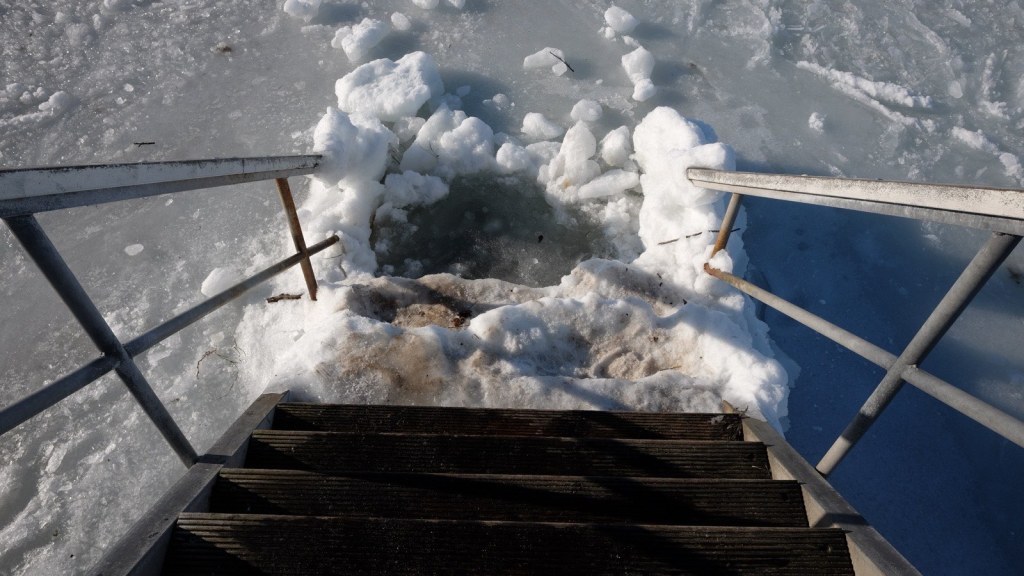
Taking a cold plunge after workout sessions may cost you a little muscle. It will not wipe out your gains. In one 12-week trial, lifters who plunged after every session put on about 100 grams of thigh muscle. Lifters who rode an easy bike for those same minutes put on about 300 grams, and got stronger too (Trial). Across 8 trials and about 116 people, the shortfall looks small. It also shows up only when the water comes minutes after the last set (Meta-analysis).
What a Cold Plunge Does
Cold water immersion is the kind of cold that researchers actually test. In the muscle trials it means water at roughly 10 to 15 degrees Celsius, for 10 to 20 minutes. How much of the body goes under varies a lot. Of the 8 muscle-growth trials, three dunked the whole body and two the legs. The other three chilled only the trained forearm. All of them started the cold within 15 minutes of the last set (Meta-analysis).
The body reacts fast. Blood vessels near the skin narrow, and blood moves away from the muscle you just worked. In one study the cooled leg sat about 5 degrees colder than the other leg right after the bath. Two hours later the two legs matched again (Trial).
Swelling goes down with it, and so does next-day soreness (Meta-analysis). That is the entire appeal of an ice bath.
It is also the problem. The swelling and mild inflammation after a hard set are not damage waiting to be mopped up. They are part of the message that tells the muscle to rebuild bigger.
The dose matters here. This is not a 30 second blast at the end of a shower, and a cryotherapy booth is a different question. The trials that raised the alarm all used a real tub of cold water and a stopwatch.
The 12-Week Lifting Trial
The study behind the scare came out of Australia and Norway in 2015 (Trial).
Twenty-one active men trained their legs twice a week for 12 weeks. A coin flip decided their recovery. Half sat waist-deep in 10 degree water for 10 minutes after every session. The other half spent those 10 minutes on an easy bike. Nobody was allowed a warm shower for two hours afterwards.
After 12 weeks the gap was clear. The easy-cycling group added about 300 grams of thigh muscle. The cold group added about 100 grams. Leg press and knee extension strength both improved more with easy cycling.
The researchers also took small muscle samples, and that is where the useful part sits. Muscles grow partly by calling in satellite cells, the repair cells parked alongside each fibre. After easy cycling, those cells turned up in numbers over the following two days. After the cold plunge they arrived late, or not at all. The growth switch inside the muscle also shut off sooner (Trial).
The same paper ran a second, shorter experiment to catch that happening. Nine active men did a single leg session, then either cold water or an easy spin. Muscle samples came back at 2, 24 and 48 hours. The repair-cell response climbed over two days after easy cycling. After the cold plunge it was smaller and came later.
The scale of this study matters. It is 21 young men in one lab, and nine more in the follow-up. Everyone knew which recovery they were doing. Every single session ended in cold water for three months, and almost nobody trains that way. The authors kept their own conclusion measured. They wrote that using cold water as a routine recovery habit should be reconsidered.
How Big Is the Hit
A 2024 review pooled every controlled trial on the question (Meta-analysis). It found 8 trials holding about 116 people, and 7 of the 8 studied men only. Muscle growth came out slightly lower with cold water. The gap was small enough that chance could still explain it. Read it as a likely dent rather than a settled one.
The authors were blunt about quality. On a scoring tool built for lifting studies, none of the 8 rated good. Three were fair and five were poor. A general checklist was kinder to them. Either way, the authors tell readers to treat the finding with caution.
The shape of that result matters. Lifting on its own produced clear growth across the trials. Lifting plus a cold plunge produced growth that was small at best (Meta-analysis). Nobody went backwards. People simply gained less than they could have.
The trials disagree about strength, which matters if strength is your goal. One 7-week trial put 16 men through three sessions a week. Each session ended with 15 minutes at 10 degrees. Their muscle fibres grew less than the comparison group’s, while their leg press strength improved just as much (Trial). The same trial found the growth signal blunted and a marker of muscle breakdown raised. With 8 men per group, those numbers are rough.
Other pooling comes out darker. A 2021 review looked at people who plunged regularly during a training programme. Their strength gains were dragged down, and the signal for explosive power was weaker (Meta-analysis).
A third review may explain the split. It pooled 10 studies in 170 people, nearly all of them men. The strength penalty showed up mainly in trials that chilled only the trained arm or leg. Whole-body immersion, which is what a real plunge is, showed no clear strength cost (Meta-analysis). The two sets of trials were never tested head to head, so treat that as a hint.
So the honest reading is narrow. Size takes a small hit. Strength may or may not, and it seems to depend on how you get cold.
Why Cold Mutes the Signal
For several hours after a hard session, your muscle turns protein from food into new muscle protein faster than usual. That raised rate is where growth actually happens.
Cooling lowers it. In a neat one-leg study, 12 active young men trained, then put one leg in 8 degree water and the other in warm water. Both legs got the same protein drink afterwards. Over the next 5 hours, the cooled leg built about 20% less new muscle protein. Across two weeks of training it stayed about 12% behind (Trial).
A 2025 follow-up showed the plumbing behind that. After cooling, blood volume in the muscle’s smallest vessels dropped, and it was still low three hours later. About 30% less of the amino acids from the drink ended up built into muscle (Trial). The legs with the biggest fall in blood flow tended to be the legs that built the least. That fits a simple delivery problem: less blood flow, less arriving, less building.
That is oddly reassuring. Nothing is being damaged. The food you ate simply arrives at a muscle that has closed its doors for a while.
Anti-inflammatory pills do something similar, which is what makes the rule stick. In an 8-week training trial, 31 young adults took either the maximum over-the-counter dose of ibuprofen every day, or a low daily dose of aspirin. Thigh muscle grew about twice as much in the aspirin group (Trial).
Dose may matter more than the drug itself. In a separate 6-week trial, 18 adults trained both arms. They took 400 mg of ibuprofen after training one arm and a dummy pill after the other. Muscle size and strength came out the same on both sides (Trial). That daily dose was a third of the one used in the 8-week trial. The pill works body-wide, though, so the dummy arm was never a clean control. And no trial has compared the two doses head to head. When the same research team went hunting for the mechanism, the usual growth machinery looked untouched (Trial). Inflammation is clearly part of the growth signal. Exactly how it works is still open.
Either way, the muscle you build is worth protecting. Even a modest weekly dose of strength training tracks with living longer.
When Cold Still Earns Its Place
Cold is not the villain in this story. Point it at the right session and it may cost you nothing.
Endurance gains appear to survive it. The same 2021 review that found strength dragged down found no detectable effect on aerobic power or time-trial results (Meta-analysis). That half rested on a handful of trials, so it rules out a big loss rather than proving none.
A separate trial points the same way. Nineteen men did one sprint interval session, and 16 of them trained that way for six weeks. Each session was followed by 15 minutes at 10 degrees, or by a rest in a warm room. Aerobic capacity, peak power and 2 km time-trial results all improved. The cold group gained as much as the rest (Trial).
Then there is the reason people plunge in the first place. Pooling 30 trials in 527 people, cold water cut next-day soreness. It also lowered a marker of muscle damage, compared with simply sitting still (Meta-analysis). A second pooled analysis of 20 trials found the same drop in that marker a day later (Meta-analysis). The soreness result is the sturdier of the two. The authors found signs that some disappointing damage-marker studies never got published.
That is worth real money in the right week. During a tournament, or three matches in eight days, tomorrow matters more than next month.
Cold has clear limits here too. Those same pooled trials also measured next-day jump height and top strength. Cold water gave no measurable boost to either. Straight after getting out of the water, jump performance was actually worse (Meta-analysis). A bigger review of 55 trials looked at dose. It did find a modest jump benefit at 10 to 15 minutes in 5 to 15 degree water, pooling tests taken within two days (Meta-analysis). So this part is genuinely contested.
Regular cold water does not appear to boost endurance either. It raises some of the cell-level markers linked to aerobic fitness. The fitness tests themselves do not follow, and aerobic capacity and time-trial results stay where they were (Review). For endurance athletes, the case for cold is comfort and recovery. It will not make you fitter by itself.
Reviewers of the field suggest treating cold like any other training variable. Keep it in competition blocks and endurance blocks. Skip it after sessions meant to build size (Review).
None of this touches the other reasons people get in cold water. The mood and alertness claims around cold water immersion are thinner than the hype suggests, and they run on their own clock. A morning plunge sits nowhere near an evening lift.
Cold Plunge After Workout Timing
The fix is scheduling. You do not have to give the cold up.
Put hours between your last set and the water. Plunge on rest days. Plunge in the morning before an evening lift. Plunge after easy cardio, where the evidence suggests nothing is lost.
In a normal training week that is easy to arrange. Lift on Monday, Wednesday and Friday evenings, and take the plunge on Tuesday and Saturday mornings. Or plunge before breakfast every day and lift after work. Neither version asks you to give anything up. Both put a long gap between the barbell and the cold.
Every trial that found blunted growth started the cold within 15 minutes of finishing. The review authors say their result applies only to that window. Whether a longer gap changes anything is unknown, and so is plunging on some days only (Meta-analysis).
The popular “wait four to six hours” rule is a convention rather than a finding. Two sports medicine doctors writing for the American College of Sports Medicine describe it as a shift people made to sidestep the problem. They note that few studies have looked at timing at all. Delayed plunges still helped recovery, just less than immediate ones (ACSM).
The mechanism gives a rough shape. Muscle temperature is back to normal within about two hours (Trial). The raised building rate runs on for hours after that. So more separation is better, and a plunge the next morning sits well clear of it. The exact number of hours is reasoning, not a tested result.
Dose deserves the same honesty. The growth review only counted immersion studies, so a cold shower has never been put to this test. Every trial in it used a tub, 10 minutes or longer, at roughly 10 to 15 degrees (Meta-analysis). A 60 second cold shower is a far smaller dose of cold.
And if you lift for health rather than maximum size, this whole question is small. A 200 gram difference in thigh muscle over 12 weeks is not what stands between you and your goals.
Frequently Asked Questions
Does a Cold Plunge After Workout Ruin Muscle Growth?
No, but it may shave a little off. Across 8 trials and about 116 people, muscle growth was somewhat smaller when cold water followed lifting straight away (Meta-analysis). The strongest single trial found about 100 grams of muscle gained over 12 weeks, against about 300 grams with easy cycling (Trial). Nearly all the people studied were young men, and the trials were rated fair to poor.
How Long Should I Wait to Cold Plunge After Lifting?
Nobody has run the trial that answers this. What is known is that the blunting was measured when the water came within 15 minutes of the last set (Meta-analysis). Muscle temperature returns to normal in about two hours, while muscle building stays raised for hours longer (Trial). Several hours of separation is a reasonable guess, not a tested number.
Is a Cold Shower as Bad as an Ice Bath?
There is no evidence either way. The muscle-growth review only included immersion studies, so no trial in it tested a shower (Meta-analysis). Those trials used 10 minutes or more at around 10 to 15 degrees Celsius. A short cold shower delivers far less cooling, so it seems unlikely to matter in the same way.
Does Cold Water Hurt Running or Cycling Gains?
It does not appear to. Pooled trials of regular cold water found no detectable effect on aerobic power or time-trial performance (Meta-analysis). A six-week sprint trial in 16 men pointed the same way, and the aerobic gains arrived whether or not the men plunged (Trial). These trials are small, so they rule out a big loss rather than a slight one.
Should I Cold Plunge Before a Workout Instead?
Plunging beforehand sidesteps the concern, since the issue is chilling the muscle during its repair window. No trial has tested that order for muscle growth, so treat it as reasoning. One thing to avoid is plunging right before a jumping or sprinting session. Jump performance measured straight after the water was worse (Meta-analysis).
Key Takeaways
- The effect is real but small. Across 8 trials and about 116 people, plunging right after lifting left people with slightly less muscle. The trials were small, mostly young men, and rated fair to poor (Meta-analysis).
- Size takes the hit more than strength. In one 7-week trial, muscle fibres grew less with cold water, while leg press strength improved just as much (Trial).
- The mechanism is slower muscle building. Cooling one leg after training cut the rate of new muscle protein by about 20% over the next 5 hours (Trial).
- Endurance training looks unaffected. Pooled trials found no detectable effect on aerobic power or time-trial results, and a six-week sprint trial agreed (Meta-analysis).
- Timing solves it. Every trial showing blunted growth chilled people within 15 minutes of the last set, so put hours or a day between the two (Meta-analysis).
- Competition weeks are the case for cold. Cold water lowers next-day soreness, which is what matters when you compete again tomorrow (Meta-analysis).
Cold Water, Timed Right
Cold water is not the enemy of muscle. The timing of it is what matters.
If you lift for size, keep the plunge away from the session itself. Rest days work well, and so do mornings before an evening lift. Save the post-session ice bath for the weeks when tomorrow’s performance counts most. A tournament or a race block is exactly that.
The evidence here is thin, mostly young men, and mostly short trials. That is worth saying plainly rather than dressing up. What it does support is a small change to your calendar, and it costs you nothing to make. Keep the cold water, and just move it away from the barbell.
This article is for educational purposes and is not medical advice. Talk to a qualified clinician before changing your health regimen.


Leave a Reply