Red yeast rice is not automatically safe. It lowers cholesterol because it contains a statin, and the bottle may not hold what its label says. In a review of 20 trials, it cut “bad” LDL cholesterol by about 39 mg/dL compared with a dummy pill (Meta-analysis).
Its main compound, monacolin K, is the same molecule as the drug lovastatin. So it carries the usual statin risks to muscles and liver (EFSA opinion). Japan’s 2024 beni-koji scandal showed a second risk: what else is in the bottle. A survey there gathered 192 patients with kidney injury linked to those contaminated pills. More than 9 in 10 had low kidney function when first seen (Study).
What Is Red Yeast Rice?
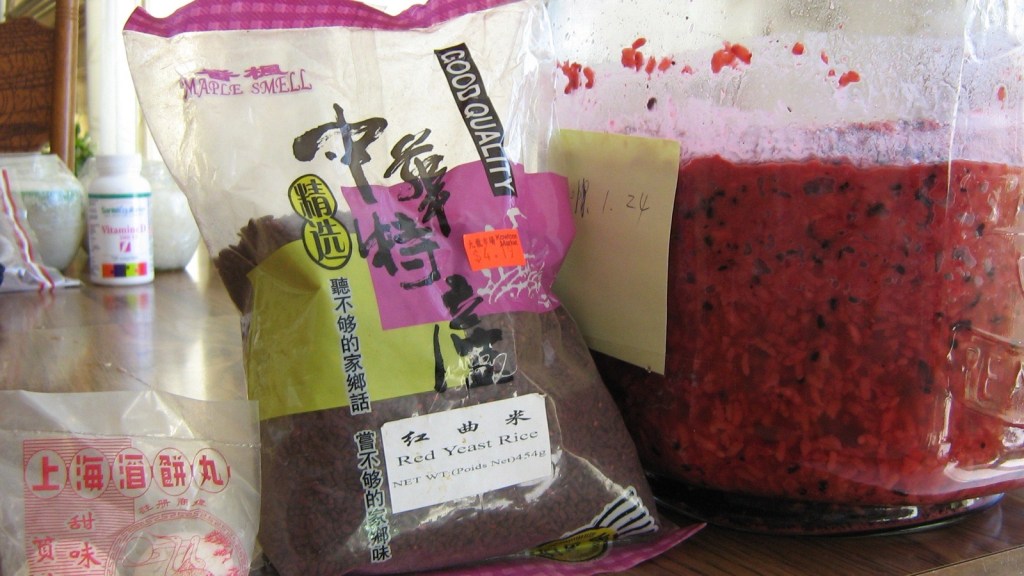
Red yeast rice is ordinary rice fermented with a mold called Monascus purpureus. The mold stains the grains a deep red. People in China and Japan have long used it to color and season food. In Japan it is called beni-koji.
As the rice ferments, the mold makes a family of compounds called monacolins. The main one, monacolin K, is chemically identical to lovastatin, a prescription statin (EFSA opinion). Statins lower cholesterol by slowing an enzyme the liver uses to make it. That is how red yeast rice lowers cholesterol too.
In other words, red yeast rice contains a real statin. Some supplements deliver monacolin K in the range doctors prescribe as lovastatin (EFSA opinion). Unlike a prescription, though, nobody sets the dose. Monacolin levels are not standardized, so they change from one product to the next (Study).
Does It Lower Cholesterol?
Yes, and by a useful amount. A 2015 review combined 20 trials that decided by coin flip who got red yeast rice and who did not. In every one, the amount of monacolin K in the product was known. Against a dummy pill, red yeast rice lowered LDL, the “bad” cholesterol, by about 39 mg/dL (Meta-analysis). In trials that compared it with a statin, LDL dropped by about the same amount.
One trial tested it directly against a statin in 43 adults. All of them had quit a statin before because of muscle pain. Over 12 weeks, LDL fell 30% on red yeast rice and 27% on pravastatin, a prescription statin (Trial). Only 1 of 21 people on red yeast rice quit for muscle pain, against 2 of 22 on pravastatin. That gap is small enough that chance could explain it. Both groups also followed a lifestyle program, and the trial was small and short.
A 2022 review of 15 high-quality trials also found it about as good as statins at lowering LDL (Meta-analysis). But only three of those trials compared it directly with a statin. None ran longer than 24 weeks.
The strongest evidence comes from a large trial in China. It enrolled 4,870 Chinese adults who had already survived a heart attack (Trial). On top of their usual care, they took either a dummy capsule or Xuezhikang, a partly purified red yeast rice extract. Researchers followed them for about 4.5 years on average (Trial).
About 6 in every 100 people on the extract had another heart attack or died of heart disease. On the dummy pill, it was about 10 in every 100 (Trial). Deaths from any cause fell too: about 5 in every 100 on the extract, against about 8 in every 100 on the dummy pill (Trial).
Each 300 mg capsule in that trial held 2.5 to 3.2 mg of lovastatin. It also held other compounds that have not been fully identified (Trial summary). So the trial tested one extract with a stated lovastatin content. Shop supplements vary far more in strength, as the testing below shows (Study).
The Statin Inside the Pill
Because red yeast rice contains a statin, it can cause the same harms as statins. A US National Institutes of Health fact sheet lists muscle, kidney and liver damage for products high in monacolin K (Fact sheet).
In the trials, those problems were uncommon. A 2019 review combined 53 trials with 8,535 people. Muscle problems were no more common on red yeast rice than in the comparison groups (Meta-analysis). Other side effects were less common on red yeast rice, and so were serious ones. The authors say this held when they split the trials by daily monacolin dose.
A 2024 review looked at 15 such reviews, covering 164 separate trials. The only warning signs it found were rises in two liver enzymes and in uric acid (Review). But it rated 12 of the 15 reviews as critically low in quality. It judged the evidence as a whole to be weak.
Italy’s watch system for natural health products logged 55 reactions to red yeast rice between 2002 and 2015 (Study). Twenty involved muscle pain or signs of muscle damage. One of those was rhabdomyolysis, a severe breakdown of muscle. Ten involved liver injury. Of the 52 reports, 14 were serious. Thirteen of those needed hospital care.
Most of those products supplied 3 mg of monacolin K a day. In about 3 in 4 reactions, symptoms got better once people stopped the product. The authors say these reports suggest red yeast rice may carry the same risks as statins, which needs more study (Study). They also note that many reactions go unreported. So reports like these cannot show how often harm happens.
In 2018, the European Food Safety Authority noted severe reactions reported at intakes as low as 3 mg of monacolins a day (EFSA opinion). It called 10 mg a day a significant safety concern. It could not name any daily amount that raised no health concerns. The products in those reported cases held other ingredients too. But the same muscle effects have also been reported after monacolin K or lovastatin taken on their own.
Red yeast rice also shares the drug interactions of statins. The liver breaks down lovastatin mainly with an enzyme called CYP3A4. Drugs that block this enzyme can push lovastatin levels up, which raises the risk of muscle damage (Review). They include the antibiotic clarithromycin, the antifungal itraconazole, cyclosporine, verapamil, amiodarone and HIV drugs such as ritonavir. Large amounts of grapefruit juice can have a similar effect. And taking red yeast rice with a prescription statin can easily mean a double dose.
Like statins, red yeast rice is generally ruled out in pregnancy and while breastfeeding (Review).
What Happened in Japan
On 22 March 2024, Kobayashi Pharmaceutical asked people to stop taking its beni-koji supplements. It also began a voluntary recall. The company acted after reports of kidney problems in people taking them (Report).
The health ministry later traced the cause. On 18 September 2024, it named a blue mold, Penicillium adametzioides, that lived in the factory. The mold had contaminated the product during fermentation. It made a compound called puberulic acid. Based on animal tests, the ministry concluded that puberulic acid can damage the kidneys. Two other compounds found in the pills do not, it said (Report).
In a 7-day rat study, puberulic acid alone damaged the proximal tubules (Report). These are the tiny tubes that pull sugar, salts and other nutrients back out of urine. A peer-reviewed 28-day rat study found the same damage in every rat at the highest dose. At lower doses, it found none in the kidneys. Two weeks after dosing stopped, the damage had mostly reversed, but one rat still had some scarring (Study).
By the end of November 2024, about 2,600 people had received medical care in the outbreak. About 540 of them had needed a hospital stay (Study).
Deaths were harder to pin down. By late June 2024, Kobayashi’s own count of harm included 5 deaths (Filing). The treating doctors could not rule out a link in 2 of them. One of the 5 had never taken the product. The company listed 76 more deaths it was looking into, including some from cancer, stroke or pneumonia. It warned that many may turn out to be unrelated. It also said it could not yet establish a link.
The clearest picture comes from Japan’s kidney doctors. A nationwide survey gathered 192 patients with kidney injury linked to the tablets. More than 9 in 10 had low kidney function at their first visit (Study). The typical patient’s kidney filtering score was 30. That is half of 60, the level that marks reduced function.
The damage followed a pattern that doctors call Fanconi syndrome. The proximal tubules stop pulling nutrients back, so the nutrients leak into urine. About 8 in 10 patients had sugar in their urine, about 2 in 3 had low phosphate and about half had low potassium (Study). Kidney tissue samples from 102 patients showed damage mainly in the tubules. The kidney’s filters showed less change. Six patients needed dialysis.
The statin in the pills does not explain this. A blood marker of muscle breakdown was normal. That argues against the rare, severe muscle injury that statins can cause. Citrinin was not the cause either. It is a kidney toxin some molds make, but the strain Kobayashi used cannot produce it (Study). So the harm came from a contaminant, not from monacolin K.
Once people stopped the pills, most of the tubule problems cleared. Kidney function did not fully recover, though. Of 100 patients with follow-up numbers, 87 still had low kidney function at their last check (Study). The typical filtering score at that check was 46. Doctors tracked them for only weeks to months. The authors say the timing strongly suggests the tablets caused the injury. They add that more work is needed to prove it.
The Problem Is the Bottle
Japan’s case came from contamination at one factory. Testing in the US and Europe points to a wider problem: you cannot tell what dose you are getting.
In 2017, researchers tested 28 brands bought from mainstream US stores. Two had no monacolin K they could detect at all (Study). Among the rest, the strongest held more than 60 times as much as the weakest. At the makers’ suggested servings, the daily dose ranged from 0.09 mg to almost 11 mg. That was despite federal manufacturing rules that already cover US supplements.
An earlier test of 12 products, run from 2006 to 2008, found the same thing. Every product listed 600 mg per capsule. Yet the strongest held about 100 times as much monacolin K as the weakest. Most labels left out monacolin levels. Four of the 12 also held raised levels of citrinin (Study).
Citrinin is a toxin made by Monascus and other molds. It mainly attacks the kidney, and in animals it is a strong kidney toxin (Review). It may also be linked to kidney disease in people, mostly where they were exposed to another mold toxin too.
Products sold in Europe have the same problem. A 2021 study tested 37 supplements bought online and in Italian pharmacies. All 37 contained citrinin (Study). Only 4 met the EU’s older limit of 2,000 micrograms per kilo. Only 1 met the current limit of 100. Four products labeled “citrinin free” contained it anyway. Monacolin K rarely matched the label: 9 products held less than stated and 24 held more. None came within 5% of its label, the standard for medicines.
The EU set that stricter limit of 100 micrograms per kilo for red yeast rice supplements in 2019 (Regulation).
Japan changed how supplement makers report harm. Since 1 September 2024, companies that sell foods with a health claim must report harm diagnosed by a doctor within 15 days. That covers any serious case, or repeated cases with the same finding, even when the link is unclear (Notice). The old guidance for Foods with Function Claims set no deadline. Kobayashi’s report took about two months to reach the authorities.
Since 1 September 2026, some Foods with Function Claims must also follow GMP, a set of factory rules. The rule covers tablets and capsules made from natural extracts (Notice). That helps, but it cannot promise what is in any single bottle.
So, Is Red Yeast Rice Safe?
It depends on who takes it and on what the bottle holds. No daily amount has been shown to be free of risk. Europe’s food safety agency could not name one (EFSA opinion).
Several groups should skip it. An expert panel advises against it during pregnancy and breastfeeding. The same goes for anyone who could become pregnant and is not using reliable birth control (Position paper). The panel also rules it out for people with acute liver disease, severe kidney disease or existing muscle disease. Heavy drinkers and people with past liver disease need extra caution (Review).
If you already take a statin, do not add red yeast rice. That would be a double dose. If you take a drug that blocks CYP3A4, such as clarithromycin or itraconazole, ask a pharmacist first (Review).
If a statin gave you muscle pain, do not count on red yeast rice to avoid it. It is the same kind of drug. And the trial above had just 43 people (Trial).
Never swap a prescribed statin for red yeast rice without your doctor. The heart-attack trial used an extract with a stated dose. With a shop product, the dose is a guess (Study). If you are older and weighing a statin, our look at whether people over 70 should take statins covers that choice.
Tell every clinician you see that you take it. The expert panel warns that leaving a supplement off your medicine list can lead to drug clashes or a doubled prescription (Position paper).
If you still choose it, read the label closely. Look for a stated amount of monacolin K per serving and a note on citrinin testing. Neither is a promise. Tests have found products far off their label, and “citrinin free” products that were not (Study). Ask your doctor to recheck your cholesterol, and whether a liver test makes sense too.
Frequently Asked Questions
Is Red Yeast Rice Bad for Your Kidneys?
In a review of 20 trials, 0 to 5% of people had liver or kidney problems, the same rate as the comparison groups (Meta-analysis). The clearer danger comes from contaminants. In Japan’s beni-koji case, 87 of 100 patients with follow-up data still had low kidney function at their last check (Study). Some products also contain citrinin, which can damage the kidneys (Fact sheet).
Is Red Yeast Rice the Same as a Statin?
In effect, yes. Its main active compound, monacolin K, is chemically identical to lovastatin (EFSA opinion). What differs is the dose. A prescription pill has a fixed one. In one test of 28 US brands, strength varied more than 60-fold (Study).
Is Red Yeast Rice Safer Than Statins?
Not clearly. Side effects looked mild in trials, but most trials tracked safety poorly (Meta-analysis). Italian reports describe the same muscle and liver injuries statins can cause (Study). Add an unknown dose and possible contaminants, and “natural” does not mean safer here.
Does Red Yeast Rice Interact With Medications?
Yes, because it contains lovastatin. Drugs that block the liver enzyme CYP3A4 may raise its levels, and with them the risk of muscle damage (Review). Examples include some antibiotics, antifungals and HIV drugs. Taking it with a prescription statin risks a double dose.
Is Red Yeast Rice Bad for Your Liver?
It can harm the liver in some people. Italy’s reporting system logged 10 cases of liver injury among 55 reactions (Study). In one analysis of 13 trials with 804 people, liver enzymes rose but stayed within the normal range (Review). An expert panel advises people with acute liver disease not to take it (Position paper).
Key Takeaways
- It works because it is a statin: Monacolin K is the same molecule as lovastatin. In a review of 20 trials, LDL fell by about 39 mg/dL compared with a dummy pill (Meta-analysis).
- It carries statin risks: Muscle pain, liver injury and drug interactions all apply. It is not for pregnancy (Review).
- Japan’s harm was contamination: A blue mold in Kobayashi’s factory made puberulic acid, which damaged kidneys in animal tests. Monacolin K was not the cause (Report).
- The kidney damage often lasted: 87 of 100 patients with follow-up data still had low kidney function at their last check (Study).
- The label rarely tells you the dose: Strength varied more than 60-fold across 28 US brands (Study). All 37 European products tested held citrinin (Study).
- Talk to a doctor first: Never swap it for a prescribed statin, or add it to one, on your own (Position paper).
Know What Is in the Bottle
The active ingredient in red yeast rice has been a prescription drug for decades. Its benefits and risks are well mapped. What sits inside any one bottle is far less certain. One brand may hold many times the dose of the next, and a batch may carry a toxin no label mentions.
If your cholesterol worries you, start with a blood test and a talk with a clinician. Bring the bottle along. A statin, a change in diet or, for some people, a supplement may suit you. That choice is easier when your numbers and your other medicines are on the table.
Red yeast rice works because it is a drug, so treat it with the same care as one.
This article is for educational purposes and is not medical advice. Talk to a qualified clinician before changing your health regimen.


Leave a Reply