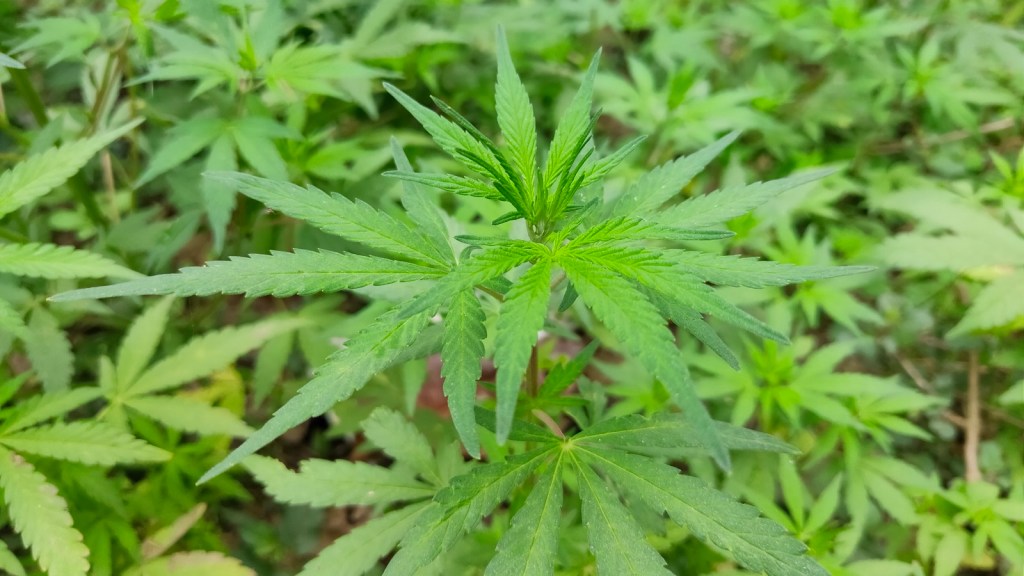
Weed can cause psychosis, but the risk is concentrated in people who use strong cannabis every day, especially young men. Across 11 sites in Europe and Brazil, daily users of strong cannabis had nearly 5 times the odds of a first psychotic episode (Study). Most users never develop psychosis. Thailand, which opened a legal market in 2022 and began rolling it back in 2025, is now a real-world test of the risk.
What Weed Psychosis Is
Psychosis means losing touch with reality. A person may hear or see things that are not there, called hallucinations. They may also hold fixed false beliefs, called delusions, that no evidence can shift.
That is not the same as a bad high. Plenty of people feel anxious or a little paranoid while stoned, but the feeling fades as the drug wears off.
Cannabis-induced psychosis goes further. Real psychotic symptoms start with cannabis use and are severe enough to need care. In a Thai hospital study of 317 such patients, all had psychosis when they were admitted. A typical stay lasted about four weeks (Study).
Schizophrenia is a long-lasting psychotic illness that continues without any drug. Some people whose psychosis first appears with cannabis are later diagnosed with it.
The main active compound in weed is THC (tetrahydrocannabinol), the part that gets you high. Can THC on its own cause psychotic symptoms? Remarkably, yes, at least for a while.
A 2020 review pooled 15 lab experiments in 331 healthy volunteers (Meta-analysis). Each person got THC on one day and a dummy dose (a placebo) on another. Neither they nor the researchers knew which was which. A single dose of THC brought on brief psychotic symptoms, the kind psychiatrists score as suspicion or unusual thoughts. It also brought on flat mood and low drive. The authors called both effects large.
This matters because it is an experiment, not a survey. It shows that THC can cause symptoms directly. It does not show whether brief symptoms ever turn into a lasting illness.
What about CBD, the part of the plant that does not get you high? In the same review, only one small study out of four found that CBD eased THC’s symptoms (Meta-analysis). The authors found no consistent evidence that it helps.
Risk Rises With Daily, Strong Weed
The best evidence on lasting risk comes from the EU-GEI study. From 2010 to 2015, researchers recruited 901 people aged 18 to 64 with a first psychotic episode (Study). They also recruited 1,237 people from the same areas who had not had one.
This is a case-control study. It looks back at people with and without an illness and compares their habits. It can show a link, but it cannot prove cause.
The pattern was clear. Compared with people who had never used, daily users had about 3 times the odds of psychosis (Study). Daily users of strong cannabis, with 10% THC or more, had nearly 5 times the odds. Daily use of weaker cannabis was linked to about twice the odds. Using more than weekly but less than daily brought a rise small enough that chance could explain it.
Those figures already take tobacco, other drugs, education and work into account (Study). Strong weed mattered most in London, Amsterdam and Paris, where it was widely available. In Amsterdam, 54 of 100 people without psychosis had used strong weed.
Across the 11 sites, places where more people used daily or used strong weed also had more new cases of psychosis (Study). Assuming cannabis is a cause, the team estimated that removing strong cannabis might prevent about 1 in 8 new cases across all sites. That figure was about 3 in 10 in London and about half in Amsterdam.
Other studies agree: the more people use, the higher the risk. A 2016 review of 10 studies and 66,816 people found risk rising with use in every study (Meta-analysis). The heaviest users had about 4 times the odds of non-users. The studies disagreed a lot on how big the risk was, and the authors say cause cannot be firmly proven.
In Denmark, a 2021 study followed 7.2 million people through national health records from 1972 to 2016 (Study). It tracked cannabis use disorder, meaning cannabis use bad enough to earn a medical diagnosis.
The share of schizophrenia cases linked to that disorder sat at about 2% until around 1995 (Study). It then climbed and settled at 6% to 8% from about 2010. Over roughly the same years, the THC in Danish cannabis rose from about 13% in 2006 to nearly 30% in 2016.
That timing fits the idea that stronger weed is to blame, but the study could not prove it. It had no data on how strong each person’s cannabis was (Study). The strength of the link also went up and down, with no clear rise over time. The authors said that would be unexpected if stronger weed were the main cause.
Young Men Carry the Most Risk
A 2023 follow-up used the same Danish records, covering 6.9 million people aged 16 to 49 up to 2021 (Study). It counted 45,327 new cases of schizophrenia and asked who carries the most risk.
The answer was young men. At ages 16 to 20, the link between cannabis use disorder and schizophrenia was about twice as strong in men as in women (Study). At ages 21 to 25, it was about 40% to 50% stronger in men. From age 26 on, there was no clear gap between the sexes.
In 2021, about 15% of recent schizophrenia cases in men aged 16 to 49 were linked to cannabis use disorder. In women, the figure was about 4% (Study). Those shares assume the disorder causes schizophrenia, which a records study cannot show.
If that assumption holds, avoiding cannabis use disorder might prevent about one in five cases in young men, the authors estimate (Study). For men aged 21 to 30, they put that share as high as 25% to 30% (Study). They think the rise in these cases is probably tied to stronger cannabis. But the records held no data on THC content.
Age shows up in the European data too. In EU-GEI, the authors concluded that starting by age 15 slightly raised the odds. But that effect was not separate from how often people used and how strong their weed was (Study).
Nobody knows yet why young men carry more risk. A brain that is still maturing through the teens is a popular guess, but the Danish study did not test it. Its authors call for research on whether young men use more often or use stronger products (Study).
Does Weed Really Cause Psychosis?
Every long-term number above comes from watching people, not from experiments. No one could ethically make teenagers smoke strong weed every day for years to find out. So two other explanations deserve a fair hearing.
The first is reverse causation, where the illness drives the weed use. People with early warning signs of psychosis may be drawn to cannabis, or may use it to self-medicate (Study). The same puzzle comes up with chatbots, as our look at the first AI psychosis studies explains.
The second is shared genes. The same genetic make-up might make someone more likely both to use cannabis and to develop schizophrenia. A large 2018 gene study found that the two do share some genetic risk (Study).
To untangle this, researchers use a method called Mendelian randomization. It treats the genes people are born with as a natural experiment, since later habits cannot change them. The results point both ways.
A 2017 study found some evidence that a genetic tendency to try cannabis raises schizophrenia risk, but the effect was small (Study). One extra check found no effect at all. The same study found stronger evidence for the reverse: genetic risk for schizophrenia made starting cannabis more likely. Its genetic markers for cannabis were weak, which limits what the first result can show.
A 2018 study tested only one direction. Genes linked to cannabis use went with higher schizophrenia risk, which fits cannabis being a cause (Study). Its 10 genetic markers explained only about 1% of the differences in cannabis use. The authors argue this did not skew the result much. The study also looked only at whether people had ever used, not how much.
The large gene study of 184,765 people, the one that found shared genetic risk, ran the test both ways (Study). The clearest signal ran from schizophrenia risk to cannabis use. The signal from cannabis to schizophrenia was weak, small enough that chance could explain it. The authors say their markers may have been too weak to pick it up, so that direction is not ruled out.
Genes cannot explain everything, though. A country’s genetic make-up changes over generations, not decades. So the Danish authors argue that genes are unlikely to explain why cannabis-linked schizophrenia rose faster in men than in women (Study).
Scale matters too: psychosis is uncommon, so even nearly 5 times the odds leaves most daily users unaffected.
Taken as a whole, the evidence lines up fairly well. THC causes short-lived symptoms in experiments, and risk climbs with how often people use and how strong the weed is. That makes it likely that heavy use of strong weed causes some psychosis. Nobody can yet say how much.
What Thailand’s U-Turn Shows
Thailand ran the experiment for real. Medical cannabis became legal in 2019, and the wider market opened on 9 June 2022 (Study). By mid-2025, more than 18,000 licensed shops were selling it (Source).
The U-turn began on 26 June 2025. From that day, cannabis flower could be sold only with a prescription, for at most 30 days’ supply (Source). Sellers who break the order face up to a year in jail and a 20,000-baht fine.
A rule reported in May 2026 narrowed who can hold a licence (Source). Only registered healthcare facilities, pharmacies and herbal product stores may now apply to distribute, process or export cannabis as a business.
On 22 September 2026, the health minister announced that the cabinet had approved a draft bill (Source). It would limit cannabis to medical use with a doctor’s prescription. The bill goes to the House of Representatives next. A month later, reports still described a draft that had cleared only the cabinet (Source). So, as far as we can find, it is not law yet.
What happened to health in between? The peer-reviewed data, from studies checked by other scientists, are thinner than the headlines.
A study of 1,695 cannabis cases reported to Thailand’s Ramathibodi Poison Center from 2018 to 2022 shows who was affected (Study). Under-20s made up 14.1% of cases while cannabis was illegal, and 26.1% after the 2022 change. Among reported cases, the share admitted to hospital rose from 68.7% to 96.8%. The study tracked cannabis cases and hospital stays, not psychosis. Only about one in five cases was confirmed by a lab test.
A national study of 10- to 19-year-olds found about 25 more cannabis-related hospital admissions a week than the earlier trend predicted (Study). That adds up to 1,762 extra admissions in the 68 weeks after June 2022. It did not count psychosis separately. Its authors also say it cannot prove the law change caused the rise.
Other numbers are weaker. A 2024 paper quotes the website of one Thai addiction hospital. There, cannabis-related admissions rose from about 5% of the total in 2019 to about 16% in 2023 (Study). That is not a peer-reviewed analysis, and it covers all cannabis problems, not just psychosis. We found no peer-reviewed study comparing Thai psychosis rates before and after 2022.
That pattern fits a 2026 review of cannabis policies worldwide from 2000 to 2025 (Review). In Canada and the US, commercial markets went with more use and more cannabis use disorder in adults. They also went with more hospital admissions for psychosis. But the review found no consistent change in how many people develop or have psychotic disorders.
Tightly controlled systems, such as Uruguay’s pharmacy sales with limits on strength, showed little change in use (Source). The review’s authors say these still need longer study.
A market of thousands of shops looks more like the commercial model than the controlled one. So far, the Thai data fit that pattern: more young people affected and more admissions. There is still no peer-reviewed count of psychotic illness in Thailand.
Frequently Asked Questions
Does Weed Psychosis Go Away?
For many people the episode settles, but not for everyone. About 1 in 5 people diagnosed with cannabis-induced psychosis later get a diagnosis of schizophrenia or a closely related illness (Meta-analysis). An earlier review put the share who go on to schizophrenia at about a third. That was the highest rate among the drugs it studied (Meta-analysis). People with psychosis who keep using cannabis relapse more than those who stop (Meta-analysis).
How Common Is Weed Induced Psychosis?
Most people who use weed never develop psychosis. We found no reliable figure for an individual user’s chance of developing it. In London, where strong weed is common, new psychotic disorders from any cause ran at about 46 cases per 100,000 people a year (Study).
How Long Does Weed Psychosis Last?
It varies. In a Thai hospital study of 317 patients, symptom scores fell about 28% within 8 days and were clearly lower by day 22 (Study). Nearly all received antipsychotic medicine, and 7% were later diagnosed with schizophrenia. The data come from one hospital between 2013 and 2019. So they say little about people who never reach a hospital.
Does CBD Protect Against Weed Psychosis?
Probably not. In a 2023 trial, 46 healthy people who rarely used cannabis inhaled it with the same THC dose but different amounts of CBD (Trial). CBD did not reduce psychotic symptoms at any of the mixes tested. On THC alone, about 1 in 4 had a clear jump in psychotic symptoms.
Key Takeaways
- THC can cause symptoms directly: In 15 lab experiments with healthy volunteers, one dose of THC caused brief psychotic symptoms (Meta-analysis).
- Daily, strong weed carries most risk: Daily use went with about 3 times the odds of a first psychotic episode. Daily use of strong weed went with nearly 5 times (Study).
- Young men are most exposed: The Danish records tied cannabis use disorder to schizophrenia most strongly in young men. At ages 16 to 20, that link was about twice as strong in men as in women (Study).
- Cause is likely, but its size is uncertain: Gene studies point both ways. Schizophrenia risk also seems to drive cannabis use (Study).
- An episode is a warning sign: About 1 in 5 people with cannabis-induced psychosis later get a diagnosis of schizophrenia or a related illness (Meta-analysis). Stopping after psychosis is linked to fewer relapses (Meta-analysis).
- Open markets went with more use: Commercial markets also saw more hospital admissions for psychosis. Psychotic disorders showed no consistent rise (Review). In Thailand, the under-20 share of poison-centre cannabis cases rose from 14.1% to 26.1% (Study).
Weighing the Risk Honestly
Weed is not risk-free, but the risk is uneven. It tracks three things: how often you use, how strong the product is, and how young you are. The evidence points most clearly at daily use of high-THC products in the teens and early twenties.
If psychosis or schizophrenia runs in your family, you have extra reason for caution. Cannabis use and schizophrenia share some genetic risk (Study).
If you hear voices, feel watched or hold odd beliefs that linger after the high fades, stop using and see a clinician. A psychotic crisis, when someone cannot tell what is real or may be unsafe, needs urgent care. Call your local emergency number. After an episode, stopping is linked to fewer relapses (Meta-analysis).
Most people who use weed will never face psychosis. Still, it is worth weighing how often you use, how strong your weed is and how young you are.
This article is for educational purposes and is not medical advice. Talk to a qualified clinician before changing your health regimen.


Leave a Reply