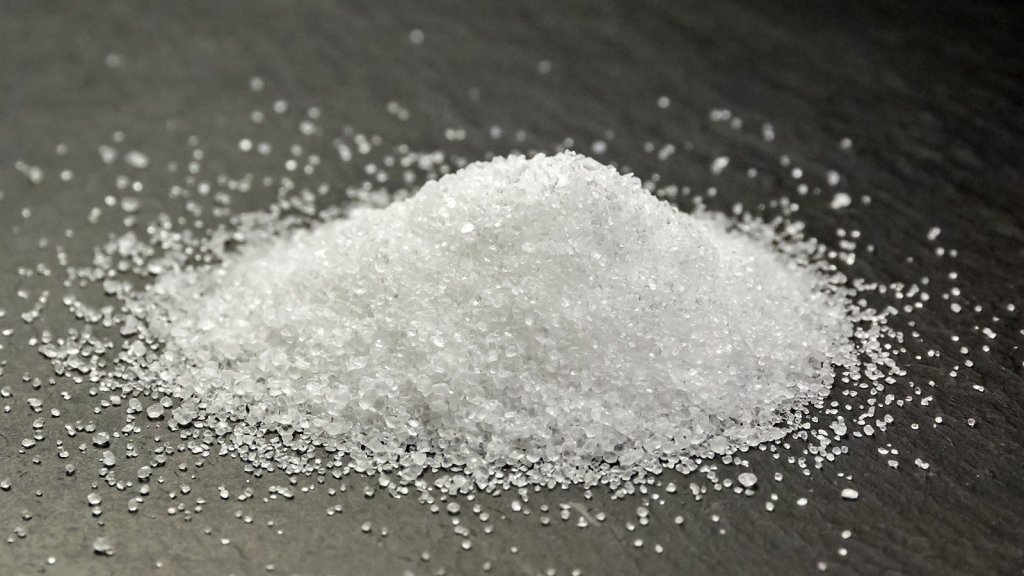
No study has shown erythritol causing a stroke in a person. The erythritol stroke risk story starts in a dish. Human cells from the lining of small brain vessels sat in erythritol for three hours. The dose matched one sugar-free drink. The cells made about double the free radicals, and about a fifth less of the molecule that opens a vessel (Study). Those changes are real, and they happened in a dish rather than in a person.
What Erythritol Actually Is
Erythritol is a sugar alcohol, a sweetener built on a sugar-like backbone. It tastes close to table sugar and has almost no calories. Your body barely uses it for fuel. Most of a dose is taken up in the small intestine, then leaves in the urine unchanged. About 30% is out within three hours, and about 78% within a day (Study).
Your body also makes erythritol on its own. Researchers tagged glucose with a tracer, then watched that tag turn up inside erythritol in human blood (Study). The route is a side branch of sugar handling called the pentose phosphate pathway. So a blood erythritol level never tells you only what someone ate.
Erythritol is also often sold under another name. In USDA’s label records, popular “monk fruit” and “stevia” spoon-for-spoon sweeteners list erythritol first, with the plant extract second (Label data).
Regulators have not moved on any of this. In the US, erythritol is one of the sugar alcohols allowed in food. The FDA looked at the 2023 heart paper and said those studies did not establish cause. It also said it would keep reviewing new data (FDA). Europe’s food safety agency re-reviewed erythritol in 2023, and set a daily limit of 0.5 grams per kilogram of body weight (Re-evaluation). That limit tracks the laxative effect at high doses, not the heart. The same review found that the heaviest users in every age group can go over it. It also said the evidence does not show that eating erythritol raises heart disease risk.
Erythritol is not sucralose, and it is not aspartame. Those two are non-sugar sweeteners, a different chemical class with its own evidence base. The World Health Organization’s 2023 sweetener guidance covers sucralose, aspartame and stevia extracts. It states plainly that sugar alcohols are not included (Guideline). Erythritol is a sugar alcohol, so it sat outside that review.
Three Hours in a Dish
The 2025 study came out of Christopher DeSouza’s lab at CU Boulder. His team grew human cerebral microvascular endothelial cells. Those cells line the tiny blood vessels inside the brain. Half were left alone. Half spent three hours in erythritol, at a level the researchers describe as matching a typical sugar-free drink (Study). The university puts that at about 30 grams, roughly a pint of sugar-free ice cream. It traces the figure to earlier work on platelets (Release).
Four things changed.
Free radical production roughly doubled. The cells also turned up their own antioxidant defenses, which is what a cell does under stress.
Nitric oxide output fell by about a fifth. Nitric oxide is the signal that tells a blood vessel to relax and widen. The enzyme that makes it was still there in normal amounts. But its “on” switch had been turned down, and its “off” switch turned up.
Endothelin-1 rose by close to a third. That is the opposite signal. It tells a vessel to squeeze.
And t-PA went quiet. t-PA is short for tissue plasminogen activator. Your vessel lining releases it to dissolve a clot as it forms. Untreated cells met a clotting trigger and raised their t-PA output by about a fifth. The erythritol-treated cells did not raise it at all (Study). The dose behind all four results was one drink’s worth, not a lifetime of them.
Why Those Four Changes Matter
Nitric oxide opens a blood vessel. Endothelin-1 closes it. After erythritol, the cells made less of the opener and more of the closer. That nudges the vessel toward being narrower.
Then the clot half. A clot forming inside a brain vessel is normally met by a burst of t-PA that breaks it up. In these cells, that burst did not happen.
Auburn Berry, the study’s first author, put it in one sentence. “Big picture, if your vessels are more constricted and your ability to break down blood clots is lowered, your risk of stroke goes up” (Release).
That describes a possible route to a stroke. It does not show one happening.
Cells in a dish are missing almost everything a body has. No blood flows over them, and they have no liver, no kidneys and no immune system. They cannot adapt over time either. The Boulder team said as much, and asked for larger studies in people.
Erythritol Stroke Risk in People
One 2023 study put erythritol on the map. A Cleveland Clinic team measured blood erythritol in patients being checked for heart problems. Three separate groups took part, over 4,000 people in total (Study). People in the top quarter for blood erythritol fared worse. Over three years they were about twice as likely to have a heart attack or a stroke, or to die.
Two things limit that finding. Everyone in it was already having their heart checked, so this is not a general population. And it measured erythritol in blood, not erythritol eaten.
The same group then ran the test that gets closest to real life. Twenty healthy volunteers had a drink. Ten got 30 grams of erythritol, and ten got 30 grams of glucose (Study). Blood from the erythritol group then showed platelets clumping more readily. That held for every trigger tested, in every single person. The glucose group showed no such change.
So something does change after a person drinks it. The test was also small. It used ten people per group, one drink, and a clotting marker rather than a real stroke. The authors say long-term safety studies are still needed.
That same drink answers one question about the dish study’s dose. Thirty grams pushed blood erythritol, measured half an hour later, into the range the lab used. Lining those two numbers up is our arithmetic, not theirs. Still, the lab was not working from an invented figure.
Similar questions now hang over xylitol, another sugar alcohol used the same way (Review). So this is not a quirk of one molecule.
The biggest look at ordinary people complicates things. The ARIC study followed 4,006 older adults with no heart disease for about eight years (Study). Higher blood erythritol went with more heart failure hospital stays, more heart-related deaths, and more deaths from any cause.
The headlines dropped one detail. Erythritol itself showed no clear link to stroke or to heart attack in that group (Study). The stroke link belonged to erythronate, a compound the body makes out of erythritol.
All of this shows a link. None of it proves a cause.
The Case Against Panic
Four things push the other way.
First, other researchers pushed back in print. A letter in the same journal argues against reading the cell work as evidence of risk in people (Letter). Its point is that a steady three-hour soak is not how erythritol behaves in a body. Real blood levels spike about half an hour after a drink. They then fall as the kidneys clear the molecule unchanged (Review). They do stay above baseline for up to two days, so the exposure is not trivial either.
Second, there is a reverse-causation problem. Your body makes erythritol from glucose, and it makes more when things are going badly. In lab-grown human cells, raising glucose sharply increased erythritol production, and oxidative stress alone did the same (Study). One study followed 264 students for nine months. Those gaining belly fat had about fifteen times the blood erythritol of the students who stayed stable (Study). A high level may be a readout of metabolic trouble rather than its cause.
A historical detail points the same way. Some of the cohort blood used in this field was drawn before erythritol was cleared for US food use. Whatever was measured most likely came from the body itself (Review).
Third, the ARIC authors reached that conclusion themselves. They wrote that erythritol and erythronate in the blood are markers of heart and metabolic health. They also noted that they never recorded what anyone ate (Study).
Fourth, the closest thing to a causal test disagrees with itself. Mendelian randomization uses inherited gene variants as a natural coin flip. Your genes are set before any habit takes hold. One analysis found no supportive evidence that erythritol raises coronary artery disease risk (Study). A second one, published in a smaller journal in 2025, reported a slightly higher risk of heart disease and of ischemic stroke (Study). That second result is worth doubting. Its estimates look unusually precise for the size of the genetic dataset behind them. Both leaned on inherited erythritol levels, which reflect the body’s own production more than the sweetener in your coffee.
No trial has tested whether cutting erythritol prevents a single stroke. A 2025 cardiology review says the causal evidence is simply missing, and asks for carefully designed trials (Review).
It Is Already in Your Cupboard
If you buy a “monk fruit sweetener” or a spoon-for-spoon “stevia”, you are almost certainly buying erythritol. One popular monk fruit product lists just two ingredients: erythritol, then monk fruit extract. In its 4 gram serving, all the declared carbohydrate is sugar alcohol (Label data). A leading stevia tabletop sweetener lists erythritol first as well.
The reason is simple. Monk fruit and stevia extracts are hundreds of times sweeter than sugar, so a serving of them is a speck. Something has to supply the volume, the pour and the sugar-like mouthfeel. Erythritol does that job.
It is not confined to the sweetener aisle either. A USDA search of branded food labels returned more than 3,000 US retail products listing erythritol, checked in August 2026 (Database). One review lists the US foods it is cleared for: baked goods, frozen desserts, puddings, yogurt, gum, candy and low-calorie drinks (Review). Keto baking mixes, protein bars and sugar-free ice cream belong on that list.
So plenty of people who believe they avoid sweeteners eat erythritol every day.
The practical step is small. Turn the packet over and read the ingredient list instead of the front of the pack. US labels run in descending order by weight. The first ingredient is the bulk of what you are eating.
Not every sweetener is the same, though. Sucralose has its own body of research. That includes dish work where human fat-precursor cells built up more oxidative stress (Study). The clearest effects there needed a dose higher than a diet drink delivers. That study measured nothing about the brain, blood vessels or stroke. The evidence on artificial sweeteners and gut health is a separate question about different molecules.
Frequently Asked Questions
Is the Erythritol Stroke Risk Real?
No study has shown that erythritol causes a stroke in a person. The erythritol stroke risk case rests on three things. The first is the cell work. The second is blood levels that track with events in heart patients. The third is one small drink study where platelets clumped more readily (Study). In the largest general-population group studied, erythritol itself was not linked to stroke (Study).
How Much Erythritol Is in One Sugar-Free Drink?
About 30 grams is the figure researchers use for a typical serving, similar to a pint of sugar-free ice cream (Release). That dose raises blood erythritol more than a thousandfold within half an hour (Study). Levels then fall as the kidneys clear it, but stay above baseline for up to two days (Review).
Is Erythritol Worse Than Sucralose or Aspartame?
They are not comparable in any simple way. Erythritol is a sugar alcohol. Sucralose and aspartame are non-sugar sweeteners with a separate research base. The WHO’s 2023 sweetener guidance covers that second group and leaves sugar alcohols out (Guideline).
Is Erythritol in Monk Fruit and Stevia Sweeteners?
Usually yes, and usually as the main ingredient by weight. Label records for popular monk fruit and stevia products list erythritol first, with the plant extract second (Label data). US labels run in descending order by weight. Check the ingredient list rather than the front of the pack.
Should I Stop Using Erythritol?
That is a judgment call, not a settled answer. No trial has tested whether cutting it changes anyone’s risk. A 2025 cardiology review says the causal evidence is missing, and asks for properly designed trials (Review). If you already live with diabetes or heart disease, it is a fair thing to raise with your doctor.
Key Takeaways
- The dish finding is real and narrow. Human brain vessel cells got one drink’s worth of erythritol for three hours. They made about double the free radicals and about a fifth less nitric oxide (Study).
- The mechanism has two halves. The cells got worse at opening the vessel and worse at dissolving a clot, at the same time (Release).
- One real serving changed something measurable. Ten volunteers drank 30 grams of erythritol and their platelets clumped more readily. Ten who drank glucose showed no change (Study).
- Your body makes erythritol too. Production climbs with high blood sugar and with oxidative stress. So a high level may mark existing trouble rather than cause it (Study).
- The genetic tests disagree. One found no supportive evidence of cause (Study). Another reported a slightly higher risk of heart disease and stroke (Study).
- The action item is the label. Most “monk fruit” and “stevia” sweeteners list erythritol ahead of the plant extract (Label data).
Reading Labels, Not Headlines
The erythritol story sits in an uncomfortable middle. The cell work is striking, and the blood-level data in people is consistent. The causal evidence is genuinely unsettled. That is enough reason to pay attention.
What you can do about it is small. Know what is in the packet. If you use sweeteners now and then, this is a footnote. Say you stir a spoon-for-spoon monk fruit blend into three coffees a day. Then you are eating more erythritol than you realized, and that is worth knowing.
Human trials are the missing piece. The researchers asking for them are the same ones who ran the studies behind the headlines. The evidence is still building, and it is worth watching.
This article is for educational purposes and is not medical advice. Talk to a qualified clinician before changing your health regimen.


Leave a comment