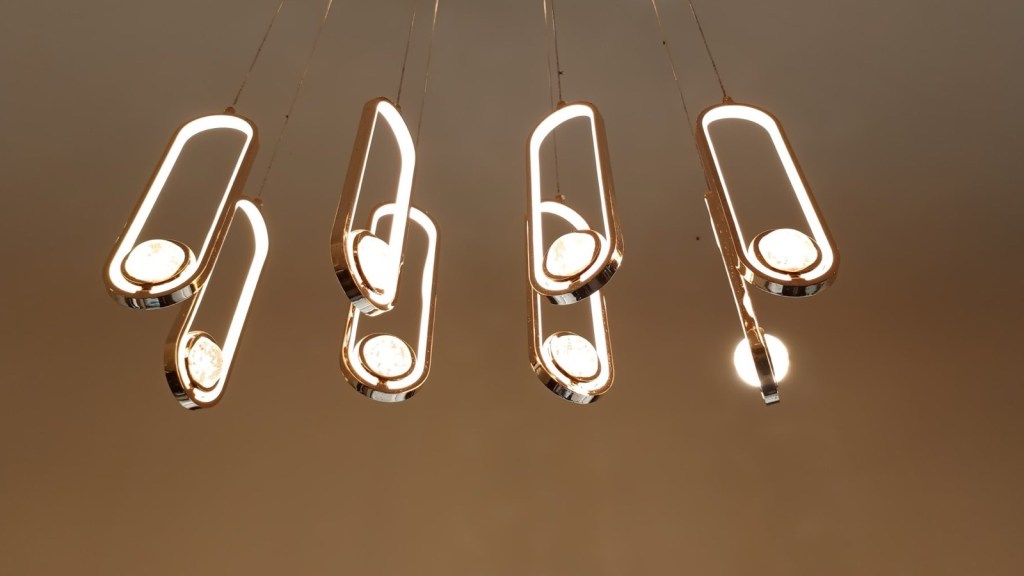
There is no proof that PWM dimming is bad for most people’s eyes, and no proof that it is harmless. In an office trial published in 1989, swapping flickering tube lights for nearly steady ones more than halved headaches and eyestrain (Trial). People with migraine show the clearest signs of sensitivity. And many phones flicker at their slowest when the screen is dim (Lab test).
Your brain also reacts to flicker you cannot see, though that is not proof of harm (Study). The evidence on phones themselves is thin.
What PWM Dimming Is
Many phone screens and LED bulbs do not dim the way an old dimmer knob did. They use pulse-width modulation, or PWM. The light switches fully on and off many times a second. To look dimmer, it stays off longer in each cycle, and your eyes blend the pulses into a steady glow.
Frequency is how many on-off cycles happen each second, counted in hertz (Hz). Depth is how far the light drops between pulses. Engineers often score it as percent flicker, where 0% is steady light and 100% means the light falls to black.
Old fluorescent office tubes flickered 100 times a second on Britain’s power grid. One study measured them at 43% to 49% flicker (Trial). In the late 1980s, electronic ballasts, the parts that power the tubes, moved to 20,000 Hz and beyond. Complaints fell (Review).
Low brightness is the worst case on many OLED phones, where each pixel makes its own light. As you dim the screen, the dark gaps get longer, and many phones also pulse at their slowest. Notebookcheck, a review site with its own test lab, clocked the iPhone 16 Pro at 239 Hz at minimum brightness (Lab test). Samsung’s Galaxy S25 Ultra ran at 240 Hz at minimum and 480 Hz when brighter (Lab test).
The other approach, DC dimming, lowers the electric current instead. The light glows less but never switches off. The downside is that very low currents can make an OLED panel look uneven or tinted. That helps explain why many makers still pulse at low brightness.
Light color is a separate question, covered in what 17 trials found on blue light glasses.
Flicker You Can’t See
Phones that use PWM flicker faster than most people can see. But seeing flicker and reacting to it are different things. In the right conditions, the eye and brain can pick up flicker far faster than that.
The clearest example is the phantom array. When your eyes dart past a flickering light, it breaks into a row of dots instead of a smooth streak. In a dark room, 11 people could spot this at an average of about 2,000 flashes a second (Study). At 120 Hz, they saw it once the flicker passed 10%.
With a tiny, very bright light, the average limit rose to about 6,000 flashes a second. A few people saw it at 11,000 (Study). People who saw it at higher rates reported a little more visual discomfort in daily life. That link was weak and does not prove cause.
The second effect is the stroboscopic effect: a moving object under flickering light looks like a string of still frames. In a lab test, viewers watched a moving arm in front of a dimmed OLED phone. They saw the effect at 480 and 960 Hz, but not at 1,920 Hz and above (Study).
Even flicker you cannot see reaches the brain. A 2025 study scanned healthy adults aged 18 to 50 in an extra-strong 7T MRI scanner (Study). LED light pulsing 50 times a second looked like flicker to them, but 100 times a second looked steady. The steady light still activated the visual cortex, the brain’s vision center. The response was weaker than at 50 Hz and showed up in largely the same areas (News report).
A brain response is not damage. The study does not appear to have measured symptoms or harm. Its authors said only that the finding may matter for health, especially for people sensitive to visual stress (Study).
The Headache Evidence
The strongest human data are decades old and come from office lighting, not phones. In the mid-1980s, 159 staff at a UK government legal department filled in weekly forms on headaches and eyestrain (Trial). A coin flip, in effect, decided which offices got new high-frequency ballasts, a placebo change or no change at all. The new ballasts ran at about 32,000 Hz, leaving under 7% flicker. The placebo offices only got parts that made the old tubes light up faster.
Later, the lights were switched without telling the staff. Asked when it happened, only 3 people could name the right month.
Under the new lighting, headaches and eyestrain more than halved on average. The placebo made little difference (Trial).
The numbers behind that result are small. Only 42 people gave data under both kinds of lighting. Headaches fell for the 20 who moved to the new lights, but barely changed for the 22 who moved the other way. A few people got headaches often, mostly under the old lighting.
The authors warned that the groups were too small to carry much weight. The lamp maker Thorn Lighting helped fund the work, and one author was listed as working there (Trial). A 2022 review notes that the benefit was clearest in the staff most prone to headaches (Review).
A newer LED office study ran for 13 weeks, with lights at 100 Hz switching between about 12% and 36% flicker (Study). The stronger flicker did not raise eyestrain, headaches or other complaints (Study). But later researchers noted that daylight watered down the flicker for much of the day. The study also gave no information on people who may be especially sensitive (Study).
In a mock office, 37 healthy adults worked under old-style and high-frequency tube lights, a week apart (Study). Little changed for the group as a whole.
But some people could see flicker at higher rates than others. Under the old-style lights, these people showed weaker alpha waves, a brain rhythm linked to a calm state. They also worked faster but made more mistakes. The authors suggest this may reflect a nervous system on alert.
People with migraine stand out most clearly. In a small study, 14 people with migraine and 14 without were tested between attacks (Study). The migraine group was no better at seeing flicker. But they stopped the flicker sooner, at a weaker strength, and that was how the study measured discomfort. Their discomfort grew with the years they had lived with migraine, not with how often attacks came.
An online survey asked 491 people about flicker. Those with headache disorders and light sensitivity rated it a stronger headache trigger than others did (Study). People reported on themselves, and the survey did not pick them at random.
The most striking numbers come from a 2024 test at a US national lab. There, 55 people, 25 of them with migraine, rated 85 flicker patterns from one LED (Study). The session lasted 1 to 2 hours. Within four hours, 41% of the migraine group reported a headache, against 8% of the others (Study). Counting any discomfort at all, the figures were 64% and 19%.
The authors note that a follow-up survey like this cannot prove cause. Only 47 people answered it. The migraine group also had an extra symptom check, which may have primed them to expect headaches.
Researchers are also looking at a second group that may be sensitive. These are people prone to pattern glare, discomfort from striped patterns such as lines of text (Study).
What Phone Studies Show
We found just two controlled tests of phone flicker and eye fatigue, and both were short conference papers. In the first, viewers used phones in the dark for about 35 minutes. The screens ran PWM at 360 to 1,920 Hz, or DC dimming (Study). Neither the viewers’ own ratings nor their eye measurements showed a difference in fatigue.
That is reassuring, but limited. It was one short session, and the abstract does not say how many people took part. Three of the six authors work for the phone maker OPPO.
The second, from 2025, tested 45-minute tasks on a dim phone screen (Study). Compared with DC, PWM had a bigger effect on some measures of how sharply the eye focused light. Yet a measure of visual fatigue showed no difference. The study did not measure headaches, and its abstract does not give a head count either.
Recent iPhone, Pixel and Galaxy flagships use PWM. Notebookcheck measured the iPhone 17 at 241 Hz in its worst case. Its Display Pulse Smoothing setting barely changed the readings (Lab test). Google’s Pixel 10 Pro also hit 240 Hz at minimum brightness, even with its setting for sensitive eyes turned on (Lab test).
Still, not every device pulses. By its Galaxy S25 Ultra review, Notebookcheck had found no PWM in about half the devices it had tested (Lab test).
Many people online call themselves PWM sensitive. Those reports deserve respect, but they are anecdotes. People know which phone they hold and rate their own symptoms. That leaves room for the nocebo effect, where expecting harm creates real symptoms.
Studies of another invisible exposure, electromagnetic fields, show how strong that can be. In blinded tests, people are not told whether the exposure is switched on.
A review of 46 such studies included 1,175 people who say these fields make them ill. It found no solid sign that the fields caused symptoms, but it did find some support for nocebo (Systematic review). In one trial, 60 people who blamed mobile phones for their headaches got worse whether the signal was real or fake (Trial).
Flicker is not like radio waves, though. Eyes and brains respond to light pulses, so it makes sense that some people could react to PWM. Self-reports alone just cannot show who is truly affected. We found no blinded test of people who say they are PWM sensitive.
How Much Flicker Is Safe?
We found no flicker safety limit written for phone screens. The closest guide is IEEE 1789, a 2015 recommended practice for LED lighting (Summary). Its low-risk level allows deeper flicker as the rate rises.
At 250 Hz, a light can reach 20% flicker and still count as low risk. Above 1,250 Hz, there is no limit at all. A stricter no-effect level drops all limits above 3,000 Hz. The guide’s summary stresses that going past these levels does not mean the body will be affected.
Many phones run at about 240 Hz at minimum brightness. By our own math, a light at 240 Hz stays low risk below roughly 19% flicker. Notebookcheck put the iPhone 16 Pro at about 15% on its own scale (Lab test). That scale may not match the standard exactly. Its reviewer called the flicker quite even and unlikely to bother sensitive users.
For bulbs, Europe has firm rules. Since 2021, LED bulbs sold in the EU must keep Pst LM, a score for visible flicker, at 1.0 or lower (Regulation). SVM, a score for the stroboscopic effect, was capped at 0.9 and tightened to 0.4 in September 2024 (Regulation). At an SVM of 1, half of viewers would notice the effect (Study).
The rules have gaps. For one, they apply only at full brightness. A 2022 Danish lab test measured flicker in 8 smart dimmable lamps and light fittings (Study). Half of them climbed above an SVM of 1 when turned down. The worst reached 2.4 at a quarter of full brightness, while the other half stayed low at every setting.
Labs checked about 580 lamps from 2017 to 2024 and found roughly 1 in 4 above the SVM limit (Slides). Most were tested before the stricter 0.4 cap began.
Neither rule covers phones, which is where high-frequency PWM comes in. In testing, the stroboscopic effect on an OLED phone vanished at 1,920 Hz and above (Study). That rate also clears the IEEE low-risk line.
How to Cut Flicker Exposure
None of these steps is proven to prevent headaches, but they are cheap and easy to undo.
Keep the screen brighter, since phones tend to flicker slowest at the bottom of the slider (Lab test). At night, try a dark theme or an extra-dim setting instead. On iPhone, people use Reduce White Point in the accessibility settings.
The idea is to keep the panel bright, where it may pulse faster, while the picture looks dimmer. This is a common tip, but it has not been tested.
Turn on any flicker setting your phone offers. It may be called DC dimming, high-frequency PWM or, on newer iPhones, Display Pulse Smoothing. Lab tests show some of these change little, so the name alone does not prove it works (Lab test).
Shop by label for lamps and monitors. Monitors sold as flicker-free claim to avoid PWM backlights. In Europe, bulb makers report SVM values in the official EPREL database, where lower is better (Slides).
If a dimmable bulb bothers you, try it at full brightness. In one small test, flicker climbed in some lamps as they were dimmed (Study).
For a rough check at home, film a screen or bulb in slow motion. Rolling dark bands suggest strong, slow flicker. But the camera’s own settings can create or hide bands, so a clean result proves little.
Breaks may help with screen eye strain in general, though the evidence is mixed. In one study, 29 computer users got reminders to follow the 20-20-20 rule: every 20 minutes, look 20 feet away for 20 seconds (Study). Their symptoms eased. But a week after the reminders stopped, they were no longer clearly better than at the start.
In another test, 20-second breaks during a 40-minute tablet task gave no benefit over taking no breaks (Study). A third test found less eye strain with breaks every 10 minutes, or whenever people wanted, than with no breaks (Trial). The exact 20-20-20 numbers have little support, but regular breaks may still help.
Frequently Asked Questions
How Much PWM Dimming Is Good for Eyes?
No amount of PWM is known to be good for the eyes, but a lighting guide does set low-risk levels. The IEEE 1789 guide sets no flicker limit above 1,250 Hz. At 240 Hz, its low-risk line works out to about 19% flicker (Summary). Many phones run at about 240 Hz at minimum brightness, so the depth of their flicker matters (Lab test).
PWM Dimming vs DC Dimming: Which Is Better?
DC dimming cuts out the on-off pulsing, so it may suit people bothered by flicker. But a 2023 phone test compared DC with PWM at 360 to 1,920 Hz. Over about 35 minutes, it found no difference in fatigue (Study). A 2025 study also found no difference on a fatigue measure (Study). Both were short lab sessions.
Does iPhone Have PWM Dimming?
Yes. Recent OLED iPhones use PWM. Notebookcheck measured the iPhone 16 Pro at 239 Hz at minimum brightness (Lab test). On the iPhone 17, turning on Display Pulse Smoothing barely changed the readings (Lab test).
Is PWM Dimming Bad for Your Eyes Long Term?
We found no long-term studies of phone flicker and eye health. The longest data come from offices. Old flickering tubes went with more headaches and eyestrain over months (Trial). A 13-week LED study found no rise in complaints (Study). None of these studies measured lasting eye damage.
Key Takeaways
- Invisible flicker reaches the brain: Light at 100 Hz looked steady but still activated the visual cortex on brain scans (Study). That is a response, not proof of harm.
- Cutting office flicker helped: In a 1980s office trial, swapping flickering tubes for high-frequency ones more than halved headaches and eyestrain (Trial). The groups were small.
- Migraine is the clearest at-risk group: After a lab flicker test, 41% of people with migraine reported a headache, against 8% without (Study).
- Phone evidence is thin: In a short OLED phone test of about 35 minutes, PWM and DC dimming showed no difference in fatigue (Study).
- Low brightness is the worst case: Recent iPhone, Pixel and Galaxy flagships all dropped to about 240 Hz at minimum brightness (Lab test).
- Cheap fixes exist: A brighter screen, flicker settings and better bulbs cost little to try. Regular breaks eased eye strain in one trial (Trial).
Trust Your Eyes, Test Your Screen
If a screen or bulb leaves you with a headache, take it seriously. Flicker does reach your brain, even when you cannot see it. But one rough evening does not prove your phone is harming your eyes.
Try one change at a time, for about a week each. Raise the brightness, turn on a flicker setting, swap the bulb that bothers you or take more breaks. Jot down your headaches so you can see what helps.
If they keep coming, especially if you have migraine, talk to a doctor. Frequent headaches deserve a proper check, and migraine has effective treatments.
The science on phone flicker is still thin. A careful week of testing your own habits is a fair place to start.
This article is for educational purposes and is not medical advice. Talk to a qualified clinician before changing your health regimen.


Leave a Reply