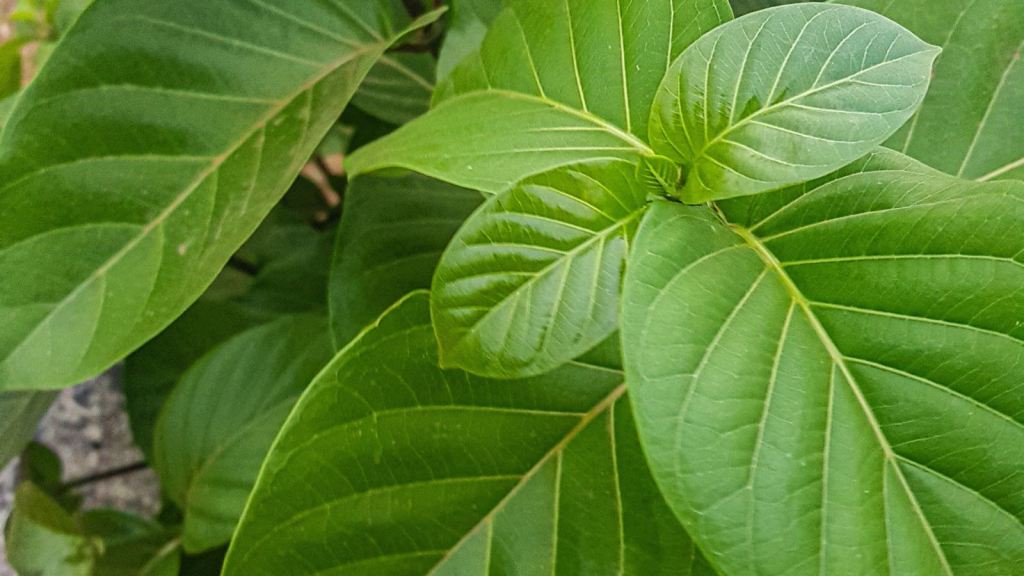
Kratom is not proven safe, and the risk depends on which kratom you mean. US poison centers logged 13,194 kratom cases from 2016 to July 2025. Of those, 219 ended in death, but only 43 involved kratom alone (Study). Concentrated 7-OH pills sold under the kratom name are stronger than the leaf, and their safety in people is unknown (Source).
Poison-center records can’t prove that kratom caused any single death. But cases that mixed kratom with other drugs were more likely to have a serious outcome (Study). For the plain leaf, the main risk is dependence, along with rare cases of liver injury (Review).
What Is Kratom?
Kratom (Mitragyna speciosa) is a tree that grows in Southeast Asia. In southern Thailand, many men chew its fresh leaves (Study). In Malaysia, people boil the leaves into a drink (Study).
The leaf’s main active compound is mitragynine, one of many plant chemicals called alkaloids. A second one, 7-hydroxymitragynine (7-OH for short), acts much more like a prescription opioid. The DEA says 7-OH makes up less than 2% of the leaf’s alkaloids, or only a trace (Source). Your body also turns some mitragynine into 7-OH after you swallow it (Source).
Kratom is not a classic opioid, but it acts like one in some ways. Animal studies show its alkaloids work through the body’s opioid receptors, the same switches that opioid drugs flip (Review). In an FDA-led trial, larger single doses of the leaf made people’s pupils shrink, a classic opioid sign (Trial).
In a US survey of 2,798 users, 91% took kratom for pain, 67% for anxiety and 65% for depression. Most of them, 59%, used it every day (Study).
The Leaf vs the 7-OH Pills
A packet labeled “kratom” in a US shop may hold very little leaf. From September 2024 to February 2025, researchers tracked products sold online. They found 304 made with semi-synthetic 7-OH or a related compound, mitragynine pseudoindoxyl (MP) (Study). Semi-synthetic means made by chemically changing a plant compound.
Of the 304, 82% held 7-OH only. Most were tablets you chew or let melt under the tongue, followed by shots and gummies. And 93% were sold as kratom (Study). Some brand names nodded at prescription painkillers, like “Roxy”, “Perks” and “Pain Crusher Rx”.
The title of the researchers’ paper calls these products “de facto opioids”, meaning opioids in practice. The DEA says they also sell in gas stations and smoke shops, including as flavored chewable tablets (Source).
Lab tests point the same way. Five US brands labeled “kratom extract” held 22 to 75 mg of 7-OH per gram (Study). A real leaf sample had no 7-OH that the test could detect. The extracts were missing the plant’s other main alkaloids, and they held unknown compounds that were not in the leaf.
The authors wrote that such levels are “achievable only by synthetic means”. The study covered just five brands. Two of its authors consult on plant-based products, including kratom.
Where US Law Stands
Federal rules aim at these concentrated products, not the leaf. On July 6, 2026, the DEA gave notice of a plan to put 7-OH above a set level in Schedule I. That is the strictest drug category. The DEA said an order could follow on or after August 5, 2026 (Source).
That order never came. In October, the DEA withdrew the July notice and replaced it (Source).
On August 26, 2026, a temporary order did place MP and two related compounds in Schedule I. It sets no minimum amount and runs until August 26, 2028. 7-OH itself was not on the list (Source).
The new notice came out on October 14, 2026. It would control 7-OH, MP or both above 1 mg per gram in solids, or 1 mg per mL in liquids. That limit is far below the 22 to 75 mg per gram found in the extracts above.
A second test catches products that hold too little mitragynine for the amount of 7-OH or MP in them. The order may come “on or after November 13, 2026” (Source). The DEA plans to swap the August MP order for this new one. Until then, the August order stays in force.
As of November 14, 2026, no such order had appeared in the Federal Register. Until the DEA or Congress acts, 7-OH is not controlled under federal drug law (Source).
The DEA says it chose a threshold because trace amounts have reportedly turned up in some ordinary kratom products. But neither the DEA nor federal health officials have found amounts below that level to be safe (Source).
How Safe Is Kratom?
Of the 13,194 poison-center cases from 2016 to July 2025, 11,205 were seen at or sent to a hospital or clinic (Study). Of those 11,205, 16.5% went to intensive care, which is about 1,850 people. Nearly half went home from the emergency room. About 1 in 10 of all cases, 1,324 in total, had effects that could have been life-threatening.
Of the 219 deaths, 176 involved other substances too (Study). Reports crept up through 2024, then rose in 2025, a year with data only through July. Overall, the outcomes stayed much the same.
An older count from the same system logged 1,807 reports from 2011 to 2017. Eleven people died, 2 of them after kratom alone (Study).
Death records show a similar pattern. Among 27,338 accidental overdose deaths in 27 states from mid-2016 to the end of 2017, kratom turned up in 152 (Study). It was the only drug found in just 7. Even in those, the authors note, other substances can’t be ruled out.
Fentanyl was listed as a cause in about 65% of the deaths where kratom turned up, and heroin in a third. About 80% of the people who died had a history of drug misuse.
A poison-center call is a report, not a confirmed poisoning. And when fentanyl is in the blood too, no one can tell how much of the harm came from kratom.
Liver injury is the other known risk, and it is rare. A 2026 systematic review, which gathers every published report on a question, found only 32 cases across 31 studies (Review). Jaundice, a yellowing of the skin and eyes, was common. The usual pattern was cholestatic, meaning bile stopped flowing properly.
Most people got better after they stopped kratom, but 4 needed a liver transplant. Most reports described a single patient, often with other drugs involved. Only 7 cases gave full details of the dose, the form of kratom and the timing.
A US network that tracks drug-related liver injury found 11 cases it judged likely due to kratom. All 11 had jaundice, and symptoms usually began about two weeks after starting kratom. All 11 recovered, and none needed a transplant or died (Study).
In one short trial, two volunteers in the top-dose group were taken off kratom when their liver enzymes rose. Their levels went back to normal within two weeks of stopping (Trial).
Dependence and Withdrawal
Kratom can be addictive. In a 2023 online survey of 2,061 adults who use kratom, 525 met the medical criteria for kratom use disorder (Study). That is 25.5%, or about 1 in 4.
Among those 525, the most common signs were tolerance (81%) and withdrawal (68%). Tolerance means needing more for the same effect. Most cases were mild or moderate.
The disorder was more common in men, younger people, frequent users and people with other mental health or drug problems (Study). Because the survey recruited volunteers online, it can’t give the rate for all users.
A smaller online sample of 129 US adults found a similar rate, about 3 in 10 (Study). Only about 1 in 10 said kratom made them cut back on work, friends or hobbies. The authors concluded that the main features were tolerance and withdrawal, not damage to daily life.
The rate depends a lot on who answers. In the 2,798-person survey, only about 2% had a moderate or severe disorder (Study). But that survey recruited through kratom-interest websites. Its authors say it likely leans toward people who like kratom.
Leaf users in Asia face this risk too. Among 1,118 men in southern Thailand, regular chewers had no more everyday health complaints than non-users (Study). But regular chewers called kratom addictive more often than occasional chewers did. The most dependent were more likely to have intense withdrawal, starting 1 to 12 hours after their last dose.
A related Thai study found the withdrawal looked like opioid withdrawal. It got worse with longer, more frequent and heavier use (Study).
In Malaysia, a survey reached 293 people who had drunk kratom regularly for more than six months. More than half had severe dependence, and 45% had moderate dependence (Study). Common withdrawal signs were muscle aches and spasms, poor sleep, watery eyes, a runny nose, hot flashes and diarrhea.
What the Trials Show
A few small trials have used a coin flip to decide who got kratom and who got a dummy pill. The largest enrolled 116 healthy adults who had not used kratom in at least a year (Trial). Of those, 49 took dried leaf powder for up to 15 days.
A drug company, NP Pharma, paid for the study. The authors note that 15 days may be too short to catch long-term effects.
After stopping, no one had meaningful opioid withdrawal. People rated the drug effects higher than with the dummy pill only at the highest single dose (Trial). In the FDA-led trial of 40 recreational drug users, the top single dose raised ratings of “drug liking” and feeling “high” (Trial).
In the 2,798-person survey, 41% said they had used kratom to cut down on or quit opioids (Study). That is what people reported about themselves, in a group that chose to take part. It is not proof that kratom works for this.
A 2022 systematic review found no controlled trial testing kratom as an opioid substitute in people. It said no conclusion could be drawn from the evidence (Review).
A US government trial of a mitragynine drug is planned, but only as a safety test in about 32 healthy adults. As of November 2026, it had not started recruiting (Source).
None of these trials tested kratom as a treatment for an illness, or its long-term safety. None tested a 7-OH product either. The DEA says no controlled clinical trials of those products exist (Source). That sets kratom apart from ketamine for depression, which was tested in controlled trials with doses given under medical supervision.
Thailand’s Legal Leaf Experiment
Thailand has tried to keep the leaf legal and aim its rules at the risks. It took kratom off its narcotics list under an amended law that took effect on August 24, 2021 (Source). The Kratom Plant Act followed, in force from August 27, 2022 (Source).
That act bans selling kratom to anyone under 18 and to pregnant or breastfeeding women. The fine for doing so is up to 30,000 baht (Source). It also bans taking kratom mixed with narcotics or other mind-altering drugs, with fines up to 50,000 baht. Sales at schools, dorms, parks and zoos were banned too.
The rules tightened in 2025. In September, the justice and public health ministers signed a new regulation (Source). Thailand’s narcotics board began enforcing it on October 12 (Source).
Under the new rules, leaves and kratom water can’t be sold within 1,000 meters of a school or college. They can’t be sold from roadside or mobile stalls either. Only authorized shops may sell them, and fines reach 50,000 baht.
Thailand also has a youth drink built on kratom. Since the 2010s, some young people near the Malaysian border have drunk “4×100”: boiled kratom tea, cough syrup, soda and ice (Study). The syrup can hold diphenhydramine, an antihistamine, or codeine, an opioid.
One case report describes a 23-year-old man who drank about 600 mL a night for 14 days. He developed sudden liver injury, and his tests were back to normal three months later. He also drank about 27 alcoholic drinks a week, which the authors say may have played a part.
A regional review describes younger city users who drink spiked kratom cocktails for a high (Review). In a 2022 survey of 5,740 Bangkok students, 9.3% had used kratom in the past year. That was 12.4% of male and 6.1% of female students (Study).
Those who used kratom were also more likely to use cannabis, alcohol, cigarettes, vapes and illegal opioids. The survey can’t say whether they took them together. It is also too early to know whether the 2025 rules will change how many young people use it.
Frequently Asked Questions
Is Kratom Addictive?
It can be, for some people. In a large online survey, about 1 in 4 current users met the criteria for kratom use disorder (Study). Most cases were mild or moderate, and tolerance and withdrawal were the most common signs. Withdrawal tends to be worse with longer, heavier use (Study).
Kratom vs 7OH: What’s the Difference?
Kratom leaf is mostly mitragynine, and 7-OH makes up less than 2% of its alkaloids (Source). Concentrated 7-OH products are semi-synthetic. They come as tablets, shots and gummies, usually sold under the “kratom” name (Study). The DEA compares 7-OH’s effects to those of opioids like morphine (Source).
Is Kratom an Opioid?
Not a classic one, but it acts on the same receptors. Animal studies show kratom’s alkaloids work through the body’s opioid receptors (Review). In Thai users, kratom withdrawal looked a lot like opioid withdrawal (Study).
Does Kratom Cause Liver Damage?
It can, but reported cases are rare. A 2026 review found 32 published cases. Most people got better after stopping, while 4 needed a transplant (Review). Warning signs include belly pain, yellow skin or eyes, itching and dark urine (Review).
Is Kratom Being Banned?
At the federal level, the proposals target concentrated 7-OH and MP, not the leaf. The DEA’s October notice would place them in Schedule I above 1 mg per gram, with an order possible from November 13, 2026 (Source). No order had been published by November 14, 2026, but MP has been in Schedule I since August 26, 2026 (Source). Thailand keeps the leaf legal but limits where it can be sold (Source).
Key Takeaways
- Two different products: The leaf is mostly mitragynine. The 7-OH pills are concentrated, semi-synthetic and often sold as “kratom” (Study).
- Dependence is real: About 1 in 4 surveyed users met the criteria for kratom use disorder, mainly through tolerance and withdrawal (Study).
- The death data can’t prove cause: Only 43 of 219 poison-center deaths involved kratom alone (Study). Fentanyl was a listed cause in most overdose deaths where kratom turned up (Study).
- No treatment trials: The few trials against a dummy pill were small and short. None tested kratom as a treatment, its long-term safety or a 7-OH product (Trial).
- The law targets 7-OH, not the leaf: As of November 14, 2026, the DEA has proposed controlling 7-OH above a threshold (Source). MP has been in Schedule I since August 26, 2026 (Source).
Know What’s in the Packet
If you use kratom, start with the label. Look for “7-OH”, “7-hydroxy” or “extract”, since those products can be far stronger than the leaf (Study).
Don’t mix kratom with alcohol, opioids, sedatives or cough syrup. Most overdose deaths linked to kratom involved other drugs, above all fentanyl (Study).
If you use it daily and want to stop, talk to a clinician first. Withdrawal can start within hours of the last dose and can feel like opioid withdrawal (Study) (Study). In the US, SAMHSA’s free, confidential National Helpline at 1-800-662-4357 can point you to treatment. And tell your doctor you take kratom, and which kind of product you use.
The research on kratom is still young, and the products are changing faster than the studies. Until the science catches up, read the label and know what you’re taking.
This article is for educational purposes and is not medical advice. Talk to a qualified clinician before changing your health regimen.


Leave a Reply