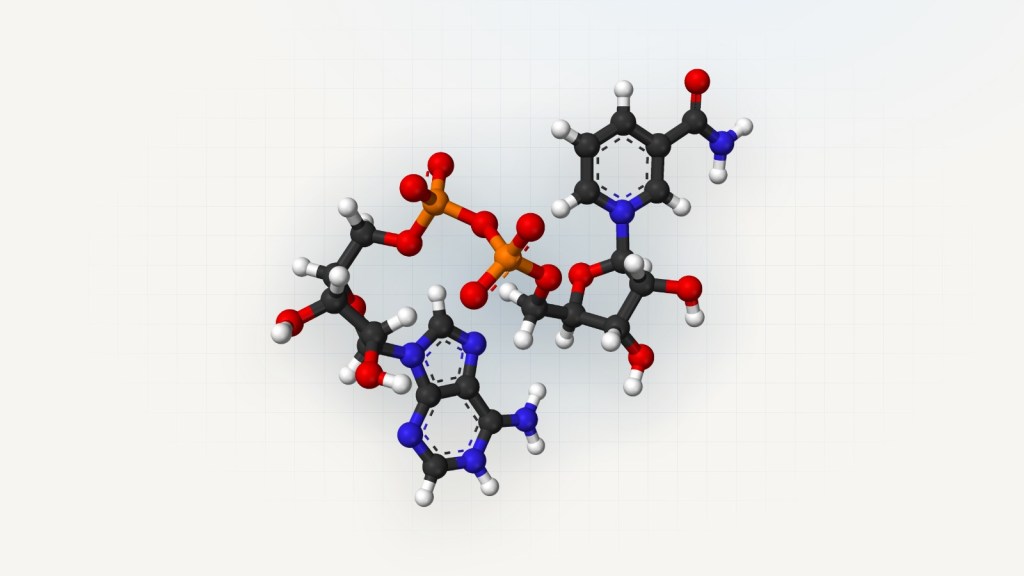
NMN vs NR finally has a head-to-head answer, and it is not the one on the labels. In 65 healthy adults, 14 days of either one roughly doubled NAD+ in the blood, and neither came out ahead (Trial). Plain nicotinamide, the cheap third option, could not hold that rise. Supplement shops skip the next part. Neither compound has been shown to extend life or change a health outcome you would feel (Meta-analysis).
What NMN and NR Are
NMN is short for nicotinamide mononucleotide, and NR is short for nicotinamide riboside. Both are lab-made forms of vitamin B3, sold as capsules and powders.
Your body turns both into NAD+. That is a helper molecule sitting inside every cell you own. Cells need it to turn food into usable energy. They also need it for repair jobs, including fixing damaged DNA.
The whole field rests on one idea. NAD+ is thought to fall as we age, and the pitch is that topping the tank back up makes cells behave younger.
The conversion path is short: NR becomes NMN, and NMN becomes NAD+. Every claim on a label grows out of those two steps. NR brands say their molecule slips into cells more easily, while NMN brands say theirs is one step closer to the finish line.
Both pitches are tidy. The newest human data does not line up neatly with either one.
NMN vs NR, Head to Head
Until this year, nobody had tested the two against each other in the same people.
That gap closed in January 2026. Researchers gave 65 healthy adults, aged 18 to 50, one of four things every day for two weeks (Trial). A coin flip decided who got what. One group took 1,000 mg of NR, and another took 1,000 mg of NMN. A third took 500 mg of plain nicotinamide, the cheapest form of B3, and the last group took a dummy capsule.
By day 14, NR and NMN had both roughly doubled NAD+ in blood, and neither pulled ahead. The word the authors use for the two is “comparably”.
Plain nicotinamide behaved differently. It lifted NAD+ for a few hours after each dose, then let it drop back. After 14 days, the level it started from had not moved (Trial).
The small print matters here. Only about 16 people took each option. The trial ran two weeks, everyone knew what they were swallowing, and the volunteers were young and healthy. Nobody measured a health outcome, only a blood marker. Nestle Research funded and ran it, and the paper’s authors work there.
Then there is the study NR brands prefer to quote. It is real, and it is small. Six healthy adults took 1,200 mg a day of each compound, eight days apiece, with a break in between (Trial). Blood NAD+ rose about 160% on NR and about 70% on NMN.
Six people cannot settle this. The pilot sat inside a brain-imaging study. Public money in Norway paid for it, but two of its senior authors are listed as inventors on patent applications covering NR (Trial). One popular claim about it is only half true. The team did not drop NMN because it failed. Their own sentence gives two reasons: the compounds behaved comparably, but NR raised NAD+ more. They carried on with NR alone to spare volunteers extra visits.
When a six-person pilot and a 65-person trial disagree, the bigger one is the better guide. It is still not proof.
The Gut Bacteria Twist
The same paper turned up something nobody is selling, and it did not come from the volunteers.
The authors think gut bacteria may be part of how these supplements work at all. Microbes appear to turn some of the dose into nicotinic acid, another form of vitamin B3 that the body can build NAD+ from (Trial).
Where that evidence comes from matters. The team tested the idea in a lab tank, using stool from six other donors. In the blood of the 65 volunteers, they found no rise in nicotinic acid at all. In the tank, NR also raised acetate and propionate, two useful compounds gut bacteria make from fiber.
It is still worth knowing. The label story says NR wins because it walks straight into your cells. If part of the effect runs through your gut first, that story is at best incomplete.
It also raises a question no trial has answered. If bacteria are part of the machinery, two people with different gut bugs might get different results from the same capsule. For now that is a lab result plus a hypothesis, not a finding in people.
What NR Has Actually Shown
NR has the longer human track record, and one study that everyone quotes.
Thirty healthy middle-aged and older adults took 1,000 mg of NR a day for six weeks. They then swapped to a dummy capsule for six weeks, or did the two in reverse order (Trial). Twenty-four finished, and NAD+ inside their immune cells rose about 60%.
The headline came from blood pressure, which the trial was not built to measure. Across the whole group, the top blood pressure number fell about 4 points, small enough that chance could explain it. The authors then looked at the 13 people who had started with mildly raised readings. In that slice, the top number sat about 9 points lower after NR.
Nine points would be worth having. But this was a small group inside a small trial, and the authors say so themselves. They call the analysis exploratory and draw no conclusion from it (Trial).
So the same team designed a proper test: 94 people, 1,000 mg a day, three months, with blood pressure as the main measure (Protocol). Years later, no results paper has appeared. The registry still lists that trial as recruiting, with nothing posted (Registry). The only paper about the trial itself describes the plan.
A different team ran its own test in the meantime. They recruited 54 adults over 55 who did not exercise and had raised daytime blood pressure. Everyone walked under supervision for six weeks, and each person also took either NR or a dummy capsule (Trial). Public money paid for it, and the maker donated the capsules. Blood pressure in the NR group did not come down. If anything, those readings drifted the wrong way.
The wider picture reads the same. A 2023 review of the 25 human NR trials published by then found few effects a doctor would call meaningful (Review). Its authors add that the literature tends to overstate the effects it does report. They do allow that NR may calm inflammation, and that a few serious diseases are worth studying further.
They also flag a trap worth remembering. A higher NAD+ reading in blood does not prove anything is happening inside your tissues. One trial made that concrete. In 12 older men, 21 days of NR more than doubled blood NAD+. The NAD+ in their thigh muscle did not measurably change (Trial).
What NMN Has Actually Shown
NMN’s flagship trial is smaller still, and far more specific. If you want the longer story on this compound alone, we covered NMN and anti-aging separately.
Twenty-five postmenopausal women with prediabetes took either 250 mg of NMN a day or a dummy capsule for 10 weeks (Trial). All of them were overweight or obese. By the end, muscle in the NMN group handled insulin about 25% better than at the start.
That number needs care. It is a before-and-after change inside one group of 13 women, not a proven gap against the dummy capsule. Body weight did not change. Neither did body fat, belly fat, liver fat, blood pressure, blood sugar, insulin or cholesterol. Insulin handling in the liver and in fat tissue stayed the same. Muscle NAD+ itself did not rise, so even the mechanism is unsettled.
Pool the trials and the pattern repeats. One review pooled 12 trials covering 513 adults, all of them using a coin flip to decide who got NMN (Meta-analysis). NMN reliably raised blood NAD+. Blood sugar, cholesterol and body fat stayed where they started. A hint of better physical performance was too small to trust. Blood fats were flat overall, though the authors report a drop in the heaviest participants. Most of the pooled studies had flaws that tend to make a treatment look better than it is. The authors write that the field may be exaggerating NMN’s benefits.
There is a reason those flat results are hard to read. Most volunteers started with normal lab numbers, so there was little room to improve.
A second, independent analysis pooled 8 trials in 342 adults. Blood sugar and blood fats did not move there either (Meta-analysis). Those volunteers were mostly healthy too, so it says little about people who already have diabetes.
What about strength and walking speed, the things an older reader actually feels? A 2025 review pooled 10 trials of NMN and NR in adults aged 61 and up (Meta-analysis). In the NMN trials, grip strength, walking speed, chair-stand time and muscle mass all stayed put. The NR results were too scattered to pool. The authors conclude the evidence does not support either compound for muscle after 60.
Safety and Sensible Doses
Trials have used 250 mg to 2,000 mg a day, and most ran 8 to 12 weeks.
For NMN, a 2026 review pooled 15 trials across that dose range, lasting from two weeks to 24 weeks (Meta-analysis). Ten of them reported safety data. In those, side effects were about as common on NMN as on a dummy capsule, and liver blood tests stayed normal. The authors keep it careful: no clear increase, in short trials, with longer ones still needed. The complaints that did show up were mostly mild to moderate stomach upset (Meta-analysis).
NR has the better data on different doses. One trial split 140 overweight adults across three doses: 100, 300 or 1,000 mg a day for eight weeks. Side effects turned up in about 40 to 46 of every 100 of them, against 49 in every 100 on a dummy capsule (Trial). Blood NAD+ climbed with the dose: up about 20% on the smallest, and up about 140% on 1,000 mg. The company that sells the ingredient paid for that trial. A separate safety trial pushed 3,000 mg a day for four weeks. Its 20 volunteers had Parkinson’s disease, and every side effect recorded was graded mild (Trial).
One footnote on the cheap option. In the head-to-head trial, plain nicotinamide caused a sharp spike in homocysteine after each dose, a blood marker doctors keep an eye on. NR and NMN did not (Trial).
The honest limit is time. Nobody has run a multi-year trial of either compound. The longest finished NMN trials stop at 24 weeks. The biggest test of either one is NOPARK, and it is also the longest to have finished. It gave 410 people NR for a full year and wrapped up in June 2025 (Registry). No results paper has appeared, and longer NR trials are still running. Twelve weeks without clear problems is not the same as ten years of safety.
The NMN Regulatory Saga
NMN spent three years in a legal limbo that had nothing to do with whether it works.
In late 2022, the FDA told suppliers that NMN could not be sold as a dietary supplement. The reason was a clause about which use came first. A company had already been cleared to study NMN as a drug, and that normally locks an ingredient out of the supplement aisle.
In September 2025, the agency changed how it reads that clause (FDA letter). It found that NMN had been sold as a supplement in the US as early as 2017, before the drug work was authorized. It also dropped its earlier demand that those first sales must have been lawful. That put NMN back inside the definition of a supplement.
In December 2025, the FDA formally set aside its 2022 letters (FDA letter). NMN is still classed as a new dietary ingredient. A seller needs a notification on file first, its own or its supplier’s (Analysis). The agency also said plainly that accepting such a notification is a paperwork step, not a ruling that the ingredient is safe. No further FDA action has surfaced since.
That saga is about a clause and a date, not about biology. NR was never caught by the same clause, and that says nothing about which compound works better.
Frequently Asked Questions
NMN vs NR: is one better absorbed?
The only decent-sized head-to-head trial found no meaningful difference. Both raised blood NAD+ by about the same amount over 14 days (Trial). A much smaller study, in which six people took each one in turn, did find a bigger rise with NR (Trial). With 65 people on one side and six on the other, no absorption winner has been shown.
Can I take NMN and NR together?
No published trial has tested the combination, so nothing supports stacking them. Both feed the same route to NAD+, and either one alone already roughly doubles the level in blood (Trial). Taking both mostly doubles your monthly bill.
How long until NAD+ levels rise?
In blood, the rise is quick. Levels climb within days and are clearly higher by day 14, and bigger doses lift them further (Trial). What happens in blood is not what happens in muscle, though. In one trial, blood NAD+ more than doubled while muscle NAD+ stayed flat (Trial).
Does raising NAD+ actually slow aging?
Nobody has shown that in a person. Pooled trials show the blood marker going up while the outcomes people care about stay unchanged (Meta-analysis). The largest test of either compound gave 410 people NR for a year. It finished in mid-2025 and has published no results (Registry).
Is NMN legal to buy in the US?
Yes, as of August 2026. The FDA reversed its 2022 exclusion in late 2025 and reopened the supplement pathway (FDA letter). Sellers still need a new-dietary-ingredient notification on file (Analysis). Being legal to sell says nothing about whether it works.
Key Takeaways
- The head-to-head came out a tie. In 65 adults over 14 days, NR and NMN raised blood NAD+ by roughly the same amount (Trial).
- Gut bacteria may do part of the work. The authors think microbes turn part of the dose into another form of B3. They showed that in a lab tank, not in the volunteers (Trial).
- More NAD+ is not a health benefit. Across 12 trials in 513 adults, the marker rose while blood sugar, cholesterol and body fat did not follow (Meta-analysis).
- NR’s best signal came from 13 people. Their blood pressure read lower in a small side analysis of one trial, and it is still unconfirmed years later (Trial).
- NMN’s best signal is one narrow finding. Muscle handled insulin better in 13 women with prediabetes, while everything else measured stayed the same (Trial).
- The legal fight is over and proves nothing. The FDA reversed its NMN exclusion in late 2025, a ruling about a clause rather than about effects (FDA letter).
So Which One Should You Take?
That is probably not the question to agonize over.
Both raise NAD+ in blood, reliably and by a lot. Neither has changed an outcome you would notice in your own life. That is the state of play, and it reads the same for both molecules (Review, Meta-analysis).
The differences that do exist are boring ones, which is why nobody markets them. Cost per gram is one thing. Another is the dose the trials actually used, commonly 1,000 mg a day for NR and 250 to 2,000 mg for NMN. The third is the size of the human record. About 25 NR trials had been published as of 2023, against a dozen or so for NMN, all short and most small.
If you try one, treat it as an experiment rather than a longevity plan. Pick a dose a trial has used, give it a few months, and stay honest about what you can and cannot feel. Then keep an eye on the gut research, because that is where the open question sits now.
The evidence is still building, and it is worth watching.
This article is for educational purposes and is not medical advice. Talk to a qualified clinician before changing your health regimen.


Leave a comment