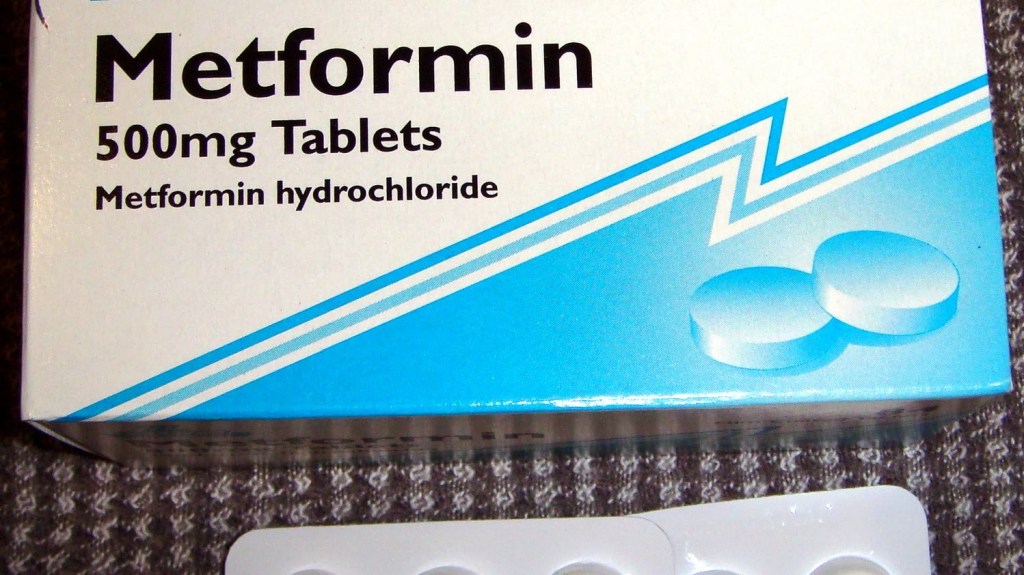
Metformin is not proven to be good for longevity in people without diabetes. One trial followed 3,234 adults at high risk of diabetes for about 21 years. Metformin did not lower their risk of dying from any cause (Study). It is still a good, cheap first choice for type 2 diabetes, so none of this is a reason to stop taking it.
Two other trials found it held back some of the gains older adults got from exercise (Trial, Trial). Then there is TAME, the trial meant to settle the question. The FDA agreed to its design in 2015. A September 2026 report says it has still not enrolled a single person (Report).
Why Metformin Looked Good for Longevity
Metformin is a pill for type 2 diabetes that doctors have prescribed for decades. It is generic and cheap, and it is usually the first drug people get after a diagnosis. It lowers blood sugar partly by making the liver release less sugar into the blood. In a trial that took samples of thigh muscle, it also raised signals from AMPK, an energy sensor inside cells (Trial).
Its second career, as a longevity pill, began with a 2014 study of UK family doctors’ records (Study). Researchers matched 78,241 people with type 2 diabetes who started on metformin alone to people without diabetes. In the raw numbers, both groups died at about the same rate. Each year, about 14 in every 1,000 people on metformin died, against about 15 in their matches.
Then the researchers adjusted for other differences between the two groups, and the result tipped toward the pill. The people without diabetes now had a typical survival time about 15% shorter than the metformin users. The authors wrote that metformin “may confer benefit in non-diabetes” (Study). That line came from a records study, not a trial. Even so, it turned a diabetes drug into a longevity hope.
The same data held a warning that got less attention. People who started a sulfonylurea, an older type of diabetes pill, did far worse. In the raw numbers, about 51 in every 1,000 of them died each year, against about 29 in their own matches (Study). Keep that drug in mind, because it comes back later.
Animal work added fuel. In a 2024 study, 6 aging male monkeys got metformin for 40 months, and 5 untreated monkeys were the comparison group (Study). The treated monkeys scored younger on several aging clocks, lab tests that estimate biological age from blood and tissue (Study). On one of those clocks, tissue from the front of the brain read about 6 years younger than in untreated old monkeys.
But an aging clock does not measure lifespan. The monkeys’ tissues were collected in a final procedure at 40 months, and the authors say they did not track deaths (Study). So this is animal evidence about lab markers. It does not show that people live longer on metformin.
A Survival Edge That Faded
When researchers in other countries tried to repeat the UK finding, it did not hold up.
A Danish team used national health records from 1996 to 2012 (Study). They compared people who started metformin alone with matched people without diabetes. They also studied twin pairs in which one twin had diabetes and the other did not. Twins share many genes and much of their upbringing, so that is a fairer test.
The result flipped. Metformin users died at higher rates than people without diabetes, both in the general sample and among twins. The gap shrank once the team accounted for other illnesses, education and marital status, but it did not go away. Even then, death rates were about a third higher in the metformin group, and higher still among twins (Study).
The raw numbers show how far apart the two countries were. In Denmark, about 25 in every 1,000 metformin users died each year, against about 14 in the UK study. People without diabetes died at similar rates in both, about 15 to 17 in every 1,000 (Study).
The Danish authors also spotted two choices in the UK study’s setup that favored metformin. First, it stopped counting metformin users once they added another diabetes drug. That can quietly drop the people whose disease was getting worse. Second, it required the comparison group to stay free of diabetes. When the Danish team copied those choices, the result barely moved, and metformin users still died at higher rates (Study).
A Welsh study then showed how the length of a study can change its answer (Study). It matched 129,140 people with type 2 diabetes on metformin to people without diabetes. Each pair was alike on sex, age, smoking, local poverty and any history of cancer, heart disease or high blood pressure. The team then cut 20 years of records into shorter windows, as if running shorter studies.
In a one-year window, metformin users seemed to live longer. That edge faded by year three and reversed from about year four. Over the full 20 years, metformin users clearly died sooner than their matches. The authors think type 2 diabetes itself explains this, not harm from the drug (Study).
Metformin users also outlived people on sulfonylureas at every length of study. That is still a records comparison, though. The sulfonylurea users were older and sicker to begin with (Study).
Why do these studies disagree? In records studies, nobody flips a coin. Doctors and patients choose the drug, and those choices can depend on how healthy someone is. A short study can catch an early edge that a longer one erases, as diabetes slowly does its damage (Study).
One newer study keeps some hope alive, but it has a catch. US researchers studied 438 women aged 60 and over with new type 2 diabetes, matched in pairs (Study). Half started metformin and half started a sulfonylurea. Over about 15 years, women on metformin were about 30% less likely to die before age 90. Each year, about 4 in every 100 women on metformin died before 90, against 5 in every 100 on a sulfonylurea.
The catch is the comparison drug. This was a records study with no placebo group, so the authors say it cannot prove the drug caused the longer survival. They add that their data do not suggest metformin helps people live longer, only that it may beat sulfonylureas (Study).
Records studies often tie sulfonylureas to more deaths, especially when metformin is the comparison. The authors of one review see that pattern partly as a sign of flawed study design (Review). A pooled look at 47 trials with 37,650 patients found no clear rise in deaths on sulfonylureas (Meta-analysis). Either way, beating another diabetes pill is not the same as helping healthy people live longer.
21 Years of Trial Data
The strongest human evidence comes from a trial, not from records. The Diabetes Prevention Program, or DPP, enrolled 3,234 adults at high risk of type 2 diabetes from 1996 to 1999 (Study). A coin flip decided who got metformin, a placebo (a dummy pill) or a lifestyle program. The metformin dose was 850 mg twice a day. Together with its follow-up study, DPPOS, the trial tracked people for about 21 years.
By then, 453 people had died. Cancer was the most common cause, followed by heart and blood vessel disease. Compared with the placebo, metformin did not lower deaths from any cause, from cancer or from heart disease (Study). A separate analysis found no fewer heart attacks or strokes either, even though metformin helped keep diabetes away (Study).
The trial has limits. The dummy-pill phase ended in 2001, and after that people knew which group they had been in. In every group, people who later got diabetes often received metformin from their own doctors. By the end of 2018, about 60% of the placebo group had diabetes, against 55% of the metformin group. Adjusting for that outside metformin use did not change the result (Study). Deaths were also fairly rare, which makes a small effect harder to spot.
These were adults with raised blood sugar, often called prediabetes, not perfectly healthy people. As far as we can find, no completed trial has tested whether metformin helps healthy people live longer. That is the gap TAME was built to fill.
TAME: The Trial That Never Started
TAME, short for Targeting Aging with Metformin, is the metformin longevity trial most people have heard of. Its leaders, including Nir Barzilai, wanted to target aging itself, not one disease at a time (Study). The FDA does not formally recognize aging as a disease you can treat. Even so, it agreed to the trial’s design in 2015 (Report).
The plan was to enroll 3,000 people aged 65 to 79 at about 14 US centers (Study). None would have diabetes. A coin flip would decide who got 1,500 mg of metformin a day and who got a placebo. The main measure would be the first new heart attack, heart failure, stroke, most cancers, memory decline or dementia, or death. The trial’s leaders say FDA input shaped that measure (Study).
The problem is money. Metformin is generic and costs pennies per dose, so no drug company profits from proving it works (Report). In 2024, NPR put the cost at $45 million to $70 million. The National Institute on Aging had set aside about $5 million. Barzilai told NPR the trial could get underway once the money came in (Report).
The American Federation for Aging Research, or AFAR, manages TAME and says it is leading the fundraising (News). In March 2025, AFAR still called the trial “upcoming” (News). A 2025 journal paper also noted that TAME had not started because it still needed funding (Study).
There was a near miss. At one point a private donation seemed to cover the rest of the budget, and a start date was announced. According to the 2026 report, Barzilai said the billionaire behind the gift later lost his money, and the trial did not start (Report).
That same report said TAME was still waiting for funding and had enrolled no one (Report). It is a secondhand news report, but it matches AFAR’s own “upcoming” wording from 2025. Since then, we have found no AFAR announcement of full funding, enrollment or results. No results have been published, so any claim that TAME proved metformin slows aging is false.
Does Metformin Blunt Exercise Gains?
There is a second problem, and it matters to anyone who works out. Two trials tested metformin in older adults who were doing an exercise program.
In the first, 53 adults with an average age of 62 did 12 weeks of cardio training (Trial). None had a chronic disease, but each had at least one risk factor for type 2 diabetes. A coin flip decided who got metformin and who got a placebo. The dose went up to 2,000 mg a day, though some people took 1,500 mg. Neither the volunteers nor the researchers knew who took which.
The placebo group raised its VO2max, the most oxygen your body can use during hard exercise. The metformin group did not see a clear rise. Metformin cut the gain by about half, though chance could explain the gap between the groups. On placebo, training also made the body respond better to insulin. On metformin there was no overall change, and people’s responses were mixed (Trial).
The clearest effect was inside the muscle. On placebo, training raised how hard the muscle’s mitochondria, the cells’ power plants, could work. On one main test, that rise was about 25%. Metformin wiped it out. Other gains held up in both groups, including fat loss and lower average blood sugar over 24 hours (Trial).
The second trial, called MASTERS, tested strength training (Trial). Of 109 healthy adults aged 65 and over who joined, 94 were counted in the results. All did 14 weeks of supervised lifting. A coin flip gave each person 1,700 mg of metformin a day or a placebo.
The researchers expected metformin to boost muscle growth. Instead, it held growth back. Lean body mass, your weight minus your fat, rose 1.95% on placebo, against 0.41% on metformin. Thigh muscle grew 3.90% on placebo and just 0.45% on metformin (Trial).
The strength results were less clear. On average, both groups got stronger. Leg strength rose about 23% on placebo and about 15% on metformin, but chance could explain that gap (Trial). An earlier trial of 32 adults with prediabetes hinted at a similar pattern for insulin response. Its groups had only 8 people each, and chance could explain that result too (Trial).
Why does this matter for longevity? In large studies, people with more fitness and muscle strength tend to live longer. Our post on VO2max as a longevity biomarker shows how closely fitness tracks survival. Our guide to strength training and longevity covers the muscle side.
So a pill that blunts those gains may work against two of your best-studied habits. The cardio trial’s authors concluded that more research is needed before anyone prescribes metformin to slow aging (Trial).
Frequently Asked Questions
Does Metformin Make You Live Longer?
No trial has shown that it helps people without diabetes live longer. The DPP trial followed 3,234 adults at high risk of diabetes for 21 years. Compared with a placebo, metformin did not lower deaths from any cause, cancer or heart disease (Study). TAME, the trial meant to test it in healthy older adults, has no results.
How Much Metformin for Longevity?
No dose has been tested for longevity, so there is no evidence-based number. The DPP used 850 mg twice a day, but that dose was meant to prevent diabetes, not to slow aging (Study). TAME planned 1,500 mg a day (Study), but it has not started. This is not dosing advice. Talk to a doctor before using any prescription drug for something it is not approved to treat.
Does Metformin Shorten Your Life?
There is no trial evidence that it does. In Danish and Welsh records, people with diabetes on metformin died sooner than people without diabetes. The Welsh authors think the disease itself explains that (Study). In the 21-year DPP trial, metformin did not change death rates compared with a placebo (Study).
Is Metformin Bad for You Long Term?
Doctors have prescribed it for diabetes for decades. One well-known long-term issue is low vitamin B12. In the DPP study, low B12 was more common on metformin, and longer use was linked to a higher risk (Study). The authors suggest that people on metformin consider routine B12 tests, so ask your doctor about them.
Key Takeaways
- The origin study was in people with diabetes: In 2014 UK records, 78,241 metformin users with diabetes seemed to outlive similar people without it (Study).
- The edge did not hold up: Danish records, including twins, found higher death rates on metformin (Study). In Welsh records, an early edge reversed as the years went on (Study).
- 21 years, no fewer deaths: Among 3,234 adults at high risk of diabetes, metformin did not lower deaths from any cause (Study).
- TAME has no results: In September 2026, a news report said the best-known trial was still waiting for funding and had enrolled no one (Report).
- It may blunt exercise: In two trials of older adults, metformin held back some of the fitness and muscle gains from training (Trial, Trial).
- Good for diabetes, unproven for aging: It helped keep diabetes away in the DPP (Study). No completed trial shows it slows aging in healthy people.
Train for a Longer Life
If you have type 2 diabetes, metformin is a sound, low-cost first choice. Don’t stop it or change your dose on your own. Bring any questions, including ones about vitamin B12, to your doctor.
If you are healthy and want a longer life, the evidence points somewhere else. Two of the best-supported levers are the ones metformin may blunt: cardio fitness and muscle. Train for both, and keep at it for years. Talk to a doctor before taking any prescription drug in the hope of slowing aging.
The question still deserves a real trial. Until TAME or a trial like it runs, metformin for longevity remains unproven.
Metformin has earned its place in diabetes care. For a longer life, the best evidence still points to the training you do.
This article is for educational purposes and is not medical advice. Talk to a qualified clinician before changing your health regimen.


Leave a Reply